
World taz
: The garbage metropolis of Adana
In the megacity in Türkiye, a large part of Europe's plastic waste is turned into money. Nature and the population no longer benefit from this...
Deutsch (original) ·Auto-translated to English
There is an unbearable smell of plastic in the air of Adana. So much so that it almost burns your nose. Umut Özşimşek crouches on the edge of a water canal and takes photos. The water is dark brown and appears rather thick. White streaks float on the surface. "That little white stuff there on the surface, that's plastic. Microplastic," says the 27-year-old.
“Everything is close together here,” says Özşimşek, pointing to the left. The factory building of SASA, one of Turkey's largest polyester producers, is located there. His finger moves to the right, to the Kemal Deniz recycling area, where numerous companies sort and process plastic waste. And in between there is the water channel in which the plastic residues collect. A shepherd passes by with his flock of sheep. The animals graze between the plants and plastic waste.
Özşimşek grew up in the megacity in southern Turkey. His family has lived in Adana for generations. Today he is the general coordinator of the Çukurova Ekoloji Hafıza Derneği, an environmental initiative that documents the destruction of nature in the region. She also calls herself “Çukuravo”. An allusion to the popular exclamation “Aboooo!” in Adana. You hear it here when someone can hardly believe something.
A plastic bottle does not automatically become a new one. Recycled plastic often creates other products, such as textile fibers, which are difficult to reuse later. This is called downcycling. Even recycling produces waste and polluted wastewater. This is not a closed cycle.
According to the OECD, only nine percent of plastic waste was actually recycled worldwide in 2019. Around 19 percent was burned, and almost half ended up in regular landfills. Another 22 percent were not disposed of properly.
Plastic consists predominantly of crude oil and natural gas. Extraction, production, processing and disposal cause greenhouse gases. In 2019, according to the OECD, plastic was responsible for around 3.4 percent of global greenhouse gas emissions - around 1.8 billion tonnes of CO₂ equivalents. Around 90 percent of this came about during manufacturing and processing. (ger)
Özşimşek probably thinks that again and again when he sees the mountains of garbage. The initiative wants to capture a kind of landscape memory of the region. Photos, videos and research reports document polluted waters, burning mountains of garbage and the destruction of agricultural land. Currently, Çukuravo is primarily concerned with imported plastic waste. For Özşimşek, the problem is by no means limited to the recycling areas. When waste burns there, the smoke extends into the surrounding residential areas.
A large part of the plastic comes from Europe. According to an analysis by the Basel Action Network, the EU states exported around 503,000 tons of plastic waste to Turkey in 2025, and a further 139,000 tons came from Great Britain. Together that was almost 650,000 tons. And Germany was the largest single supplier with around 154,000 tonnes. This makes Turkey the largest buyer of plastic waste from the EU.
Politicians and experts from all over the world are meeting for the 31st UN Climate Change Conference in Antalya, Turkey. From November 9th to 20th, representatives from around 200 countries will discuss the fight against global warming. The taz has a team on site. Follow our reporting on our focus on taz.de, on klima.taz on Instagram, in the podcast klima update°, in the newsletter TEAM ZUKUNFT, in the weekday e-paper and in the weekly taz.
Why does all this garbage end up in Adana of all places? Yaşar Gökoğlu knows the answer. The 78-year-old has a white mustache, calls himself a socialist and also comes from the city. Today he is involved in the Adana Ekoloji Platformu, an association of environmental activists that campaigns against environmental destruction in the region. There were recycling companies here when he was a child, he says. At that time they mainly processed paper and plastic that local waste collectors collected.
But when China largely exited the waste business in 2018 due to the environmental and health impacts of processing imported waste, Europe had to find new buyers. Turkey offered itself. Although there are also numerous recycling companies in Istanbul, Izmir and Gaziantep, there are particularly many concentrated in Adana. In addition to the existing recycling industry, this is also due to the proximity to the port of Mersin. The European waste arrives there on container ships and trucks then take it to Adana.
Gökoğlu estimates that more than half of Turkey's plastic waste imports now end up here. However, there are no exact figures because the Turkish authorities do not transparently disclose the regional distribution of imported waste.
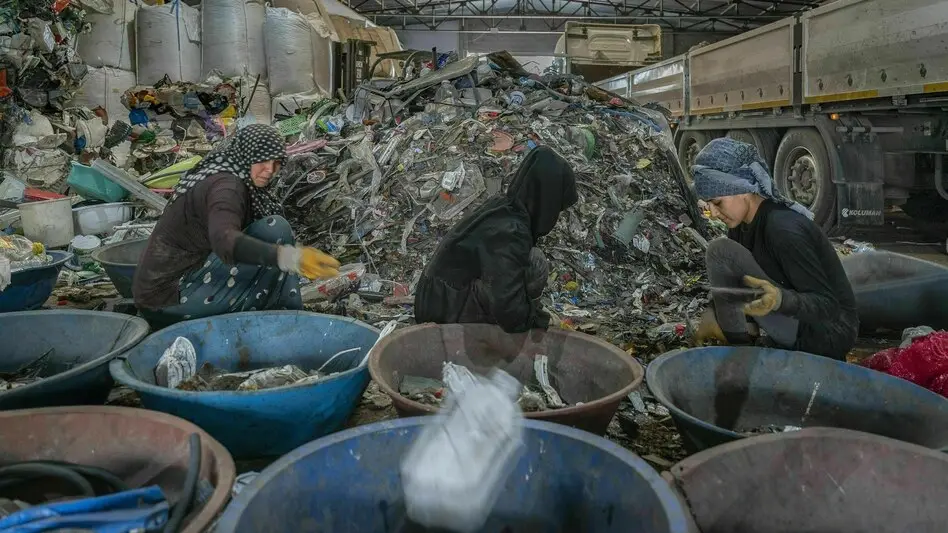
In the companies, workers sort and shred plastic waste by hand without adequate occupational safety, says Gökoğlu. To protect themselves from the plastic dust, they covered their faces with cloths; they did not have respiratory masks. As early as 2022, Human Rights Watch documented similar conditions in Adana's recycling plants. “It used to be mainly Kurds who worked there,” says Gökoğlu. Today there are increasing numbers of refugees from Syria and Afghanistan, some without work permits.
What happens behind the gates remains largely hidden from outsiders. How risky research can become was also shown in 2022: Two journalists said they were attacked at a recycling site in Adana and temporarily detained.
Gökoğlu is particularly concerned about the recurring fires in the recycling districts. In September 2025 there was a fire in Küçükdikili for 48 hours, there were further fires in April 2026 in Sarıhamzalı and most recently on November 2nd in the Onur Mahallesi district. The fires are no longer uncommon. A day after the fire in Sarıhamzalı, the Adana Ekoloji Platformu released a statement. In it she asked two questions: Are the companies not adequately monitored? Or are some fires started intentionally?
The initiative has long been calling for clarification about the causes of the fire. Gökoğlu says that he and his colleagues tried to view the fire department's reports. The city administration refused to release it. Gökoğlu suspects that some fires are deliberately set to get rid of unusable waste. However, there is no evidence of this yet.
While Gökoğlu and others in Adana have been warning about the consequences of the garbage trade for years, the Turkish government has rejected the criticism. On October 20, the state-run Center for Combating Disinformation described media reports about European plastic waste exports and pollution in Turkey as “serious manipulation.” Only clean, sorted and recyclable waste is allowed to be imported. Compliance with the regulations is strictly monitored. A request to the city administration in Adana remained unanswered.
22 organizations, including the Adana Ekoloji Platformu, called on the authorities in a joint statement to look at the affected neighborhoods themselves and talk to the residents.
The fact that so many signed their names to the declaration surprised even Gökoğlu. His name was also there. The next day he sat at home, expecting the police to show up. “But luckily that didn’t come,” he says with a smile.
The European Union also shirks its responsibility too easily, says Gökoğlu. From November 21, 2026, the EU will ban the export of plastic waste to countries outside the OECD. Turkey, however, is one of the member states of the International Economic Organization and is therefore exempt from the ban. This does not apply to Malaysia, Indonesia and Vietnam, which have also been collecting European plastic waste so far. Gökoğlu fears that the waste that Europe will no longer be allowed to export there in the future will instead end up in Turkey even more frequently.
You can make money with trash. And the EU doesn't even have to pay Turkey anything for that. The business is between companies: European companies can sell their plastic waste and save on disposal costs. Turkish recycling companies receive raw materials cheaply, which they process and resell. In 2024 alone, Turkey imported plastic waste worth around $194 million from all over the world. That is the value of the waste, not the profit of the companies.
However, a study by economists published by the Ifo Institute shows that the calculation does not work out for Turkey. Companies do benefit from plastic imports: they get raw materials cheaper and can produce more. The researchers estimate the economic benefit for the country to be a maximum of $116 million. That sounds like a lot of money, but it is not a profit for individual companies, but rather an estimated benefit for the entire economy. The researchers estimate the damage caused by air pollution to be between $558 and $655 million. Almost five to six times as much.
Gökoğlu takes out several index cards from his bag, which he has cut into equal-sized pieces from an old paper packaging. On one he noted the program items of the upcoming COP31 world climate conference in Antalya, which begins on Monday. He reads it out loud: climate finance. Investments in renewable energy. Green business. That doesn't give him any hope for change. “Capitalism knows how to profit from the crises it causes itself.”
Instead, his hopes are directed towards the alternative climate summit, the Halkların İklim Zirvesi. Those affected by the climate crisis should have their say there. Gökoğlu is particularly looking forward to the exchange with coal opponents from Colombia and activists from Great Britain. They want to fight together “shoulder to shoulder”. At the last climate summit in Belém, Brazil, environmental movements networked internationally, with indirect support from President Lula da Silva, he says. However, he does not expect such support from the Turkish government.
"What has the COP changed in Azerbaijan? Or in Qatar, the United Arab Emirates and Egypt?" asks Sedat Gündoğdu rhetorically. On his desk sits a white metal bottle labeled “COP17.” The marine biologist has been researching plastic pollution and international waste trade at Çukurova University for years. Climate conferences could definitely trigger changes, he says. But voluntary commitments were no longer enough.
Gündoğdu's studies show how much the recycling companies pollute the water. In a canal at the Kemal Deniz recycling site, where Umut Özşimşek previously photographed the white streaks, the researchers found ten times as much microplastics below the systems as above. Elsewhere in Adana the pollution was up to 132 times higher. When the plastic waste is shredded and washed, polluted wastewater is created, which, according to Gündoğdu, is sometimes illegally discharged into the canals.
There are officially supposed to be 167 recycling companies in Adana. But when Gündoğdu and his colleagues went through the neighborhoods themselves and counted, they came up with more than 500. Many of them worked without a license, he says. And only around 70 companies have permission to discharge their wastewater into the sewer system. Instead, polluted water repeatedly ends up illegally in the city's canals and rivers, reports Gündoğdu.
And it is through these very channels that the polluted water flows into the Seyhan River and ultimately into the Mediterranean. There, ocean currents carry the plastic particles along the coast from Mersin to Antalya and beyond. Off the coastal city of Alanya, Gündoğdu and his colleagues found microplastic concentrations on the sea surface that were up to 65 times higher than the usual reference values. Plastic particles were also observed off Cyprus, he reports.
Microplastics are only part of the problem. Plastic is predominantly made from crude oil and natural gas. Its production alone causes large amounts of greenhouse gases and thus contributes to global warming. There are also numerous chemical additives that can end up in the wastewater during shredding and washing. Gündoğdu warns of the consequences for soil and plants if contaminated water is used for irrigation. Whether and to what extent the smallest plastic particles are absorbed by plants still needs to be investigated.
“Germany is behaving contradictorily on this issue,” says Gündoğdu. The country is environmentally conscious, but burns large amounts of garbage and exports plastic waste to Turkey. For him this is a new form of colonialism. He also emphasizes that European waste imports not only pollute the environment, but also undermine domestic waste management.
Meanwhile, Turkey is presenting itself internationally as a pioneer in waste prevention. “Sıfır Atık”, or “zero waste” in German, is the name of the program launched in 2017 under the patronage of First Lady Emine Erdoğan. There is even a day dedicated to him at COP31. Authorities, schools and companies across the country should separate and recycle their waste.
But is zero waste even possible? “Zero waste is of course possible,” says Gündoğdu. In nature, what one organism excretes serves as the basis of life for another. Things are different with plastic. Not all plastic can be reused, and even when recycled, residue remains. The problem cannot therefore be solved through recycling alone. Instead of producing more and more plastic, the consumption of single-use plastics and packaging must decrease. This requires reusable packaging and alternatives to plastic.
But developments are going in a different direction. New plants for plastic production and the production of petrochemical raw materials are planned in Ceyhan and Yumurtalık, not far from Adana. While COP31 is talking about limiting global warming, the production of plastics from fossil raw materials is to be further expanded here.
Turkey is already exporting plastic products to Germany and Great Britain, among others. It in turn imports plastic waste from the same countries. “How is this supposed to produce less waste?” asks Gündoğdu.
And what about the microplastics that have long been in water and soil? Can it be removed again? "Impossible. It's too late for that," says Gündoğdu. Once in the environment, the tiny particles spread further and further. Some sinks to the seabed and is deposited there. “We are leaving a polluted and toxic legacy for future generations,” he says.
In Şakirpaşa, Umut Özşimşek walks between mountains of plastic waste. Shredded foil, polyester sweaters and leftover packaging lie on the floor. In between a small pocket scale and detergent packaging with a British logo. On many packaging: the recycling symbol. Much of the waste here in Şakirpaşa comes from Great Britain, says Özşimşek.
Actually, they should be recycled. And what recycling companies can't recycle apparently just ends up on the side of the road. He has even found health insurance cards with the names and personal details of the insured. Özşimşek shakes his head: “You can’t recycle cards like that!”
But Şakirpaşa is also a residential area in which, according to him, predominantly Kurdish families live, who are disadvantaged in many areas of society in Turkey. Kurds are often exposed to repression and discrimination, for example when looking for housing and work. In addition, many families simply lack money. Many people would therefore not be able to move away from the rubbish district. "Where should these people go? To a hotel?" asks Özşimşek sarcastically.
A few kilometers further, in Küçükdikili, a huge mountain of garbage piles up behind the metal fence of a recycling plant. The smell of burnt plastic is almost unbearable. Right next door, children are playing in front of a primary school. Özşimşek doesn't know exactly what will happen to the mountain of garbage, but he fears that the waste will eventually be burned.
Not far away, a resident who wishes to remain anonymous talks about the stench that sometimes fills the entire place. She keeps having headaches. Whether it was a migraine or the symptoms were related to burning plastic? She shrugs her shoulders. But one thing is clear to her: if things continue like this, the future of her children will look bleak.
For Özşimşek, pollution is also a question of fundamental rights: it affects people's health, their housing and children's education. "Some make a profit. And others just have to pay the price," he says. For him there is therefore only one solution. “And that’s called system change,” says Özşimşek.
Once, he says, he accompanied a British person to Şakirpaşa. In view of the mountains of rubbish, she asked him how he felt about it. Özşimşek then asked back the question: “How does it feel to you?”