
World Socialist Project
The twilight of macronism
Young people are asking for one simple thing: resources to get an education.
English (original) ·Read in Deutsch ⇄
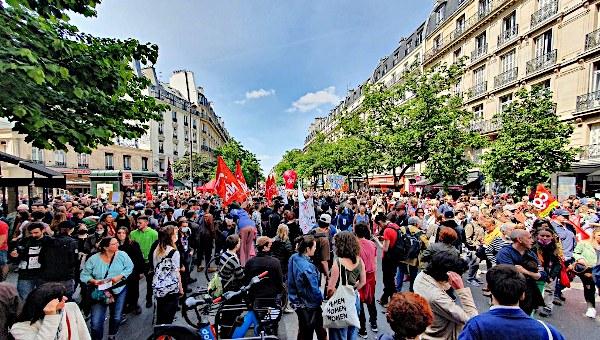
The current high school and student movement in France marks the twilight of Macronism. Young people are asking for one simple thing: resources to get an education and access to quality studies. In doing so, the current protest highlights what is undoubtedly the most glaring failure of the current government: a catastrophic and unprecedented 20% drop in the budget per student since 2017.The government, in bad faith, sometimes boasts that the nominal budget for higher education rose from €13.3 billion to €15.5 billion between 2017 and 2026 (+17%). That is true, except that inflation over the same period was 22%, meaning the budget actually fell by 5% in real terms. Add to this that the number of students rose from 2.6 million to over 3 million, an increase of 15%. The result is that the budget per student dropped by about 20%, as shown transparently by the data published online by Lucas Chancel.In practice, this means that hundreds of thousands of young people work hard to earn their high school diplomas, but there is nothing planned to welcome them into higher education. The number of high school graduates in technical and vocational tracks increased sharply, but places in tertiary programs for them – IUTs and BTSs – did not keep pace. As a result, many are assigned to overcrowded and less expensive university programs that are often entirely ill-suited to their needs and aspirations. The human and economic waste is enormous and reflects a deeply unequal and hierarchical worldview. In the view of Macronists, national prosperity depends on an ultra-minority of brilliant innovators and leaders. The rest are expected to patiently wait for wealth to trickle down.To make matters worse, the shortage of places in higher education has been managed with the utmost opacity and with an incomprehensible algorithm (Parcoursup), despite repeated calls from students, families, teachers and researchers to change the system. All of this against the backdrop of the fiasco of the 2019 high school reform by former education minister Jean-Michel Blanquer (introducing increasingly complex and unpredictable course choices for future academic pathways and disjointed schedules) and ongoing structural inequalities between regions.Research by the economist Asma Benhenda, based on payroll data from the French national education system, shows that the proportion of contract or beginning teachers in privileged areas like Paris or Hauts-de-Seine is just 10%. That figure rises to 50% in poorer departments, like Seine-Saint-Denis and Val-de-Marne, around the capital. The average salary per secondary school teacher is about 20% lower in the poorest areas than in the wealthiest, even after taking into account the (meager) bonuses awarded for priority education.When the education minister appears on television and claims that Seine-Saint-Denis is better funded than Paris, he is considering only the class sizes, and simply ignoring the differences in teacher pay. This does not do justice to his office. The reality is that disadvantaged areas may have (slightly) smaller class sizes but (far) less qualified and experienced teachers. It is far from clear that these areas actually benefit from this arrangement.To justify the inadequacy of education funding, and in particular the decrease in spending per student, the government and its supporters argue that France cannot afford to invest more. They are making two reasoning errors. Public debt has indeed risen from 20% of GDP in 1970 to 120% today. But at the same time, private wealth has grown much more dramatically: It has gone from 300% to 600% of GDP, with extreme concentration among the wealthiest financial fortunes. In other words, France’s national wealth – the sum of private and public assets minus private and public debts – has never been so high, not only in absolute terms but also as a percentage of GDP (which itself has never been higher).In other words, France has never been richer. The problem to solve is simply one of distribution. The situation was far more difficult in 1945, when public debt was even higher than today and private fortunes were depleted. Yet that did not prevent the introduction of a national solidarity tax with rates of several dozen percent on the largest fortunes, which could yield much more today. Those who endlessly repeat that nothing substantial can be expected from this side are clearly at odds with mathematics, as well as with history.
The second error is even more serious. Everyone knows that spending on education and health will rise faster than GDP in the decades ahead. Curiously, some seem to think that private spending would be more efficient. Yet all the historical and comparative evidence we have suggests that the public, nonprofit and associative sectors deliver better results than classic capitalist logic in many areas, especially in education and health. Reinvesting in these sectors today is not simply a matter of equality between regions or social classes. It is also a key issue in moving further toward the gradual de-commodification and dematerialization of the economy, and, beyond that, to building a different model of development. Let us hope the current movement helps put these issues at the heart of the upcoming elections.
Activez JavaScript pour laisser un commentaire.
Ce blog est celui d’un chercheur en sciences sociales, engagé dans la vie de la cité. L’auteur du Capital au 21e siècle porte un regard sans concession sur l’actualité sociopolitique française, européenne et internationale. Les chroniques publiées sur ce blog sont disponibles gratuitement quelques jours après leur publication par Le Monde. Pour retrouver toutes les recherches, articles, extraits de livres et liens vers les différents projets de Thomas Piketty, consultez sa page personnelle.
This is the blog of a committed social scientist. The author of Capital in the 21st century casts an uncompromising eye on current social and political issues in France, Europe, and the world. The chronicles published on this blog are available for free a few days after their publication by Le Monde. In order to find all research works, articles, book extracts and links to the various projects of Thomas Piketty, consult his home page.
Commentaire S'abonner Abonné Thomas Piketty Rejoignez 47 autres abonnés M’inscrire Vous avez un compte WordPress.com ? Connectez-vous maintenant.