
Politics Socialist Project
School Boards Under Supervision: Ontatio Ford Government wants to swear in trustees but give them no power
Ontario Education Minister, Paul Calandra has got himself into a spot. A couple of weeks ago, he interfered with the 2026 trustee elections for school boards currently under supervision due Keep readi
English (original) ·Read in Deutsch ⇄
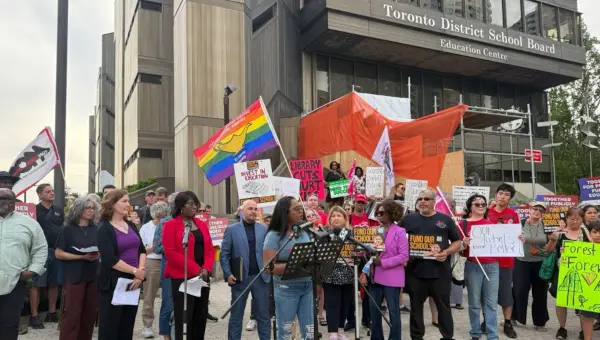
Ontario Education Minister, Paul Calandra has got himself into a spot. A couple of weeks ago, he interfered with the 2026 trustee elections for school boards currently under supervision due to financial problems encountered under the Tories. He postponed school board meetings in which successful candidates would be sworn in as trustees. Calandra didn’t bother to explain why he was doing this; it’s just the way things are under the democracy-averse Ford government.
But then he realized something. The Tories don’t yet control freedom of speech or association for citizens; that includes trustees who have just been elected to public office and want to meet with their constituents. Some of them like Maria Rizzo at the Toronto Catholic Board talked about holding community meetings in places like churches or libraries. Good God! What would happen if they spoke to parents and community members without any government constraint? It would be going rogue – acting like Tories.
As Calandra told the Toronto Star: “…it became immediately clear to me that some of these elected trustees immediately recognized they could do things and they would not be subject to the code of conduct, and they would not be under the integrity commissioner’s purview.” He was accusing them of trying to circumvent his government’s arbitrary rules.
God forbid; the Tories certainly don’t want trustees anywhere to “do things” but especially in the eight boards run by provincially appointed supervisors. They might hold public meetings where they’d highlight awkward questions like “What’s going on in our school board?” “What happened with all the cuts and changes made without public consultation?”
Calandra in a Corner
Calandra is grappling to control the situation, but he wants things both ways. He wants trustees to be sworn in so he can use the Ministry-regulated Code of Conduct to lean on potential miscreants whose speech might be interpreted as using “…board resources for any purpose other than the business of the board.” But he doesn’t want them to have any power, so he still won’t let supervised boards call their important first meeting. This is the one in which board chairs are elected. It sets the stage for trustees to discuss the business of the board, ask questions of administrative staff, make resolutions, and do the rest of what is normal at all levels of government.
Re-elected Toronto District School Board (DSB) trustee Alexis Dawson explained that being sworn in acknowledges that trustees have an official title and a platform that enables them to advocate for students and families. She also pointed out a fundamental flaw in Calandra’s plan to control but not enfranchise trustees in boards he’s not finished eviscerating: “Calandra has indicated that the reason he wants to swear us in is to have us follow the Code of Conduct. But without a first meeting and being able to elect a chair and vice-chair it makes the Code of Conduct inoperable.” There’s no official board to enact it.
Trustees in Name Only
Calandra wants his control to be the same as it was when he put school boards under supervision. While trustees may be sworn in to follow the code of conduct, they must not attend school events, communicate with principals or school staff, serve on committees, incur expenses, issue newsletters or updates or use board resources. And they still won’t be paid.
Same as it ever was. In 2025, duly sworn trustees were simply dismissed. They weren’t allowed to do anything for which they were elected. They lost their measly salaries. This move should have sparked an uproar not heard since 2022 when Doug Ford threatened to override the Constitution by using the “notwithstanding clause” to force low-paid education workers back to work. It wasn’t just that Calandra removed elected officials but that, in doing so, he degraded democratic norms in Ontario – again. Boards don’t usually get tossed out without good reason, for example, failure to address huge issues like racism or serious financial irregularities suffice. But there was no impending catastrophe looming in any of these boards. Calandra could have limited supervisors’ scope to financial issues and leave trustees to continue supporting parents and students. He never explained why trustees needed to be treated so harshly while Ministry and board bureaucrats sorted out financial problems.
Bite by bite the authoritarian Ford government takes power from citizens and transfers it to appointees.
History
Historical amnesia is bad for democracy. So, it’s worth recapping what happened at some of these boards. Sixteen months ago, Calandra assigned educationally unqualified supervisors to take over the Toronto, Toronto Catholic, Dufferin-Peel Catholic, and Ottawa-Carleton District Boards after the Ministry of Education sent investigators to look at their finances. Calandra’s oft-repeated claims of boards’ financial mismanagement just weren’t true. Auditors made it clear they weren’t concerned about that but about budget deficits that had accumulated over the years leading to a situation in which boards might be unable to post a balanced budget. At the Toronto DSB, auditors pegged the accumulated deficit in 2024-25 at $11.3-million. Auditors of the Toronto Catholic (TCDSB) forecasted a $72.5-million accumulated deficit for 2025. The Dufferin-Peel Catholic DSB faced a challenging projected deficit accumulation of $136.3-million in 2024-25, and the Ottawa Carleton DSB $9.2-million.
School boards in Ontario must post a balanced budget every year. All of them did so for the 2025-26 school year. But it was ruinous to their ability to educate kids; these boards were trying to keep up with inflation and habitual Ministry underfunding by selling assets, cutting teachers, closing programmes, hiking fees, and so on.
Since the Tories took office in 2018, the gap between inflation and what they spend on education resulted in a funding drop of $6.5-billion for boards across the province. In a recent article, Ricardo Tranjan, researcher at the Canadian Centre for Policy Alternatives (CCPA), noted this means that more schools need major repairs; class sizes have gone up; and there are fewer staff in schools despite higher enrolments. Boards spent $367-million more for Special Education than they received from a Ministry that doesn’t count the number of students who need that support. The Ministry has left school boards to fund increases in mandatory Canada Pension Plan (CPP) and Employment Insurance (EI) for board employees. Of 72 boards across the province, 41 projected budget deficits in 2025-26, compared with eight in 2018-19.
While the above reports mentioned efforts by boards to save money by cutting staff and programmes, there was little in them about the elephant in the room: government underfunding. Still, Price Waterhouse Cooper’s report on the Ottawa Carleton board (p.2) notes “unfunded employees’ benefits expenses related to Bill 124 salary adjustments.” Bill 124 was the Ford government’s attempt to limit government employee salary increases to 1 percent per year. It was struck down as unconstitutional in 2022, leaving the government to pay back over $6-billion to employees like educators. Why were boards short of money to do this?
None of that mattered. Paul Calandra put eight boards under his direct supervision and kept them in the dark. He certainly didn’t want trustees interfering with fundamental changes he was making, not just to boards’ finances but also to governance, relationships with their communities, and the nature of public education itself. Supervision was never just about money; it was about a radical change in public education, government accountability, and local democracy.
Fallout
Supervisors rarely meet with local parents or community groups; they issue decisions posted online. Trustee, Maria Rizzo says “…they don’t understand what’s going on.” Issues are swept under the carpet and decisions made behind closed doors. The results don’t look positive. She points to the 77 international language instructors who lost their jobs last spring. The board’s supervisor also cut a special remedial reading programme and even changed bell times. The TCDSB has a current year deficit of $39-million.
The Ottawa Carleton DSB still posts a deficit for the coming year of $3.5-million despite cutting school administration costs and supervisory officers. Local MPP and NDP Education Critic, Chandra Pasma, says there is more to the story; the supervisor also trimmed funds for textbooks, classroom resources, office staff, custodians, and trades people. Twenty-one additional education assistants claimed to have been added to board classrooms were redirected from special education classes that had been cut.
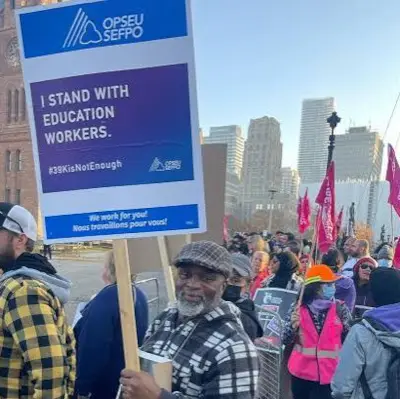
At Dufferin-Peel Catholic DSB, the projected deficit for 2026-27 is $36.4-million, and like other boards, plans to sell property to offset some of this. Declining enrolment has resulted in administrative and central office cuts, and the supervisor is setting up a task force to see what might be done about the fact that the board receives less money than it spends on special education.
The Toronto DSB closed outdoor education centres, eliminated 289 teaching positions, including 150 attached to the highest-needs schools in the board. It downsized its equity department and shuttered its Heritage Month committees. Caps on the number of students allowed in a classroom have been lifted. It posts a $15-million deficit for the 2026-27 school year.
Against this huge damage to local education, what has demonstrably improved at these boards?
Nowhere in any of the above audits or from the Ministry Education is something resembling a plan for dealing with the funding shortfalls these and so many other boards across the province face each year. Might the Ministry meet its payment obligations to boards? Might it increase funding to match inflation? Might it finally develop a funding formula that takes all actual costs of running schools into consideration? No wonder Calandra is reluctant to give up his supervisors who will act on his instructions to empty boards’ cupboards. No wonder he has taken away most of the power of all trustees across the province, attempting perhaps to make them an afterthought.
What he has overlooked is that they still have a voice of opposition. So, he can deny some of them the responsibility to do their jobs, but that won’t stop them. No one who has just been elected to any level of government wants to be complicit in turning it into a joke. Trustees have options: they can defy him and refuse to be sworn in until they have a position and power to be sworn in to. They can ignore arbitrary rules and hold town hall meetings throughout their communities to ask and reflect on the pointed question on everyone’s mind: How will the supervisors ensure the proper education and support of their kids?
That’s not the question on the Ford government’s mind. Eight years of budget cuts make it clear that for this government, education is simply a tool for delivering a commodity – students – as cheaply as possible to employers. Of course, parents aren’t buying this corporate version of education as they show up in groups at Queen’s Park, or most recently, at local schools to demand that the Ministry of Education restore funding to their boards, along with the trustees who have been sidelined. Teachers are organizing along the same lines with locals like Elementary Teachers of Toronto (ETT) taking an activist approach to issues that relate to their work like hunger and lack of affordable housing through its “Education Starts in the Home” campaign.
The more Calandra pushes trustees aside, the more ridiculous and autocratic he becomes. Let’s face it, he belongs to the government that brought us the Greenbelt scandal, the Highway 413 debacle, and $3-billion worth of tax rebates just before the 2025 snap election. Stan Cho, Calandra’s parliamentary assistant, has just returned after three months banishment from Ford’s cabinet for spending $16,000 for hotel stays on those nights it felt too far to drive home from Queen’s Park to Willowdale [suburb of Toronto]. His $22,500 salary bump comes as the Tories post a $16.9-billion deficit for the 2026-27 fiscal year. The Tories rule when it comes to financial imprudence.
Unless Paul Calandra has something to hide, he should stop trying to fiddle with election results. As Toronto NDP MPP Chris Glover says: “Trustees should be sworn in and assume the duties and responsibilities that we elected them to fulfill. Anything less is an attack on our democratic rights.” •