
Politics Real Media
Police arrest 325 outside US Embassy in London
Many thanks to our contributor, freelance journalist Anne Alexander. The mood outside the US embassy in London was defiant, but also gently satirical. People taking part in a protest organised by acti
English (original) ·Read in Deutsch ⇄
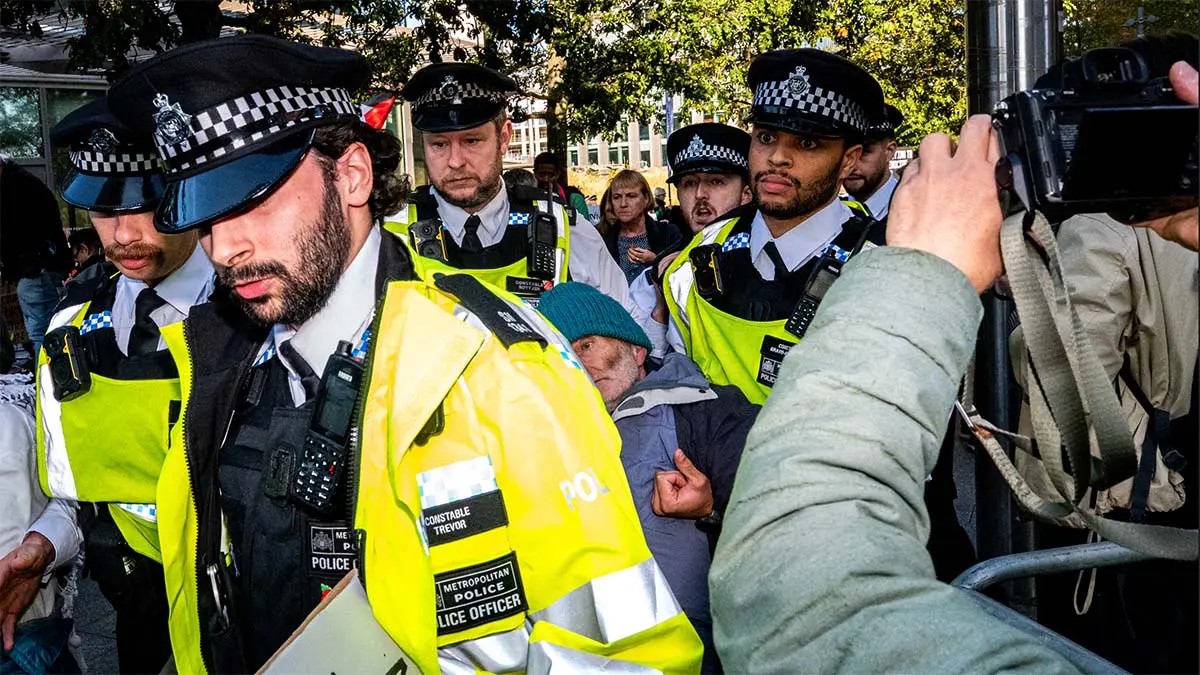
Peaceful protest against proscription of Palestine Action met with repression
Many thanks to our contributor, freelance journalist Anne Alexander.
The mood outside the US embassy in London was defiant, but also gently satirical. People taking part in a protest organised by activist group Defend our Juries clutched Halloween pumpkins carved with the words “I support Palestine Action” alongside around 400 holding the familiar home-made placards defying the government’s ban on the group. Hi-vis jacketed activists from the ‘welfare’ team mingled with Amnesty International’s protest observers, a delegation from Quakers for Peace and London trade unionists and a band of photojournalists.
For the next eleven hours, police filed in and arrested activists, finally giving up at around midnight, just leaving one man, sitting in his wheelchair, still holding his sign.
A statement from the Metropolitan Police before the event had claimed that the entire gathering was illegal and threatened to arrest not only sign-holders, but those deemed to be providing “logistical support” to protesters.
Commander Adam Slonecki said: “All those intending on coming to this event know that supporting a proscribed organisation is unlawful – they are essentially meeting to purposefully commit a crime”
Defend our Juries hit back in a statement released after the protest: “Embarrassingly for the Met, their Friday threat to arrest all those providing practical support for this peaceful demonstration turned out to be empty – a desperate attempt to intimidate.”
John McDonnell MP and leading trade unionists condemned the Met Police’s threats to make blanket arrests. In a statement published on X on Saturday, John McDonnell wrote: “Surely it cannot be right that someone protesting against the Government’s decision to proscribe an organisation is automatically interpreted by the Met Police as supporting that organisation and is therefore committing an arrestable offence. I believe the government and parliament made the wrong decision in proscribing Palestine Action as a terrorist organisation and I continue to call for its deproscription. If the people turning up today to demonstrate against the proscription of Palestine Action are to be arrested for simply turning up, are we all to be criminalised for suggesting that the government got this wrong?“
Ian Hodson, National President of the Bakers’ Union BFAWU was one of a group of leading trade unionists who signed a statement attacking the Met’s claims that mere attendance at the protest could lead to arrest. He told Real Media: “Threatening mass arrests simply because people attend a demonstration raises deeply troubling questions about where our democracy is heading. As trade unionists we know that many of the rights we enjoy today were won because ordinary people were prepared to stand together, challenge injustice and protest against those in power. We should be defending those democratic freedoms, not creating a climate where people are frightened of exercising them.”
Environmental and human rights campaigner Angie Zelter slammed the Met’s statement as “absolutely ridiculous“. The threat to make blanket arrests among wider layers of people attending the protest, “shows just how much in hock the Met are to the US“, she added. Zelter was taking part in the Defend our Juries‘ action outside the US embassy alongside other long-standing activists against the arms trade and military bases.
Britain’s role in working alongside the US to support the Israeli war machine was a major reason for her decision to defy proscription, she said. “In Britain we have a lot of responsibilities to Palestine, because American and British forces are involved in bombing Gaza from US bases here.”
The issues at stake were much bigger than civil liberties, Zelter told Real Media. “Britain is being turned into an industrial site for not only AI data centres, but also for the military, and that is impacting our climate. The trade unions need to be thinking about decent jobs which are not linked to the military, but are about tackling climate change. The problem with the structures in our society is that there are so many things which need to be done and are not being done because of the power of the corporations.”
Meanwhile, the numbers of prominent authors affected by the fallout from proscription widened this week, as the Home Office withdrew permission for Swedish academic and author Andreas Malm, who is a leading authority on climate change, to enter the UK. Malm’s publisher, Verso Books, and Tribune magazine, organiser of an event where Malm was due to speak alongside Palestine Action founder, Huda Ammori on 4 November, slammed the decision. Tariq Ali said: “The notion that his presence ‘harms the public good’ is farcical. It is the Home Office’s outrageous act of political censorship that harms the public good, as many MPs know only too well.
We can only assume, since no reasons have been given for banning him, that it is Andreas’s positions on Palestine, no different from the ICC and UN commissions, is the cause. Only a weak and cowardly government seeks to curb dissent in this fashion.”
Over 1000 academics, teachers and activists have signed an open letter calling on Home Secretary Shabana Mahmood to reverse her decision.
The next step in the campaign challenging the ban on Palestine Action will depend on the decision of the Supreme Court, which is set to rule on whether proscription was legal after a hearing scheduled for 4 and 5 November.