
World Real Media
Over the Threshold
Please note – this article contains descriptions of animal cruelty The Shed The smell came first. It was a little after eleven on a warm, windless night at the end of September, two or three days past
English (original) ·Read in Deutsch ⇄
Inside the cruellest but profitable beagle sheds of MBR Acres
Please note – this article contains descriptions of animal cruelty
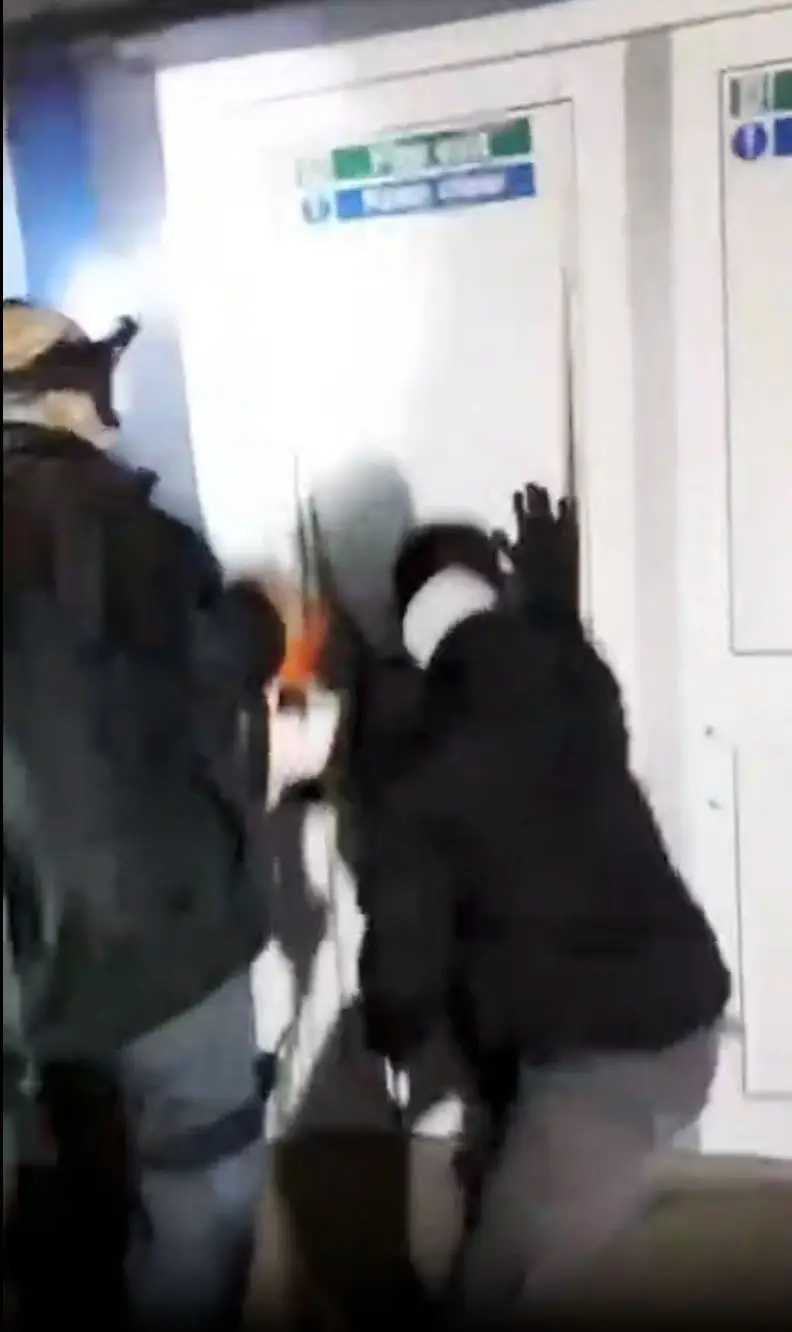
It was a little after eleven on a warm, windless night at the end of September, two or three days past the full moon. When the panel finally gave way in the door of the long metal shed, the air inside came out to meet her. Weeks later, speaking to me by telephone, she was still searching for a word to describe the moment. The nearest she came was “a real full-body engulfment” – not something she breathed but something she walked into. It was the air of several hundred young dogs who had never been outdoors. Urine, faeces, sawdust, bodies, and the trapped heat of a building with nowhere to put any of it.
She stepped over the threshold. For a moment there was nothing to see. The shed was pitch black, and so long that the beam of her head torch disappeared into it, as if the dark were swallowing the light. Then her eyes adjusted and the building assembled itself – a spine of cages set back to back down the middle, a corridor running along either side, and, directly in front of her, the first row.
The noise had been there all along, but now it arrived properly. It was not the warning bark of a dog at a gate. It was high, excited and continuous, dozens of voices at once. Puppies had come to the fronts of their cages. They were climbing the mesh, standing on their hind legs, tumbling into one another. “There were paws and tails and ears,” she told me, “and just all these little eyes looking up at me.”
One pair of eyes, to her left, held hers. They belonged to a small female, and the rescuer went straight to her. What went through her head was not a plan but a greeting – Oh, there you are. She had watched footage shot inside these buildings. She had talked about the dogs in them with more people than she could count, had seen photographs of puppies who might have been this one’s brothers and sisters, or her parents. “But this is you,” she said. “I’m literally here looking at you, and you’re looking back at me.”
The cage was fastened with a simple slide lock. She slid it open, lifted out the first puppy, and settled her into the rucksack. Then she hurriedly scooped up a second, another female, and tucked her in beside her sister.
Other rescuers left with whoever they could carry. She had always meant to stay. Outside, with a bag of puppies on her shoulder and nobody left to hand it to, she stood for a moment and weighed it – run, or go back. She went back in.
She could not take them all with her – but she would open as many cage doors as possible. It was the only gift left in her power to give, and it became the most life-affirming thing that building had ever held. She worked her way down the corridor, sliding back lock after lock, asking nothing in return. For a few precious minutes, the puppies were free simply to be puppies – to tumble, to sniff, to chase one another across a cold floor that had never known play. The shed was a place of darkness and stale air, where suffering was certain. Yet for one fleeting moment, with no captor in sight, something beautiful happened there.
“They were so happy,” she said. “Just for those few minutes, they got to be puppies.”
She estimates she let out about seventy of the young beagles. She had not even reached the end of her corridor – a matching corridor ran down the other side, with more cages across the far end. Every cage held at least five puppies, some more. What struck her was how alike the puppies were in size. She had expected older dogs among them. There were none, and there were no mothers anywhere in the building. Some of the puppies who left that night were weighed afterwards at around five pounds. Vets put their ages at eight to ten weeks.
There was one more detail, and she offered it last, almost reluctantly. Some of the puppies already carried wounds that she believes came from being bled. They were barely two months old.
Why did she stay, when she could have run? Partly to film the dogs who were left, so that people could see their faces. Partly to bear witness. But mostly just to be there – to offer comfort, for a sliver of time, to animals who had known none. “We couldn’t rescue everyone,” she said. If she could not give them freedom, she could give them a corridor to run in, a few minutes to lose themselves in play, and for however briefly, the sense that they mattered.
From the outside, MBR Acres does not look like much. I have stood beside it on Sawtry Way, the B1090 outside Wyton, near Huntingdon in Cambridgeshire, and what you see is a perimeter of wire-mesh fencing, half a dozen or so low sheds behind it, CCTV cameras on poles, and security staff dressed in black. Across from the gate, on the verge, are three tents. That is Camp Beagle.
You do not see the dogs. That is the point of the architecture. But on any given day, walking the public footpaths that run down the sides of the site, you can hear them – yelping, crying, and a high, frantic, stress-pitched barking that rises, breaks off and starts again. It is the sound of very young animals who have been separated from their mothers too early. Most of them are puppies of twelve to fifteen weeks or younger. At around four months old, they are put in vans and driven to laboratories.
MBR Acres is owned by Marshall BioResources, an American company. The site is estimated to breed around 2,000 beagles a year for testing laboratories, and campaigners describe it as the only facility in the UK breeding dogs for that industry. The puppies are sold for drug and chemical testing. Camp Beagle has kept a continuous presence outside the gates since the summer of 2021 – it is Europe’s longest-running permanent animal rights protest camp.
Breeding is not the only thing MBR Acres is licensed to do. It also holds a “bleeding licence” – government authorisation to take blood from dogs for sale to research facilities. The trade term is “bioproducts”, and a whistleblower provided Camp Beagle documentation from Camp Beagle which listed what could be bought from a single dog’s body – blood, organs, spinal fluid, saliva. Campaigners say the licence covers terminal procedures such as exsanguination and cardiac puncture – drawing blood directly from the heart. An open letter from more than fifty MPs, public figures and organisations put it bluntly – the site holds a licence to bleed healthy dogs to death.
The company insists it does nothing unlawful, and on that point it is right. The sheds are licensed, inspected and compliant. The question, then, is not whether MBR Acres is breaking the rules. It is what the rules permit.
What the rescuer saw that night was not an aberration. People who have been inside these places, as workers, investigators or rescuers, describe the same features again and again, at MBR Acres and at breeders on the other side of the Atlantic.
Taken together, campaigners’ undercover footage, whistleblower testimony and rescuers’ accounts describe MBR’s housing as long, windowless metal sheds. They describe artificial lighting on a twelve-hour cycle, concrete floors and rows of wire-mesh cages. The dogs never go outside or feel sunlight. Cages are often barren and soiled, with a scattering of sawdust to soak up waste rather than anything to lie on. Five or six puppies share a cage. Staff are on site for limited hours, leaving the dogs unattended for 15 to 16 hours on weekdays and up to 20 or 21 hours at weekends. In hot summers, campaigners have reported temperatures of 30°C to 40°C inside the metal buildings. Footage from inside the sheds shows pacing, high-pitched howling and repetitive movements, the signs of animals under severe strain.
The footage has been accumulating for years. In 2022, Camp Beagle released the first undercover footage from inside the breeding sheds. In 2024, it released film and photographs from a whistleblower who had worked at MBR in 2023, edited into four short films – the routine killing of puppies, the mothers kept for breeding, the cycle from birth to death at a toxicology laboratory and the living conditions. Footage published by The Independent in 2022 showed barren enclosures and faeces-stained floors. The veterinarian and animal welfare scientist Andrew Knight told the paper the puppies showed “pathological behaviours typical in confined animals whose needs are not being met”.
MBR’s parent company runs much larger operations in the United States. A whistleblower from Marshall’s facility in New York state described beagles and their puppies in barren cages with mesh floors, and staff handling dogs roughly enough to injure their jaws. The same whistleblower said incompatible dogs were caged together, causing stress-induced fights. Other footage showed beagles being trained to wear face masks, in preparation for inhalation studies – Marshall charges more for dogs it says are “trained” to wear them.
The case for the sheds rests on one claim – that what happens to a beagle tells us what will happen to a person. The evidence for that claim is far weaker than most of the public assumes.
First, the scale. According to Home Office figures given to Parliament, 2,579 dogs were used in scientific procedures in 2021, 2,683 in 2022 and 2,477 in 2023. Across all species, Great Britain recorded 2.64 million procedures on living animals in 2024. Dogs are used mainly in toxicology – regulators usually want a drug tested in a rodent and a second, non-rodent species, and that second species is most often a beagle.
So does the beagle predict the human? In 2013, Jarrod Bailey, Michelle Thew and Michael Balls tested that question against a dataset of 2,366 drugs with both dog and human data. They found that when a drug showed no toxicity in dogs, this gave virtually no evidence that it would be safe in humans. A clean result in a dog, the very outcome a drug developer hopes for, tells us almost nothing. The authors repeated the analysis for rats, mice and rabbits, and then monkeys, with the same conclusion, and called for human-focused methods to replace them as a matter of urgency.
The failures show up downstream. The research charity FRAME, which co-authored that study, estimates that 92 to 94% of drugs that pass preclinical tests fail in human trials, and that around half of those that are approved are later withdrawn or relabelled because of side effects that animal tests failed to predict. In a 2015 paper in the Cambridge Quarterly of Healthcare Ethics, the physician Aysha Akhtar reviewed the literature and concluded that animal experimentation is poorly predictive of human outcomes and unreliable across many disease areas. She described three ways the practice harms people – misleading safety studies, the abandonment of treatments that might have worked in humans, and money diverted from better methods. Among her examples was the stroke drug NXY-059, which worked in animals and failed in people. Britain has its own reminder – in 2006, six healthy volunteers at Northwick Park Hospital were left critically ill within hours by TGN1412, an antibody that had been tested on monkeys at doses hundreds of times higher.
If the science is weakening, why are the sheds still full? Follow a single puppy from the shed to the laboratory, and you pass through a chain of businesses, each of which is paid for its part.
The chain begins with a living animal treated as a raw material. A beagle mother costs a breeder what any livestock costs – feed, housing, a vet, labour. Her body produces the product, again and again, at no charge to anyone. Her puppies are taken from her early, raised to the size a laboratory specifies, and sold. If MBR Acres sends out around 2,000 a year, then roughly 2,000 times a year a life is converted into an invoice. Under the bleeding licence the conversion goes further – the dog’s blood and tissues become “bioproducts” with their own catalogue. A puppy trained to accept an inhalation mask is worth more than one who isn’t. Even compliance is priced in.
Around the breeder sits everything else the business needs – the hauliers whose unmarked vans carry the puppies to so-called research organisations, that charge drug companies to run the tests, the sponsors who pay them, the gas suppliers, the security contractors, the clinical waste firms.
This is why the dogs remain long after the science has started to move on. Human-relevant methods exist, from organ-on-a-chip systems to human cell models and computer toxicology, and regulators on both sides of the Atlantic, from the US Food and Drug Administration to the UK government, have committed to expanding them. But adopting them fully would mean dismantling a supply chain that dozens of companies are paid to keep running – breeding contracts, laboratory capacity built around dogs, regulatory dossiers written for animal data, careers built on it. An industry rarely abolishes its own revenue on the strength of a journal article. It changes when the cost of staying the same rises above the cost of changing.
The beagle was chosen for this work because of who she is. Researchers prefer the breed because beagles are small, even-tempered and eager to please. In the industry’s own vocabulary, they are docile. The traits that made the puppy in the cage lean towards a stranger’s hand that warm September night are the traits that make her easy to restrain, to dose and to bleed. She was born into ownership, in a shed, to a mother who was herself owned, and every stage of her short life was arranged so that someone could be paid for it.
What the rescuer discovered that night, she told me, was that the fences that make the dogs seem so far away, and the doors that seem impenetrable, are not. “They’re really not.” The distance between us and those puppies is mostly a matter of not looking.
We know why the business wants the sheds – they make money, and the money is steady. The harder question is about the rest of us. Most people would not keep a dog on a concrete floor for a single night, or hand a ten-week-old puppy to someone who planned to bleed her and, eventually, to kill her. Yet outside Huntingdon, around 2,000 times a year, that is what happens, lawfully and in our name. The science is faltering and the alternatives are funded. The sheds are not kept full by necessity. They are kept full by habit, by contract and by our silence. So why do we allow it?
The beagles cannot ask that question. Somebody has to ask it for them, and every day, on the verge of the B1090, a few people at Camp Beagle do.
On a September night, one person did more than ask. For a few minutes, in the dark of a shed, dozens of puppies were held, spoken to, kissed and told they were loved, and that they mattered. For most of them, it will probably prove to be the only care they ever know – the one moment in their short lives when a human hand reached for them out of love and respect rather than abuse. The rescuer knew the cost, and she stayed anyway. She now waits to learn whether she will be charged. She risked her own freedom so the young beagles could have a few minutes of their own.
If this story has troubled you, the most direct thing you can do is add your presence and your voice to the people at Camp Beagle, who have kept watch outside MBR Acres, day and night, since 2021.
— © 2026 Sul Nowroz – Real Media staff writer – Insta: @TheAfghanWriter