
Housing Pressenza
Yes, I am homeless, but i want you to know this: My home is gone!
On October 28, an emergency call reached volunteers helping the residents of the homeless encampment at Pepsi Park: SOS PEPSI PARK ENCAMPMENT TEAR DOWN IN PROGRESS … GO TO PEPSI PARK NOW ! Removing en
English (original) ·Read in Deutsch ⇄
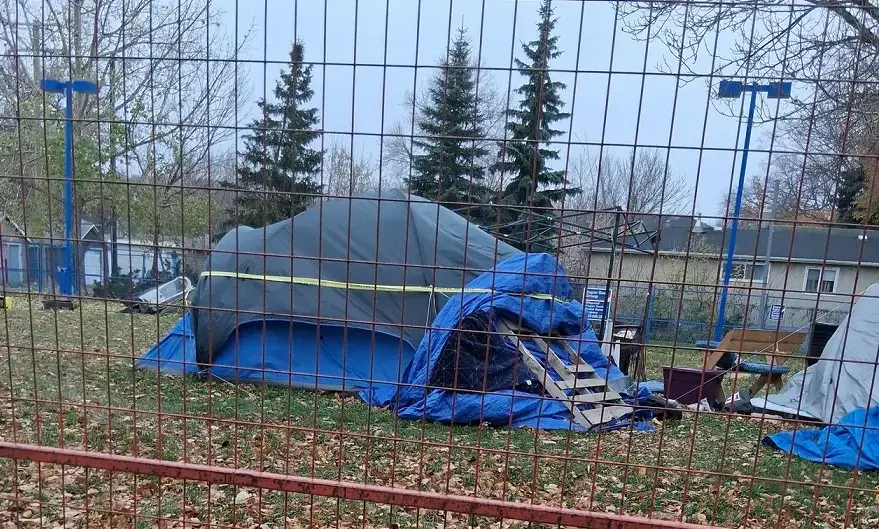
On October 28, an emergency call reached volunteers helping the residents of the homeless encampment at Pepsi Park:
SOS PEPSI PARK
ENCAMPMENT TEAR DOWN IN PROGRESS
…
GO TO PEPSI PARK NOW !
Removing encampments is a common occurrence in Regina, and is obviously not a solution to homelessness.
One of the reasons for decommissioning encampments is the risk of fire , and this was the reason why this encampment was dismantled.
However, the dismantlement caused a lot of distress. Residents did not know the encampment was going to be removed.
“My tent is gone. I didn’t even know this was happening at all”, said one camper.
In addition, there is concern about what’s going to happen to people and their belongings.
Mayor Chad Bachynski said the city is trying to find a solution. The city also plans to monitor shelter capacities and help people who need to access provincial government services.
I can’t make ends meet
Adam Loosley-Millman, an encampment resident told CBC News “he wants his own place to live, but social assistance is not enough for that”. He regrets the camp where they at least had fires, food, and shelter.
In October 2026, Noelle Greuel declared that in Saskatchewan, “between rising rents, declining social welfare, and a lack of affordable housing, people are not being given the help they need to stay in stable housing that they can afford month after month.”
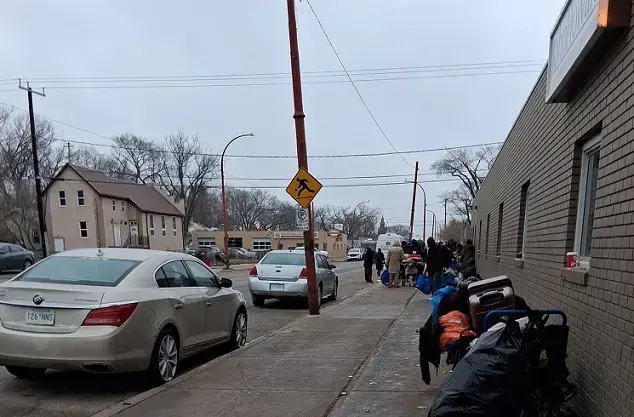
Photo-Credit: Evelyn Tischer
I lost my home; I lost my friends
One of the positive aspects of living in an encampment is the community feeling, the feeling of not being abandoned, which is reinforced if volunteers are helping. Nevada Adams, also a Pepsi Park camper, declared to CBC News reporters: “Living at the encampment was great. The volunteers took care of us. There was food brought to us all the time”.
Research conducted in Toronto during the Covid-19 pandemic showed that encampment residents formed communities and supported each other. “It’s like a little village, you know? We all take care of each other” declared one of the encampment residents.
“They said I am not ready for housing. What about housing being ready for me?”
There appears to be a system of “deservingness” for the homeless to have access to support. For instance, women and children victims of violence come first, whereas drug users are not as “deserving”, and everybody must be considered “redeemable” in order to receive support.
Since 2008, Finland has a policy of “Housing First”. You get housing first, then you work on whatever you need, from health problems to getting a job.
This policy has allowed to decrease the number of people who experience long-term homelessness by 68% between 2008 and 2022.
“I cannot study if I don’t have a home”
The Canadian Human Rights Commission reminds us that “The right to adequate housing is a fundamental right for everyone in Canada.” It also argues that “having an affordable, suitable and safe place to live helps people and families succeed and thrive”. This is particularly applicable to students: Maria [not her real name], studying in Canada, was homeless from age 17 to 21. She was also unable to do well at school because she did not have the possibility to “[feel] safe in a normal apartment”.
A 2025 study found that one quarter of students in Canada may experience housing problems during their university career. It was also found that , among the students they interviewed, nearly 70% of those who had been affected by homelessness dropped out of their programs.
If I like carrots, ¿then I am human?
In 2008, Professor Lasana Harris of University College London, then a young doctoral graduate, used an MRI scanner to see the effect on the brains of undergraduates when shown people’s pictures. He found that photos of homeless people activated the part of the brain usually activated when we see objects, whereas when “archetypal” pictures of people, like a businessman in a suit were shown, the expected part of the brain was activated. He deduced that we dehumanise homeless people.He inferred that this dehumanisation could explain genocides, colonialism, or slavery.
Another experiment showed that our brains can be retrained. He asked the MRI scanning participants if the homeless person would like broccoli or carrots. This changed the MRI data!
Homeless people were then seen as humans! The conclusion is that we can be retrained to see those we dehumanise as humans.
Dad was wrong
Many of us, as we struggled to figure out when two trains will meet or the hidden meaning of a poem, have been told “Study hard; then you’ll have a good job and a happy life”; and quite often, we have found that this is not true.
It is commonly assumed that the homeless are “lazy, insufferable, unaccountable, and incapable of maintaining any semblance of normalcy.” Jeff Bleich, an American diplomat insists: “…the only thing that’s similar about homeless people is that they lack housing.”
Using examples, he shows that even advanced university degrees do not protect us from homelessness. We can become homeless due to family obligations, age, health and, as the author notes, “an avalanche of unfortunate events”. He points out that “the next man you see rough sleeping may indeed be better educated than you.”
I wonder if an F-35 fighter jet would make a nice home
In 2023, one F-35 jet cost US$85 million, and Canada planned to buy 88 of them. Now, Prime Minister Mark Carney is thinking of buying a mixed fleet, but it’s interesting to see how US$85 million could be used for housing. A CA$ million property has on the average 3.2 bedrooms. So, with one fighter jet worth US$ 85 million or CA$ 118 million, about 378 people could be housed.
If governments spent less on war and war preparation, there would be more money for housing.
The money is here!
In October 2026, Carolyn Whitzman found that about CA$ 124 billion a year would be needed for everyone in Canada to have an “affordable and adequate home”.
That’s a lot of money, acknowledges Carolyn Whitzman, but she says it is here, and that “all the federal government needs is start steering investment in line with its human rights commitments.”
Do I want a tiny house?
To try and solve the homelessness crisis in Canada, municipalities try to build tiny houses as a “right now” solution. However, it means that their inhabitants are still marginalised and worse, may live on contaminated land.
Research in Canada showed that the Housing First approach is the only one that “breaks the cycle of chronic homelessness”. Moreover, it saves money as less emergency calls and emergency shelter drop-ins occur.
“The measure of society is how it treats the weakest members”, said Thomas Jefferson.
How to treat the homeless is addressed by Capitalism Can’t Be Fixed which consacres part of its platform to housing, stating that “Tens of thousands of Canadians live unhoused across the nation, while millions pay exploitive rents beyond their means.”
It asks for the government to declare a state of emergency and for homes to be run by the people who live in them, as well as for many other measures. No doubt, this is the way to go.