
World · Pressenza · · 1h
The Savanna Can Catch Fire I: Brics and a World That No Longer Accepts a Single Center
English (original) · Read in Deutsch ⇄
“Power begins to change long before maps do. It changes when those who obeyed discover that they can also choose.”
NEW DELHI, MUCH MORE THAN ANOTHER SUMMIT
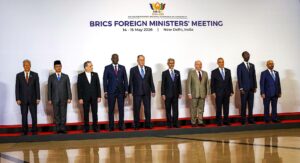
The BRICS meeting in New Delhi is not simply another photograph of heads of state gathered around a table. Some of the planet’s largest populations are there, along with enormous energy producers, industrial giants, nuclear powers, vast agricultural territories, and countries that control resources essential to the functioning of the global economy. They do not constitute a military alliance, nor do they need to. Their importance lies precisely in the accumulation of different capabilities.
Narendra Modi framed the problem in particularly clear terms. Conflicts, supply-chain disruptions, pandemics, and climate disasters no longer remain confined to the places where they begin. But he added an even greater warning: technology and critical minerals can become weapons. In a few words, he described a fundamental part of the new structure of global power.
“In the twenty-first century, shutting down a factory can begin thousands of miles away from it, in a mine, a port, or a strait that someone decided to use as an instrument of pressure.”
FROM FOUR COUNTRIES TO ELEVEN
Brazil, Russia, India, and China began the journey. South Africa came afterward, and later new members expanded the group to eleven: Egypt, Ethiopia, Iran, the United Arab Emirates, Saudi Arabia, and Indonesia. Today BRICS is composed of Brazil, Russia, India, China, South Africa, Egypt, Ethiopia, Iran, the United Arab Emirates, Saudi Arabia, and Indonesia, bringing together approximately half of the world’s population and concentrating an enormous share of the planet’s production, natural resources, energy, and economic growth. This is no longer simply a group of emerging economies seeking greater international representation. It is an increasingly broad platform from which a considerable part of the world is beginning to discuss trade, financing, development, and power without necessarily accepting that every decision must continue to pass through a single center.
But counting inhabitants or adding GDP does not fully explain its scale. China contributes a gigantic industrial machine. India adds population, technology, and an expanding economy. Russia possesses energy, minerals, territory, and strategic capacity. Brazil adds agriculture, iron, oil, fresh water, and an extraordinary continental position. Iran contributes hydrocarbons and geography. Other members further expand the group’s presence in Africa, Asia, and the Middle East.
There is no BRICS commander and no automatic obedience among its members. And perhaps that is precisely why it has grown. But they all know where they want to go and what they want to achieve….
“Eleven countries do not need to march in step to discover that together they carry much more weight.”
WHEN MINERALS BECOME WEAPONS
Modi’s warning goes directly to the industrial heart of the twenty-first century. Copper, lithium, nickel, cobalt, graphite, rare earths, and uranium are no longer simple commodities. They are strategic components of electrical grids, batteries, vehicles, electronics, defense, artificial intelligence, energy generation, and infrastructure.
And there is a second dimension that is often forgotten. Having the mine is not enough. Then come concentration, refining, processing, metallurgy, components, manufacturing, and transportation. Real power is increasingly distributed along that entire chain.
Africa possesses extraordinary resources. Latin America concentrates copper, lithium, iron, food, and water. Russia has a gigantic mineral and energy base. China dominates numerous industrial processes. India is rapidly developing its technological and manufacturing capacity. Suddenly, the old expression “raw materials” seems too small.
“The mineral beneath the ground is potential wealth. The ability to transform it, transport it, and turn it into industry is power.”
CHINA, THE FACTORY INSIDE THE BOARD
China is one of the great pillars of this architecture. Over four decades, it built a manufacturing capacity that cuts across virtually every industrial sector. Steel, electronics, machinery, batteries, electric vehicles, solar energy, infrastructure, and mineral processing form part of a productive platform of exceptional scale.
But precisely because of its size, it needs resources from abroad. Oil, gas, iron ore, copper, and food travel thousands of miles before feeding its industries and cities.
That is why Beijing builds infrastructure, diversifies suppliers, finances land and maritime corridors, and deepens relations with Asia, Africa, the Middle East, and Latin America. This is not only about trade. It is about reducing vulnerabilities.
“China possesses enormous industrial power, but it knows something elementary: no factory operates without energy, materials, and routes.”
RUSSIA, THE STRATEGIC COUNTERWEIGHT
Russia represents a completely different form of power. Its territory spans eleven time zones and contains enormous reserves of oil, gas, coal, minerals, fertilizers, and nuclear resources. Added to this is a strategic military capacity that no major power can ignore.
Its nuclear arsenal constitutes one of the two largest atomic forces on the planet. That reality establishes a brutal limit on direct confrontation between major powers. Not because their governments are necessarily prudent, but because they know the consequences.
Moscow can be sanctioned, pressured, contained, and confronted indirectly. But there is a boundary everyone knows. A direct confrontation between nuclear powers introduces an equation in which no conventional victory can be imagined. This is where invulnerability ends. Not because any power has lost its strength, but because another exists that is also capable of destroying the attacker.
“The true counterweight to absolute power is finding someone across from you who can also press the final button.”
INDIA, THE LION THAT DOES NOT WANT TO OBEY ANY PACK
India may be the most fascinating piece on the new board. It has surpassed 1.4 billion inhabitants, possesses nuclear weapons, develops technology, maintains a gigantic industrial base, and seeks to become one of the great economic centers of the century.
New Delhi buys Russian oil, participates in BRICS, maintains relations with the West, competes with China, develops ties with the Middle East, and avoids surrendering its foreign policy completely to any bloc.
That is not indecision. It is strategic autonomy. Modi seems to understand that a multipolar world makes possible something that for decades was far more difficult: keeping several doors open at the same time.
“India does not need to choose a pack. Its objective is to become one of the lions itself.”
IRAN IS ALREADY SITTING AT THE TABLE
Iran adds a piece that turns geography into geopolitics. It possesses enormous reserves of oil and gas and sits beside the Strait of Hormuz, through which a critical share of internationally traded hydrocarbons passes.
But Tehran now also belongs to BRICS and maintains deep relations with China and Russia. That does not mean Beijing or Moscow have signed a blank military check. It would be irresponsible to claim that.
It means something different. Any attempt to completely isolate Iran now encounters a much larger international network than it did twenty years ago. Trade, energy, diplomacy, and strategic cooperation cross borders that no longer necessarily coincide with the old blocs.
“Iran still has enormous vulnerabilities. But it is no longer standing alone in the middle of the savanna.”
THE HOUTHIS AND THE WORLD’S OTHER THROAT
The Houthis add another explosive piece to the savanna: the Bab el-Mandeb Strait, the gateway between the Red Sea and the Gulf of Aden. From Yemen, their missiles, drones, and ability to pressure shipping have demonstrated that a non-state actor can disrupt trade routes used by oil tankers, container ships, and vessels linked to Europe and Asia. In 2026, their advance along the Red Sea coast once again placed the strait at the center of regional risk. If Hormuz is an energy throat, Bab el-Mandeb is another artery of the same body. A prolonged disruption would force more ships to sail around Africa, increasing sailing time, insurance, fuel, and logistics costs. Saudi Arabia, Egypt, Israel, Europe, China, and India all have direct reasons to watch every move. The savanna does not end in the desert: it also extends over the water, where a few miles can make global trade more expensive in seconds.
“Hormuz can close one throat; Bab el-Mandeb can close the other. When two gateways of the same energy system begin to burn, the world discovers that the ocean is also part of the savanna.”
WASHINGTON FACING A WORLD THAT NO LONGER REVOLVES AROUND ONE CENTER
From Washington, the expansion of BRICS is viewed with a mixture of caution, concern, and strategic calculation. The United States understands that the issue is not only the economic growth of China, India, or Brazil, but the emergence of a political space where more countries seek to trade, finance, and negotiate without necessarily going through the dollar, the IMF, or institutions designed under Western leadership.
The White House knows that BRICS still does not constitute a homogeneous alliance or a military bloc, but it also knows that it represents something deeper: the desire to reduce dependencies. That is why it responds by strengthening alliances, technological agreements, sanctions, and presence. Washington does not fear only losing power; it fears losing centrality. And when an empire discovers that others can meet without asking its permission, the savanna begins to dry dangerously.
“Washington’s problem is not that new centers of power are emerging, but discovering that the world may begin to organize itself without always waiting for its authorization.”
THE GLOBAL SOUTH WANTS TO NEGOTIATE
Africa, Asia, and Latin America contain a large share of the resources the global economy will need during the coming decades. Copper, lithium, cobalt, nickel, rare earths, iron, oil, gas, uranium, food, and water are widely distributed outside the old industrial centers.
For too long, many countries exported raw materials and then bought manufactured products several times more expensive. That is slowly beginning to be challenged.
Indonesia wants to process its nickel. African countries seek to capture more value from their minerals. Latin America is debating the industrialization of lithium and copper. India is promoting manufacturing. China has already traveled much of that road.
“The Global South does not need to become an ideological bloc. It only needs to understand the value of what it possesses.”
MONEY IS CHANGING TOO
The international financial system remains concentrated around institutions, currencies, and markets built over decades. That will not disappear through a political declaration. But BRICS is trying to expand alternatives.
Trade in national currencies, cross-border payment mechanisms, new financial institutions, and the New Development Bank are all part of a gradual search for greater autonomy.
There is no BRICS currency tomorrow capable of replacing the dollar now.
Yes, it can be done, and that is precisely one of the keys to the change. If BRICS countries begin settling a growing share of their trade in yuan, rupees, rubles, reais, dirhams, or other national currencies, the dollar does not disappear, but its necessity as an intermediary currency declines. Intra-BRICS merchandise trade already reached around USD 1.17 trillion in 2024, and UNCTAD notes that there is still substantial room to increase it. If a significant share of that exchange began to be settled directly in national currencies, hundreds of billions of dollars’ worth of trade could circulate each year without requiring U.S. dollars in every transaction.
The dollar would remain a benchmark of value and an international reserve currency, but it would lose part of an even more important function: being the mandatory bridge between buyers and sellers.
“And in geopolitics, having a second door can be more important than tearing down the first.”
THE SAVANNA
BRICS does not need to conquer the world. Nor does it need to become a military alliance or speak with one voice. Its potential strength comes precisely from something far more elemental: population, territory, energy, minerals, food, industry, technology, and markets brought together within the same platform for cooperation.
China contributes industrial muscle. Russia, energy, resources, and strategic deterrence. India, population, technology, and growth. Brazil, agriculture, minerals, and territory. Iran, energy and geography. Africa and the other members expand the equation even further.
None can dominate the planet alone. Together, they do not form a world government either. But they make it impossible to continue imagining that the twenty-first century can be managed from a single capital. That may be the real message from New Delhi.
The great lions are already inside the same savanna. Some compete. Others cooperate. Some even deeply distrust one another. But all know their own weight.
The danger begins when technology, minerals, food, energy, maritime routes, sanctions, and financial systems stop being used only as economic instruments and begin to become weapons.
Because then a crisis in Hormuz can reach Shanghai. A European war can change an energy bill in Delhi. A mineral restriction can stop a factory on another continent. And a decision taken by one great power can provoke the reaction of several others.
“The savanna does not need another lion. It already has too many lions. And when several possess teeth capable of destroying one another, the problem is no longer who rules. The problem is who prevents the dry grass from finally finding its match.”
THE LIONS HAVE NUMBERS TOO
Behind the lions watching one another, threatening one another, and calculating every move are figures large enough to explain why no one can afford a mistake. In 2025, military spending in the Middle East reached approximately USD 218 billion; Saudi Arabia spent close to USD 83.2 billion, Israel USD 48.3 billion, and Iran around USD 7.4 billion, although part of their military capabilities does not necessarily appear in official budgets.
Add Hormuz to that equation: during 2025, around 21 million barrels of oil per day passed through the strait, equivalent, at an average Brent price of approximately USD 69 per barrel, to about USD 1.449 billion per day, USD 43.470 billion per month, and nearly USD 528.885 billion per year. More than 20% of global LNG trade also depended on that maritime throat. In a geography where arsenals, oil, gas, naval routes, and external powers coexist, the lions can roar for years; the problem begins when one of them decides to leap.
“When more than half a trillion dollars’ worth of oil passes every year through a single throat of the planet, we are no longer talking about geography: we are talking about one of the switches of global power.”
Bibliography
• BRICS. BRICS Leaders’ Declarations and Official Documents. Official documents of the bloc on expansion, economic cooperation, global governance, and reform of the international system.
• International Monetary Fund (IMF). World Economic Outlook Database. Comparative data on GDP, economic growth, population, and the relative weight of BRICS economies in the global economy.
• World Bank. World Development Indicators. Statistics on population, trade, resources, production, and economic development in BRICS member cou
Read the full story at the source
Source: Pressenza