
World Pressenza
The Humanist Movement at the 9th International Conference on World Religions
In a historical moment marked by conflict, division, environmental crises and inequality, the 9th International Conference on World Religions (ICWR-26), held on October 24th and 25th at Minhaj Univers
English (original) ·Read in Deutsch ⇄
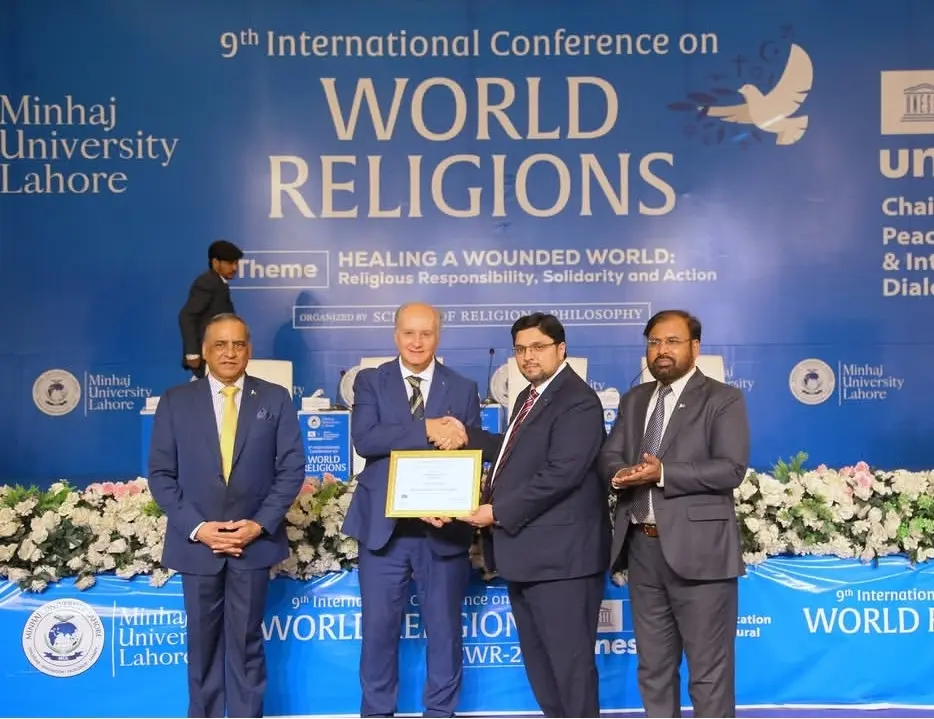
In a historical moment marked by conflict, division, environmental crises and inequality, the 9th International Conference on World Religions (ICWR-26), held on October 24th and 25th at Minhaj University in Lahore, Pakistan, set out to be a forum for reflection on how religious traditions can help heal fractured societies through compassion, ethical leadership, interreligious solidarity and collective action. Scholars, researchers, policymakers, religious leaders and students discussed the role of religion in fostering peace, social justice and sustainable coexistence.
Among the many and fascinating themes at the center of the discussion, particular attention was given to the inclusion of minorities and marginalized groups, the contribution of women and young people as agents of renewal, ecological wounds, the relationship between digital technology and sacred spaces, and interreligious cooperation against inequality.
The thread running through these areas is a question that is simple and yet thorny: what moves a human being to care for others, even when the social context pushes them in the opposite direction? Religions answer through faith and tradition. But there is also another path: that of people who work on consciousness without passing through dogma, engaging through experience, and coming to experience the same faith in the Human and in the principles that elevate consciousness, which are shared by many religious traditions.
The Humanist Movement, too, found a place in this fertile space dedicated to dialogue and consultation.
Starting from the concept of promoting personal and social human development through active nonviolence and non-discrimination, the humanist contribution focused on the non-confessional character of its work, while underlining its strong spiritual roots.
The humanist starting point is a principle that does not need a religious framework to be shared: every human being, simply by being born, has the right to health, food, education, shelter and a dignified existence. From this comes the aspiration to a Universal Human Nation, in which ethnic, cultural and religious diversity is valued and not feared.
Within the debate that took place at the Conference, Humanism gives strong weight to the inner dimension, cultivated through meditative practices and personal work rooted in spiritual inquiry. However, it does not present itself as a religion, because it replaces the concept of “dogma” with that of “experience.” What it asks of those who practice it is to observe and investigate the workings of their own consciousness. Indeed, the mechanisms of consciousness are common to all human beings, regardless of the place and culture into which they are born, and for this very reason they can be studied and oriented toward nonviolence and solidarity.
In this sense, human consciousness becomes the lowest common denominator: the ground on which people of different faiths, or of no faith, can meet.
The principle that sums up this vision reads: “Nothing above the human being, no human being below another.”
It carries a precise thesis about social change. Humanism holds that the structures that produce injustice, whether economic, political or cultural, must be transformed, but that this transformation cannot be separated from personal transformation. Person and structure influence each other: an unjust system is reproduced also through the behavior of those who live within it, and an individual cannot truly change without confronting the social dynamics that shaped them.
From this thesis follows a consequence that bears directly on the themes of interreligiosity and inclusion. If we cannot expect institutions to be, on their own, the bearers of improvement, then the responsibility for change also falls on individuals and communities. Cultivating internally a coherence between thought, feeling and action produces, as a reflection, social coherence. This is where Humanism meets the golden rule that runs through the great monotheistic traditions: “Treat others as you would want to be treated.” The point, however, is not adherence to a religious precept, but the direct verification of what that precept produces in relationships.
This orientation also brings a change of perspective on helping. The classical model of humanitarianism sees a giver and a receiver, with a distance that is often hierarchical between the two. Humanism proposes instead reciprocity: whoever receives is called to give in turn. The relationship does not end with the transfer of resources; it becomes an exchange, and those who have benefited from a project become active participants in it.
It is on this basis that Energy for Human Rights, a humanist-inspired organization, has started collaborations with the communities of the countries where it operates. Its most recent project, concluded in July, involved a series of awareness campaigns against gender-based violence in the outskirts of Dakar, Senegal. The activities were entrusted to local female operators, who worked in schools and in homes following a methodology structured on two levels: the personal and the social.
The first level is inner work. Before speaking to others, the operators had to examine the mechanisms of internalized violence, including those that directly concerned them. They studied gender discrimination and started from their own personal experience, because without this step the message risks remaining theoretical or, worse, reproducing the very patterns it seeks to fight.
The second level was social activity. Once the knots and contradictions within their own life stories had been identified, the operators brought the topic into classrooms and families with greater awareness, approaching it from different angles: education, religion, and the right to work.
Change, in this scheme, proceeds in two directions that feed each other: the more a person works on themselves, the more coherent and credible their social action becomes.
Particularly significant was the training of the operators on the role of religion in deconstructing gender stereotypes. Thanks to the contribution of Prof. Qadri, between January 2025 and January 2026, the operators studied the Quran and the Sunnah, discovering how the interpretation of Islamic precepts had been distorted by a patriarchal culture. This culture has often legitimized discriminatory practices against women. It is a cultural phenomenon, which must be clearly distinguished from the religious text, too often subject to manipulation.
Here the dialogue between Humanism and religion becomes concrete. The distinction between what a tradition professes and what the dominant culture has made of it is exactly the kind of work that the 9th International Conference on World Religions identified as necessary at the close of its proceedings: distinguishing the message of the founders from the structures of power that have bent it.
What emerges is that religion can be a powerful tool for social justice, provided it is not subordinated to systemic interests. The Muslim tradition, as the experience in Dakar shows, is grounded at its deepest core in the values of solidarity and the pursuit of truth, the same values that inspire the Humanist Movement.
It is on this common ground, more than on doctrinal differences, that a truly universal social justice can grow.
The rich testimonies of the various religious communities at the Conference and the experience of Energy for Human Rights, inspired by Humanism, converge on one question: how can suffering be overcome, both personally and collectively?
The discussion was left precisely on this point, with the idea that the answer lies in personal paths of coherence and in networks built at local and community level, capable of deconstructing what the system has produced at the social level.
The powerful and deeply human effort of the Conference to bring together people sincerely inspired and determined to see change in the world, the exchange of ideas and the will to plan together represent a common ground from which it is well worth starting again.