
World Pressenza
Restructuring the United Nations through Weighted Voting
The United Nations, the first institution in history to represent the world community, is one of humanity’s great achievements. By David C. Oughton But the structure of the United Nations, created in
English (original) ·Read in Deutsch ⇄
The United Nations, the first institution in history to represent the world community, is one of humanity’s great achievements.
By David C. Oughton
But the structure of the United Nations, created in 1945, has often left it weak and ineffectual. The present confederal UN system includes 193 independent national governments and is based on the principle of national sovereignty. Have we really found the best way for these independent nations to decide upon policies for the world―policies that, hopefully, would foster peace, justice, and environmental sustainability?
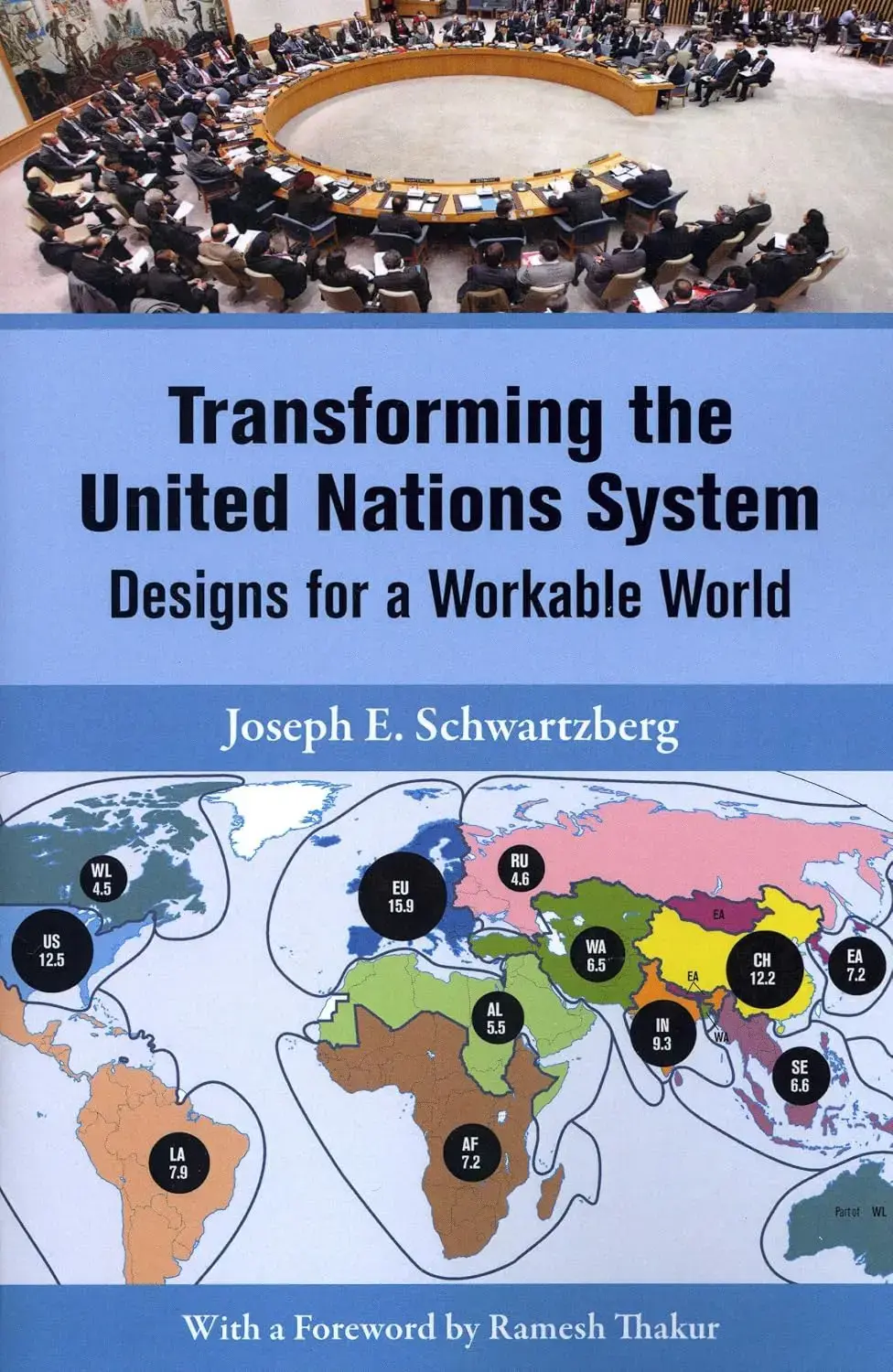
A particularly promising way to facilitate UN collective decision-making and action would be to adopt a democratic system of weighted voting, a system suggested by the late Professor Joseph Schwartzberg in his path-breaking book, Transforming the United Nations: Designs for a Workable World.
One of the biggest problems with the current structure of the United Nations is the “one-nation-one-vote” principle that is followed in the UN General Assembly and most other UN agencies. India with a population of 1.476 billion people, Tuvalu with a population of 9,000 people, and all of the 191 nations in between each have the same voting power in the General Assembly. Some nations pay a large percentage of the regular UN budget while most pay very little. It is therefore possible for 129 nations that together have only 8 percent of the world’s population and who pay only 1.271 percent of the UN budget to vote as a two-thirds majority on a substantive issue in the General Assembly. Sixty-five nations with a combined population below one percent of the world total can block passage of a substantive resolution.
In order to change General Assembly resolutions from being merely non-binding recommendations to legally binding obligations, Schwartzberg’s proposal involves calculating a weighted vote (WV) for each Member of the General Assembly by averaging three percentages: (1) its percentage of the total Population of all UN members; (2) its financial Contribution as a percentage of the UN budget; and (3) the percentage of the total number of Members in the UN, which would be the same for every Member, now 1 out of 193 or 0.521 percent. The initial formula is therefore WV = P + C + M / 3.
The United States has 4.558 percent of the world’s population, is assessed 22 percent of the UN budget, and is 0.521 percent of the Members of the United Nations. Averaging these three numbers would give the United States a weighted vote of 9.026. The weighted vote for China would be 9.640, for India 6.700, for Japan 3.543, for Germany 2.554, for France 2.047, and for Brazil 2.006. Ten countries would have a weighted vote between 1 and 2. For all other 176 Members, their weighted vote would each be less than 1.00. All of these percentages would need to be revised periodically because of changes in a nation’s population, its contribution to the UN budget, or the number of nations in the UN. Also, after years of increased democratization, the formula could be modified to 3P + 2C + M / 6.
Decisions of the General Assembly on global and general questions would be binding if made by a two-thirds majority of the weighted votes, provided that the total population of the concurring members represents a majority. On issues such as proposals for Charter revision and recommendations to the Security Council to impose sanctions on nations in serious violation of international law, Schwartzberg suggested that such proposals require as much as 75 percent of all weighted votes as well as approval by nations with at least two-thirds of the total population of all UN members.
Schwartzberg’s proposal for weighted voting could also apply to the composition of the UN Security Council. Under the present UN Charter, a resolution is passed with a three-fifths vote or 9 out of 15 countries that make up the Security Council at any one time without a veto by any one of the five permanent members (United States, Russia, China, United Kingdom, and France).
Schwartzberg recommended that a restructured Security Council be composed of twelve seats, each representing a major region of the world. He proposed that any single UN member for which the sum of its percentages of the world’s population and of contributions to the UN budget exceeds a threshold of 12 percent (currently, United States, China, and India) would be allowed to form its own region. The formula for any region would be the average of (1) the combined population as a percentage of the total for all UN members, (2) the combined contribution to the UN as a percentage of the total for all UN members, and (3) 8.333, one-twelfth of 100 percent.
The twelve regions and their weighted vote would be: Europe (15.86); United States (12.53); China (12.24); India (9.30); Latin America (7.90); East Asia (7.24); sub-Saharan Africa (7.16); Southeast Asia (6.61); West Asia (6.49); Arab League (5.45); Russia and some neighboring countries (4.67); and the Westminster League, including Canada and Australia (4.54). No country would have a veto. Resolutions in the Security Council on procedural matters would require a simple majority vote while decisions on substantive matters would require a two-thirds majority and the concurrent approval by regions whose combined populations exceed 50 percent of the world’s total.
Schwartzberg argued that this system of weighted voting could be accomplished by simply amending a few sentences in Article 18 of the UN Charter.
Given the massive problems humanity currently faces from war, climate change, poverty, and disease, surely it’s time to find ways like weighted voting to enable international institutions to adequately address them.
David C. Oughton’s doctorate is in Philosophies and Theologies of Peace and Justice. He is a retired professor at Saint Louis University. He is a member of the Board of Citizens for Global Solutions Education Fund.