
War & Militarism Pressenza
Michiko Kodama, a Hiroshima survivor: “A categorical ‘No’ to war and the possession of nuclear weapons”
On the occasion of the event Never Again Hiroshima. Spain’s Role in Nuclear Disarmament, we had the opportunity to speak with Michiko Kodama (Kodama-san), a Hiroshima survivor, secretary-general of Ni
English (original) ·Read in Deutsch ⇄
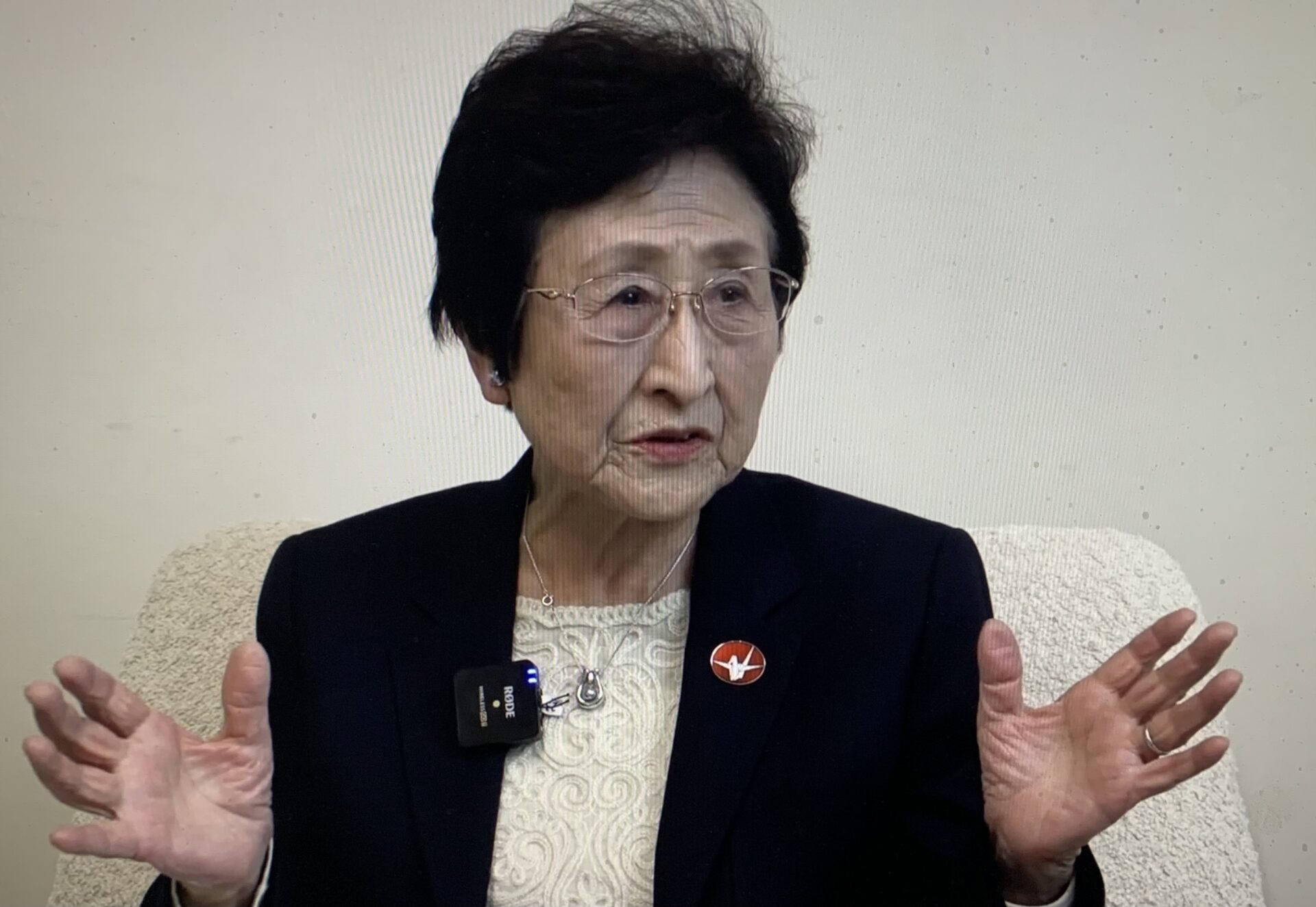
On the occasion of the event Never Again Hiroshima. Spain’s Role in Nuclear Disarmament, we had the opportunity to speak with Michiko Kodama (Kodama-san), a Hiroshima survivor, secretary-general of Nihon Hidankyo (Confederation of Atomic Bomb Victims’ Associations), and 2024 Nobel Peace Prize laureate. The event, organized by the Alliance for Nuclear Disarmament, was held at the University of Madrid.
How is your trip to Spain going?
This is my first visit to Spain, and it’s actually turning out to be very fruitful. I’m learning a lot and meeting many people; it’s very rewarding to be here.
There are currently many demonstrations against war in Europe. Have you found people to be more receptive to the message against nuclear weapons?
I support the demonstrations, such as those by teachers currently taking place in Spain. I sense an atmosphere in which everyone is striving to protect their rights, and this atmosphere truly heartens me. I can only encourage and applaud you, because we truly have many common causes to fight for.
The current Japanese government wants Japan to abandon the pacifist principle of its Constitution in order to return to militarization and rearmament. What is your opinion on this?
Not only on a personal level, but also as an activist—along with the entire confederation—we are firmly opposed to the policy our prime minister is pursuing. Instead of investing money in the well-being of the people, what she is doing is buying weapons from the United States. But there is reason for hope because many mothers and students, who oppose this policy, are organizing to demonstrate in front of Congress.
As a survivor of Hiroshima, what is your message for Spain and for the world?
As an activist, I will truly commit myself with all my strength, but the reality we face is that atomic bombs—nuclear warheads—are on the rise. Today there are about 12,000 of them. When they detonated the atomic bombs in Hiroshima and Nagasaki, there were only a few. So we are truly heading in a clear direction where there is investment and interest in maintaining nuclear weapons. That is why I want to issue an appeal so that humanity becomes aware that it cannot relive the hell I experienced or the hell they might experience. For me, it is a categorical “no.” In my speech, I want to emphasize and highlight this categorical “no” to war and to the possession of any nuclear weapon.
We survivors have lived through that experience, but we will carry its burden until the day we die, and we will carry our own hell within us. The talk I will give will focus precisely on this: in addition to my personal experience, I intend to raise awareness about the devastating effect of atomic bombs that we continue to carry with us. We survivors do not want the second or third generations to go through the same experience.
What role can Spain play in the fight to ban nuclear weapons?
My hope is that the Spanish government will sign the Treaty on the Prohibition of Nuclear Weapons—that is, that it will recognize the danger these weapons pose and that, by joining forces, we can move forward to raise awareness among humanity. That is the only thing I would ask of the Spanish government.
Would you like to share a final message or add any other comments?
I found this to be a truly interesting country because the people are very passionate about current politics, and that gives me hope; I’m learning so much from them—from the fact that there’s a shared interest in discussion, especially regarding the well-being of the people—and seeing and experiencing that here has given me a lot of strength.
Given that Japan was the victim of two atomic bombings, the fact that it has not signed the TPAN is something we find incomprehensible. So, together with these protest groups, we will continue to pressure the government to take this issue seriously.
It was very interesting to hear that mothers and young people in Japan are protesting…
I’ve been giving talks at high schools for 10 years. So it was a pleasure for me that those very students became aware of the issue, went to Congress, and collected signatures, which they then delivered to the Ministry of Foreign Affairs. And I had the honor of accompanying them to the demonstration, strengthening this bond.