
World · Pressenza · · 2h
Michigan, seven weeks on: coalition boundaries begin to shift
English (original) · Read in Deutsch ⇄
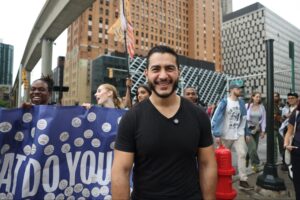
Seven weeks after Michigan’s Democratic primary, the Senate race appears to be entering a new phase. Not because Abdul El-Sayed has built a decisive lead, nor because Mike Rogers has lost ground irreversibly. The change is different: the boundaries of the two candidates’ coalitions are beginning to grow less rigid.
The question is no longer only whether El-Sayed can broaden his base without dividing it. Increasingly, both candidates are also trying to speak to voters who, at least on paper, belong to the other side.
Part of the Jewish electorate organizes in support of El-Sayed
In previous weeks, El-Sayed’s relationship with Jewish voters in Michigan had appeared mainly as a problem to be solved. Some rabbis and community leaders had set out “non-negotiable” principles; other Michigan Jews had announced their support for Rogers.
On September 17, however, more than 600 Michigan Jews signed a public letter pledging to vote for El-Sayed. “Michigan Jews for Democracy” includes liberal and progressive figures, rabbis and people active in the state’s public life. The letter explicitly acknowledges disagreements over Israel and some of the candidate’s positions, while separating those differences from the electoral choice. [1]
The change, then, is not that El-Sayed has “won back” Jewish voters. It is that the internal division has become public and organized in both directions. The image of a Jewish community united against him no longer adequately describes the situation.
The Democratic Party also moves closer to El-Sayed
A second movement concerns the Democratic establishment.
During the primary, an important part of the national leadership had backed Haley Stevens. Now the Senate Majority PAC, aligned with Democratic Senate leadership, has added another $10 million to its Michigan investment, bringing its total commitment to $30 million. Axios described the decision as a sign that the party is coalescing around El-Sayed after the primary. [2]
On September 22, Kamala Harris also appeared in Michigan to support the Democratic nominee, with particular attention to mobilizing Black and progressive voters. [3]
The movement is significant: El-Sayed does not appear to have shifted sharply toward the party center. Rather, a growing part of the party is converging on his candidacy after his victory.
Rogers seeks votes beyond his own camp
The movement, however, is also taking place in the opposite direction. Rogers is courting Democrats, independents, Black voters and Jewish voters, presenting himself as a pragmatic candidate and focusing in part on urban issues such as education and housing. [4]
At the same time, at the Republican convention El-Sayed was turned into one of the party’s major national targets: Republicans attacked his progressive positions, his past ties to left-wing online political commentator Hasan Piker, and even his Muslim identity. El-Sayed has tried to move the discussion away from that terrain, returning it to gasoline prices, housing, the auto industry and the cost of wars abroad. [5]
More interesting still is Rogers’s shift on the war with Iran. Having supported the Trump administration’s intervention, he has now called for a swift end to the conflict, linking it to higher energy prices and economic pressure on families. Reuters noted the distance from Trump’s position. [6]
In recent weeks we had watched conservative political commentator Tucker Carlson find points of contact with El-Sayed over opposition to interventionism. That signal has not developed into a broader conservative current in El-Sayed’s favor. But now Rogers himself is moving, at least on one issue, toward terrain El-Sayed has occupied for some time: the relationship between war abroad and the cost of living.
The polls: a small shared signal
The polls also show something new. The five latest surveys collected by 270toWin all put El-Sayed slightly ahead, with an average of 47.2% to 45.0%. RealClearPolitics shows a similar average margin, 46.9% to 44.8%. [7]
The differences remain small and are often within or close to the margin of error, so they do not indicate an established lead. But compared with the weeks when polls pointed in different directions, they now show a limited but visible convergence.
When the boundaries become fluid
The new feature of the seventh week is not a single endorsement or a single poll. It is the fact that several movements are happening at once.
Part of the Jewish electorate is organizing in support of El-Sayed. The national Democratic leadership is investing more heavily in his candidacy. Rogers is courting Democrats, independents, Black voters and Jewish voters and, on the Iran war, is moving toward language closer to anti-interventionist concerns and the cost of living.
The coalitions have not yet changed. But their boundaries are becoming more permeable.
Both candidates are now seeking votes and issues beyond the boundaries of their own camp. It is in this fluid zone that the race could be decided.
Notes
[2] Axios, September 16, 2026, “Scoop: Schumer’s super PAC doubles down in Michigan”.
[7] 270toWin, Michigan Senate polls, updated September 2026. / RealClearPolitics
Read the full story at the source
Source: Pressenza