
Politics Pressenza
How to evaluate a politician from the standpoint of peace, nonviolence, human rights and democracy: The case of Abdul El-Sayed
A method for not starting from the conclusion. Over the past two months, Pressenza has followed the election campaign of Abdul El-Sayed, the Democratic candidate for the U.S. Senate in Michigan.¹ From
English (original) ·Read in Deutsch ⇄

A method for not starting from the conclusion.
Over the past two months, Pressenza has followed the election campaign of Abdul El-Sayed, the Democratic candidate for the U.S. Senate in Michigan.¹ From the outset, he seemed to us a politician worth watching from the standpoint of peace and nonviolence. But on what criteria is that impression based?
Evaluating a politician is harder than it seems. If we ask not only whether we agree with the proposals, but whether that person’s political action contributes to peace, nonviolence, human rights and democracy, the program alone is not enough.
We also need to observe how the politician responds to violence, whether the same standards are applied to one’s own side and the opposing side, whether there is dialogue with critics, recognition of suffering on both sides, correction of errors, and consistency between means and ends.
Yet by selecting facts carefully, almost opposite portraits can be drawn of the same politician. In El-Sayed’s case, his record on the Israeli-Palestinian conflict includes at times very harsh language, his admission “I made a mistake” after controversy over his remarks following the attack on Temple Israel,² and the later endorsement of Sander Levin, a veteran Jewish Democratic figure in Michigan, despite a “significant disagreement” over the Israeli-Palestinian issue.³
How should facts like these be brought together? It would be easy to build a portrait by selecting whichever ones fit best. To reduce arbitrariness, the opposite route was chosen: first define what to observe, then gather the evidence, and only at the end attempt an evaluation.
The first version of the framework contained 14 indicators. But once they were placed in a table, it became clear that the “policies and ideas” section was too heavily concentrated on war, Israel and foreign policy, while health care, cost of living, jobs, money in politics, housing, education, the environment and civil rights — all central to El-Sayed’s program — were nearly absent.⁴ In addition, “radicality of rhetoric” belongs more properly under political style.
The framework was therefore expanded to 20 basic indicators in three areas, plus an independent outcome indicator on the capacity to bridge divisions. This was the first result of testing the instrument itself.
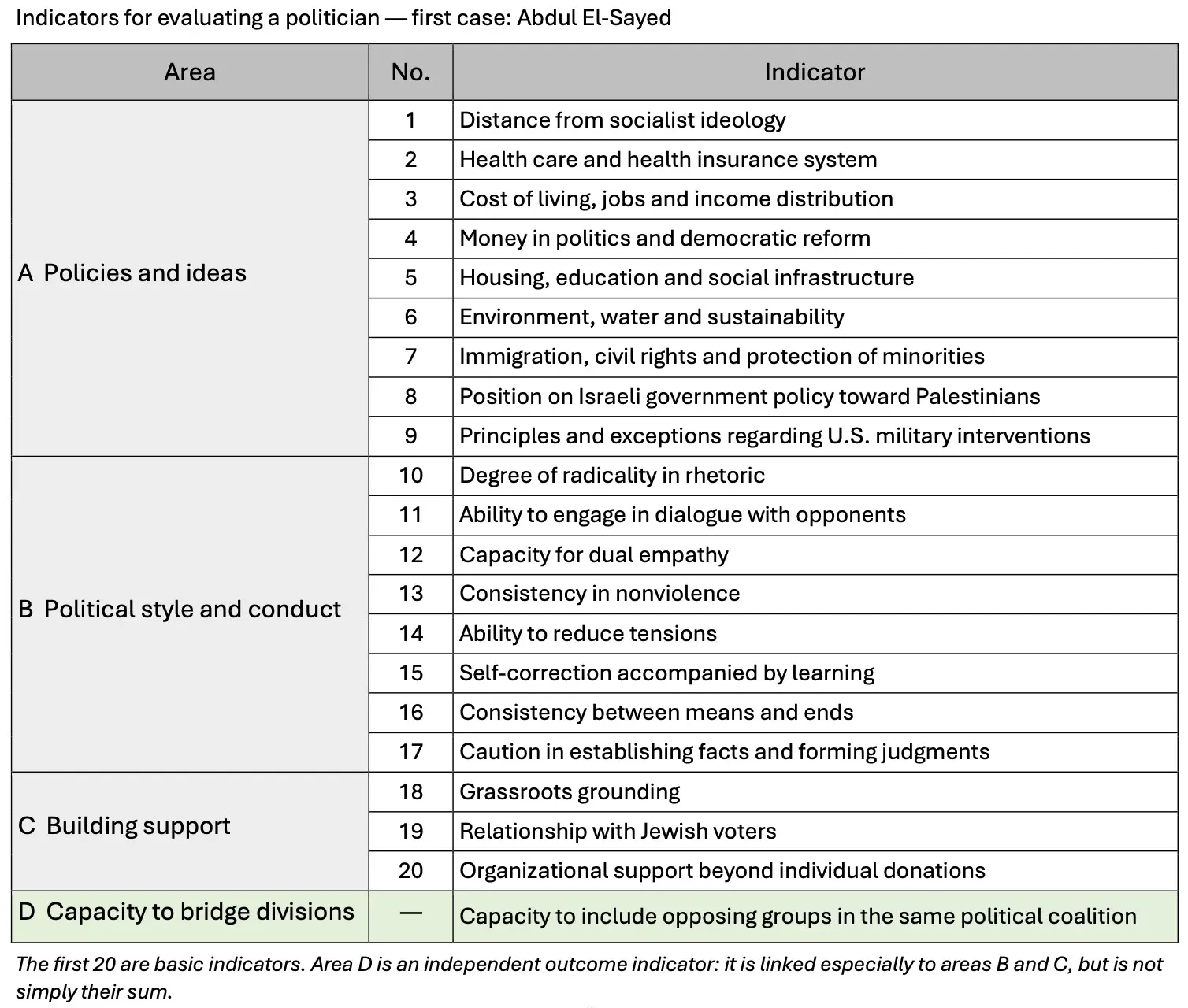
Changing the framework is not a defect. A criterion can seem adequate until it is applied to a concrete case. The problem is not correcting the yardstick, but changing it because one dislikes the result.
Take the “radicality of rhetoric.” Two or three strong statements can easily portray a politician as aggressive or incendiary. To reduce that risk, at least twenty examples were collected, reaching twenty-four statements in the first phase for each of the two politicians compared, El-Sayed and Zohran Mamdani.
The statements were provisionally classified into four groups: explanations of principles or policies; strong policy criticism; expressions that may intensify confrontation; and interventions oriented toward repair or reconciliation. The sample is not random and does not permit statistical precision, but it shifts the question from “Has this politician ever said something extreme?” to “How often does this kind of language appear, in what circumstances, and against what target?”
An error can thus become a richer piece of evidence. What matters is the sequence: error → criticism → understanding → correction → learning. A simple “I’m sorry” does not yet show that anything has been learned; we need to see whether the same kind of error recurs.
A second example concerns organizational support. It is not enough to know which unions or associations support a candidate; what matters is when they enter the coalition. Was a large organizational infrastructure already in place? Did support expand gradually? Are the new groups increasingly diverse? Did some arrive only after a victory?
Politics should be observed not only as a photograph, but as a film. In El-Sayed’s case, what matters therefore is also the way organizations of different kinds appear to be joining over time.
The indicators are not meant to give a political judgment a mathematical appearance, but to prevent us from unconsciously changing the rules whenever we encounter a fact we like or dislike. The framework itself must also be able to change: correcting a tool because it does not measure well what we intend to observe is research; altering it because we dislike the result is rationalization.
The 20 basic indicators and the outcome indicator do not constitute a universal model. For now, they are tools built for a first case: Abdul El-Sayed.
The work nevertheless suggests a broader possibility: deriving from concrete cases a general core of indicators for observing politicians from the standpoint of democracy, human rights, nonviolence and sustainability, adapting it to role, context and research question.
For a U.S. senator, war and foreign policy weigh heavily; for a mayor, policing, housing, immigration and urban conflict; in a sustainability-oriented analysis, climate, energy and responsibility toward future generations.
But it would be premature to build a universal model now. These tools first need to be tested on a concrete case.
The next step, then, will not begin with the question, “Is El-Sayed a good politician or not?” It will begin with narrower questions: What do the data show? Where are they consistent? Where do they conflict? What do we know with reasonable confidence, and what still needs verification?
Before judging a person, it is worth testing the yardstick with which we intend to measure them. That is where I would like to begin.
Notes
- Pressenza has so far published eight articles in English that directly follow or provide context for El-Sayed’s campaign: ① ② ③ ④ ⑤ ⑥ ⑦ ⑧
- Andrew Lapin, “Abdul El-Sayed apologizes for Temple Israel comments in meeting with Michigan Jewish Dems”, Jewish Telegraphic Agency, August 29, 2026. Link
- Andrew Lapin, “Sander Levin, storied Michigan Jewish Democrat, endorses Abdul El-Sayed in Senate race”, Jewish Telegraphic Agency, September 16, 2026; see also The Washington Post, September 16, 2026. JTA / Washington Post
- The campaign’s official priorities page centers “Money Out of Politics,” “Money in Your Pocket,” and “Medicare for All,” and also includes housing, education, the environment, water, immigration, civil rights and foreign policy. Priorities
Article based on publicly available materials consulted through October 20, 2026.