
World Pressenza
From Mississippi to the Indian Diaspora: Why Black America s Historic Victory Is Our Victory Too
History sometimes moves so slowly that generations lose hope. Then, suddenly, an extraordinary event reminds us that the sacrifices of ordinary people, their courage, their struggles against injustice
English (original) ·Read in Deutsch ⇄
History sometimes moves so slowly that generations lose hope. Then, suddenly, an extraordinary event reminds us that the sacrifices of ordinary people, their courage, their struggles against injustice, and their dreams of equality have not been in vain.
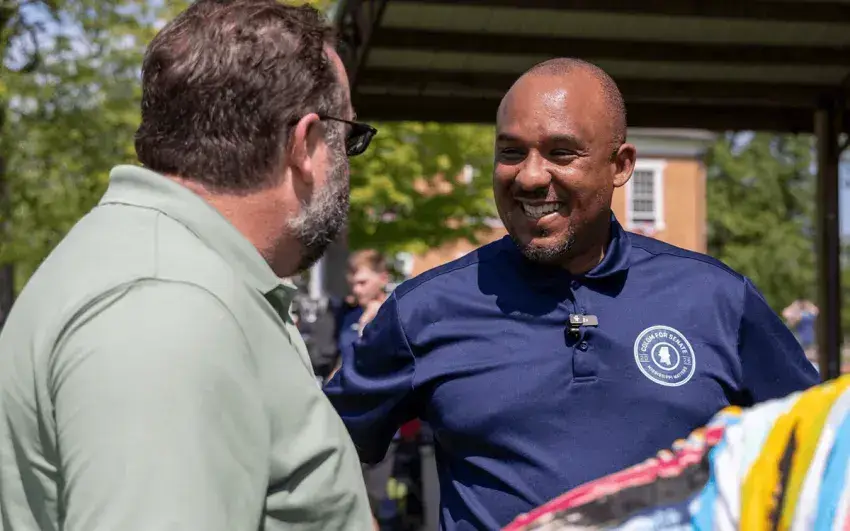
The historic election of Scott Colom, an African-American Democrat, to the United States Senate from Mississippi in November 2026 is one such event.
Mississippi! The very name evokes some of the darkest chapters of American history: slavery, lynching, segregation, racial terror, and the brutal suppression of Black voting rights. Yet this same Mississippi has now elected its first Black U.S. senator since the Reconstruction era following the Civil War.
Colom defeated Republican incumbent Cindy Hyde-Smith in a state Donald Trump carried by approximately 23 percentage points in 2024. His victory was not merely an electoral upset. It was a powerful reminder that history is not necessarily a prison from which people cannot escape.
And for us—Indian, Bengali, Pakistani, Bangladeshi, and other South Asian immigrants in America—it carries a message we urgently need to understand.
Mississippi: From Racial Terror to Nonviolent Democratic Possibility
To appreciate the significance of Colom’s victory, we must remember the Mississippi of Medgar Evers, Fannie Lou Hamer, and the Freedom Summer of 1964.
Medgar Evers, the courageous civil rights organizer, was assassinated in Jackson, Mississippi, in 1963. Three civil rights workers—James Chaney, Andrew Goodman, and Michael Schwerner—were murdered in Mississippi in 1964 while working to register Black voters.
Fannie Lou Hamer, born into a sharecropping family, challenged the political establishment with extraordinary courage. She endured imprisonment and brutal beatings but refused to surrender her demand for dignity and democratic participation.
These were not isolated incidents. They were part of an institutionalized system of white supremacy that denied millions of African Americans the most fundamental human rights.
The Civil Rights Act of 1964 and Voting Rights Act of 1965 emerged from decades of organizing, resistance, sacrifice, and bloodshed.
Today, when Scott Colom stands victorious in Mississippi, I see more than a Democratic candidate defeating a Republican. I see the long shadow of Medgar Evers, Fannie Lou Hamer, Martin Luther King Jr., and countless unnamed activists who refused to accept racial oppression as America’s permanent destiny.
Colom’s victory does not mean racism has disappeared. Far from it. But it demonstrates that organized democratic resistance can overcome even deeply entrenched political and racial barriers.
Trump’s Politics of Division—and the People’s Response
Donald Trump’s political movement has repeatedly exploited racial resentment, hostility toward immigrants, religious suspicion, and anxieties about America’s changing demographic composition.
His political rhetoric has often divided Americans into supposedly deserving insiders and threatening outsiders. His attacks on immigrants, Muslims, racial-equity initiatives, and political opponents have contributed to an atmosphere of fear and distrust.
Alongside this divisive politics operates an economic system in which billionaires, powerful corporations, and wealthy political donors exercise enormous influence over public policy.
This combination of cultural polarization and concentrated economic power deserves particular attention.
When ordinary working people are encouraged to blame immigrants, racial minorities, or religious outsiders for their economic insecurity, they may overlook the corporate decisions, regressive policies, and unequal distribution of wealth that also shape their lives.
Racism and economic exploitation have frequently reinforced each other throughout American history.
The 2026 midterm elections suggest that this political strategy has serious limits.
In Texas, Democrat James Talarico won a historic Senate contest. In Michigan, Abdul El-Sayed became the first Muslim elected to the United States Senate, overcoming vicious anti-Muslim attacks.
These victories, alongside Colom’s triumph, offer evidence that many Americans are prepared to reject fear-based politics and embrace a broader vision of democratic representation.
But elections alone cannot guarantee equality. The struggle must continue through education, community organizing, labor solidarity, independent journalism, and the defense of constitutional rights.
The Uncomfortable Truth About South Asians and Immigrants
Here is where I must turn to my own community.
I have lived in America for decades, worked as an educator, and participated in human rights and grassroots movements in both America and India.
During these years, I have repeatedly encountered an uncomfortable contradiction.
Many Indians and Bengalis who have achieved professional success in America—physicians, engineers, academics, businesspeople, and technology professionals—know surprisingly little about African-American history.
Some even carry deeply ingrained anti-Black prejudices.
They repeat stereotypes about crime, intelligence, poverty, education, and work ethic. They sometimes distance themselves from African Americans, believing that their own educational and economic achievements make them fundamentally different.
But how many realize that their opportunities in America were profoundly shaped by the struggles of Black Americans?
Before the Immigration and Nationality Act of 1965, America’s immigration system heavily favored immigrants from Europe and restricted immigration from much of Asia.
The 1965 legislation abolished the discriminatory national-origins quota system and opened new pathways for immigrants from India, Pakistan, and eventually Bangladesh, among many other countries.
The legislation did not emerge in isolation.
It was enacted during the civil rights era, when the moral and political force of the African-American freedom movement was compelling America to confront its discriminatory institutions.
The same democratic transformation that challenged segregation also helped undermine explicitly discriminatory immigration policies.
Without that historical transformation, the large-scale South Asian professional immigration that followed would have been far more difficult.
Of course, immigration reform had multiple causes, including Cold War diplomacy, economic interests, and political negotiations. But the civil rights movement fundamentally changed the moral climate in which reform became possible.
In a profound historical sense, many of us South Asian immigrants are beneficiaries of freedoms for which African Americans fought, suffered, and sometimes died.
How many of us acknowledge that debt?
Gandhi, Martin Luther King Jr., Ambedkar, and Du Bois
There is another extraordinary historical connection that South Asians should remember.
Martin Luther King Jr. was deeply influenced by Mahatma Gandhi’s philosophy of nonviolent resistance.
King regarded Gandhi as a major inspiration for transforming moral conviction into organized political action. When he visited India in 1959, he recognized the profound relationship between India’s anti-colonial struggle and the African-American struggle against segregation.
Yet this relationship should not be reduced to admiration for one individual.
Another remarkable connection existed between Dr. B. R. Ambedkar, the great Indian anti-caste intellectual and architect of India’s Constitution, and W. E. B. Du Bois, the pioneering African-American scholar and civil rights leader.
In 1946, Ambedkar wrote to Du Bois seeking information about African Americans’ efforts to secure international recognition of their rights. Du Bois responded sympathetically, recognizing the parallels between caste oppression in India and racial oppression in America.
Their correspondence represented an early intellectual bridge between two monumental struggles against inherited systems of human inequality.
One confronted the brutal hierarchy of caste. The other challenged the structures of racial subordination.
Their methods and historical circumstances differed, but their fundamental questions were strikingly similar.
Why should birth determine human worth? Why should inherited identity decide social opportunity? Why should any community possess the power to humiliate, exclude, or dominate another?
These questions remain urgently relevant in India, Pakistan, Bangladesh, and the United States.
When Will South Asia Learn?
South Asia has produced extraordinary traditions of humanism, secularism, equality, and resistance.
From Buddha and Kabir to Nanak, Lalon Fakir, Rabindranath Tagore, Begum Rokeya, Gandhi, and Ambedkar, our intellectual and spiritual history contains powerful challenges to hierarchy and exclusion.
Yet caste discrimination, religious fanaticism, class arrogance, color prejudice, and hostility toward minorities remain deeply entrenched.
In India, Dalits and religious minorities continue to confront discrimination and violence. In Pakistan and Bangladesh, religious minorities and marginalized communities face their own forms of exclusion and insecurity.
And across the South Asian diaspora, colorism and inherited caste and class prejudices often survive migration.
We may change countries without changing our consciousness.
This is why Mississippi matters to us.
Scott Colom’s victory tells us that even societies burdened by centuries of injustice can change through courageous, sustained democratic struggle.
Michigan’s election of Abdul El-Sayed demonstrates that religious identity need not permanently exclude someone from the highest institutions of political power.
Texas offers another reminder that political establishments can be challenged.
But we must resist the temptation to celebrate these victories without learning from the history that made them possible.
The Second Circle of Human Solidarity
I have long argued that meaningful democratic transformation requires building broad alliances among ordinary people across ideological, racial, religious, and cultural boundaries.
The overwhelming majority of humanity shares basic aspirations: security, dignity, education, healthcare, decent employment, freedom, and a peaceful future for their children.
Yet political and economic elites frequently benefit when these people remain divided.
The African-American civil rights movement offers an enduring example of how disciplined grassroots organization, moral courage, and broad democratic coalitions can challenge entrenched power.
Its lessons belong not only to Black America but to all humanity.
Scott Colom’s victory is therefore not merely a victory for Mississippi’s African-American population, nor simply for the Democratic Party.
It is a victory for the possibility of change.
For those of us who came to America seeking freedom and opportunity, it should also be a moment of humility and gratitude.
We must teach our children not only about our own immigrant achievements but also about the African-American workers, teachers, organizers, intellectuals, and martyrs who helped make those achievements possible.
We must challenge anti-Black racism within our families, temples, mosques, cultural associations, and professional communities.
And we must recognize that the struggle against racism in America cannot be separated morally from the struggle against caste oppression, religious hatred, and economic inequality in South Asia.
The freedom of one community is never secure while another community remains oppressed.
That, to me, is the enduring message of Mississippi.
And perhaps the most important question is not simply whether America is changing.
It is whether we, the beneficiaries of its unfinished democratic revolution, are willing to change ourselves.