
World · Pressenza · · 3h
Dr. Khalilur Rahman: Hate Speech Can Increase Division and Violence
English (original) · Read in Deutsch ⇄
by Maksuda Lisa, Dhaka Bureau
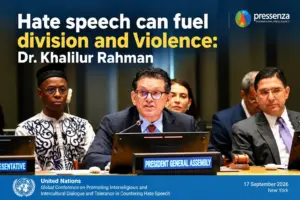
Dr. Khalilur Rahman, President of the 81st Session of the United Nations General Assembly, has called for dialogue, respect and responsible communication as alternatives to speech that incites hatred and violence. Speaking on 17 September at the United Nations Headquarters in New York at the global conference titled ‘Global Conference on Promoting Interreligious and Intercultural Dialogue and Tolerance in Countering Hate Speech,’ he highlighted the spread of hate speech, its social harm and the importance of dialogue and tolerance in addressing it.
Dr. Khalilur Rahman said that hate speech is not merely offensive language. It is an attack on human dignity, equality and the values of the United Nations Charter. Such speech creates divisions among people, portrays individuals as less than human and presents difference as a cause of danger. Through this, discrimination, exclusion and violence may increase, and in the most extreme circumstances it may also pave the way for atrocity crimes.
He said that, at present, hate speech is crossing borders and reaching people more rapidly and widely than ever before. Women, migrants, refugees, persons with disabilities, young people and various minority groups are often targets of such speech. In many cases, hateful narratives are also being used for political interests.
He also noted that the rapid development of digital technology and artificial intelligence has made the situation more complex. In his view, these technologies can make the dissemination of false information, the influencing of public opinion and the spread of hatred faster and more extensive. However, if technology is developed, managed and used responsibly, it can also be used to identify risks, disseminate accurate information and strengthen society’s capacity to address hate speech.
Dr. Khalilur Rahman also spoke about the sources of hate speech. In his view, hate speech often does not begin with words alone. It may also arise from fear, ignorance and a lack of communication toward people of different religions, cultures and beliefs. That fear and insecurity may later be exploited to turn particular individuals or groups into targets. By contrast, when people listen to one another, understanding takes the place of suspicion and recognition of humanity takes the place of hostility.
For this reason, he presented dialogue and tolerance not merely as ideals, but as practical means of prevention, peacebuilding and sustainable development. In his view, dialogue and tolerance can address the root causes of hatred so that it can be prevented before it turns into discrimination, violence or conflict. At the same time, building mutual trust can also serve as an important defence against hatred, misinformation and hostility.
Dr. Khalilur Rahman also mentioned rebuilding trust as one of the key goals of the current General Assembly session over which he presides. He noted that such trust between individuals and states can be built through mutual respect and working in good faith toward collective solutions.
He emphasised increasing education and media and information literacy, or awareness about media and information, and giving young people opportunities for meaningful leadership in addressing hate speech. He called for strengthening the role of local communities and religious leaders, ensuring accurate and reliable information, and increasing cooperation among governments, technology companies, the media, academics, civil society, faith-based organisations and ordinary users. In his view, this effort needs to engage the whole of society and be guided by the principles of international human rights law—legality, necessity, proportionality and non-discrimination.
Recalling the founding belief of the United Nations—to safeguard the dignity and worth of every human being—Dr. Khalilur Rahman called for choosing dialogue over division, respect over contempt and solidarity over hatred. He also said that new and emerging technologies should be used not to increase fear, but to expand understanding and advance human dignity. At the same time, he emphasised ensuring the values of tolerance, inclusion and mutual respect in both physical and digital spaces.
The central message of Dr. Khalilur Rahman’s speech is therefore to bring dialogue, respect, tolerance, accurate information and responsible communication to the forefront as alternatives to communication that may incite hatred and violence. This call to choose dialogue over division, respect over contempt and solidarity over hatred is important not only in the international sphere, but also in society’s everyday communication.
From the perspective of Nonviolent Journalism, this is where the significance of the speech lies. Differences of opinion and disputes are a natural part of society. But it is essential to act responsibly so that the language used to express those differences does not create an environment of hatred, division or violence. Through dialogue, mutual respect and responsible communication, disagreements can be moved toward understanding. Dr. Khalilur Rahman’s speech brings precisely this point to the forefront—creating dialogue in the realm of words before violence spreads, and strengthening humane communication instead of hatred.
Read the full story at the source
Source: Pressenza