
World · Pressenza · · 3h
Children of Returned Migrant Mothers: Birth Registration and Education Halted Without Paternal Identity
English (original) · Read in Deutsch ⇄
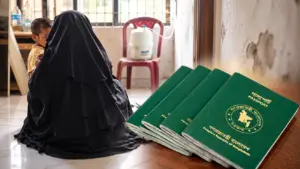
Going abroad carried the dream of changing their family’s fortunes. However, after falling victim to abuse, fraud or unwanted pregnancies and returning home with children, these women face another difficult battle. Alongside the negative attitudes of family, relatives and society, they encounter various hurdles when attempting to register their children’s births. And without a birth registration certificate, many of these children are unable to enrol in school.
Although the law allows for the birth registration of children without an identified father, complications frequently arise at the local level in practice. In some places, the father’s NID or name is demanded. Elsewhere, applications stall because local officials lack clarity regarding the process. Thus, a father’s identity—which has no bearing on the fact of a child’s birth—becomes a major barrier to receiving education, social recognition and future civic rights.
Monica (not her real name), a returnee from Jordan, is one such case. Her daughter is now eight years old, yet her birth remains unregistered. Because she lacks a birth registration certificate, Monica was unable to enrol her daughter in a government primary school. Monica herself missed out on an education due to poverty, making her all the more determined to educate her daughter by any means necessary. Ultimately, she was forced to enrol her in a local madrasa (Islamic school).
Monica’s father, whose name has also been changed to protect the family’s identity, said that he approached the local Union Parishad Chairman, Zahid, several times to get his granddaughter’s birth registered. However, he was told: “The father’s name is required for birth registration. Do you want me to get sued?”
Yet, under the provisions of the Local Government Division regarding birth and death registration, there is explicit allowance for registering individuals without paternal identity, maternal identity or any known parentage. Section 3 of the Birth and Death Registration Act, 2004 dictates that no person’s birth or death registration may be rejected due to missing information stemming from being an orphan, disabled, transgender, lacking paternal or maternal identity, unidentified, nomadic (Bede), vagrant, street-dwelling, homeless or a sex worker. Where information is unavailable, the word “Unavailable” must be recorded to complete the registration.
Samiul Islam Rahad, Assistant Registrar General (Law & Research) for Birth and Death Registration under the Local Government Division, clarified that a father’s identity is not required to register the birth of children born to returned migrant female workers. The application can be processed through the Union Parishad official.
In his words: “Should a child suffer their entire life just because there is no paternal identity? That cannot be allowed.” He added that Union Parishads in every sub-district (Upazila) across the country have received training on this matter. Acknowledging that problems persist nonetheless, he assured that steps are being taken to address them swiftly.
Mohammad Zahirun Rahman Sourav, Chairman of Singair Union Parishad, also acknowledged that the law permits birth registration for children without a named father or known paternal identity. However, he emphasised that the process needs to be further simplified. He noted that some individuals acting as birth registrars misinterpret the law and regulations, creating unnecessary obstacles.
Returning Home as Victims of Abuse
Monica’s life story is harrowing. At just 16 years old, she went to Jordan to work as a domestic worker with hopes of a better future. Kashem, a sub-agent from the Singair area, and Ayesha, a sub-agent from Dhalabasta village in the Dhalla Union, arranged her deployment through a recruiting agency. Her family was charged 10,000 BDT (€70) for training in Dhaka and processing her trip abroad.
Upon her arrival in Jordan, her employer confiscated her passport. In addition to performing domestic chores, she suffered sexual abuse for nearly three months at the hands of her employer and other male family members. Unable to speak the language and knowing no one, she had no way to contact her family. Although she received a monthly wage of 30,000 BDT (€210), she did not know how to send money back home to Bangladesh, accumulating 90,000 BDT (€630) over three months.
At one point, while taking out the trash, she met a Bangladeshi woman named Sonia. Learning that they were from the same region, Monica trusted her. But danger followed: according to Monica, Sonia took her money and brought her to a brothel, where she was forced into sex work and beaten whenever she resisted.
Months later, Monica realised she was pregnant. Even after falling ill, the abuse did not stop. Nearly a year later, her father, Tara Mia—not his real name—tracked her down. He demanded the return of the money from Sonia’s family, but it was never returned. Instead, her family alleges that because Monica was pregnant and unable to work, she was handed over to the police. Six months pregnant, she returned to Bangladesh empty-handed in 2018 on an outpass. A few months later, she gave birth to a daughter.
Monica’s ordeal did not end upon her return. She endured relentless public humiliation, psychological abuse and social ostracisation from her family and community. Al Amin, Case Management Specialist for BRAC’s Migration Program, shared that at one point, overwhelmed by severe mental distress, Monica attempted suicide. She was provided with psychosocial counselling and brought to the Ahsania Mission Mother and Child Safe Home in Dhaka for childbirth, where her daughter was born. Later in 2018, an initiative by BRAC and Leathergoods provided a grant of 100,000 BDT (€700) each to 22 women, including Monica. Her father used the funds to purchase a van.
According to BRAC data, between 2018 and June 2026, the organisation supported only eight migrant women workers who returned home pregnant or with a child.
Hundreds of Thousands Abroad, But No Records on High-Risk Motherhood
Data from the Bureau of Manpower, Employment and Training (BMET) shows that between April 10, 2023, and September 14, 2026, a total of 218,185 female workers migrated to 10 key destination countries. This includes 49,611 in 2023 (from April 10), 61,150 in 2024, 62,365 in 2025 and 45,059 in 2026 (up to September 14).
Among these destinations, Saudi Arabia received the largest share—145,189 female workers. Jordan received 40,906. The other destinations were Qatar, with 6,537; the United Kingdom, 6,484; Oman, 4,385; the United Arab Emirates, 3,927; Kuwait, 1,875; Lebanon, 1,597; Hong Kong, 975; and Brunei, 936.
Despite these numbers, there is no comprehensive government data tracking how many of these women return home pregnant or with children.
Policies Exist, but Implementation Suffers From Data Gaps
Various government policies and projects offer financial and social assistance to migrant women who return with children or give birth abroad. However, stakeholders point out that significant gaps remain between policy and practice regarding the rehabilitation of returning single mothers, legal guardianship of their children and social recognition.
Md. Shafayat Mahbub Chowdhury, Joint Secretary at the Ministry of Expatriates’ Welfare and Overseas Employment, stated that if a returned mother reports being unable to register her child’s birth, the ministry will issue recommendations to the relevant authorities. He added that Monica missed out on financial assistance because she lacked membership in the Wage Earners’ Welfare Board. Before going abroad, workers can obtain board membership for a fee of 3,500 BDT, enabling victims to claim financial support upon returning under specific conditions.
Md. Asaduzzaman, Director General (Additional Secretary) of the Wage Earners’ Welfare Board, noted that the “RAISE” project exists specifically for affected returnee female workers. Operating from July 1, 2021, to March 31, 2027, the project has so far provided 13,500 BDT each to 20,000 female workers out of 253,000 beneficiaries. Monica had not applied for this assistance, and her family was unaware that compensation could be requested. Given her physical and mental distress, she was in no position to navigate the application process.
Without Birth Registration, the Path to Education Stalls
Bobi Hajjaj, State Minister for Primary and Mass Education, stressed that birth registration is mandatory for school enrolment, as it serves as a crucial legal document for every child. Therefore, those in authority must urgently ensure that birth registration facilities are accessible. He added that if specific issues are submitted in writing, he will discuss them with the relevant authorities to seek solutions.
Afzal Kabir Khan, Manager of Child Labor Elimination and Child Rights Protection at Educo Bangladesh, emphasised that every child has a fundamental right to birth registration. However, using terms such as “Unknown” or substituting alternative details in place of a father’s identity remains complex for many people to navigate, leaving children deprived of their rights because of information gaps.
In his view, birth registration is vital for ensuring that children of female migrant workers can attend school, obtain National ID (NID) cards in the future and exercise their civic rights. Therefore, coordinated action between government and non-governmental bodies is essential.
Monica’s daughter is now eight years old—a time that should be spent learning letters at a school desk. Yet, for lack of a birth registration certificate, that path remains blocked.
Where the law explicitly provides for registering births without a paternal identity, why must a child wait for a father’s name in reality? Answering this question is urgent. The violence and stigma experienced by women returning after abuse abroad must not be transferred to their children. Ensuring that a lack of paternal identity does not halt a child’s birth registration, education and future is the duty of the state, society and all relevant institutions.
Read the full story at the source
Source: Pressenza