
World · Pressenza · · 2h
Bangladesh’s hilsa trade raises questions over prices, imports and accountability
English (original) · Read in Deutsch ⇄
Asif Showkat Kallol (Dhaka Bureau)
Hilsa is Bangladesh’s national fish and one of the most recognisable symbols of its rivers. Yet this year, the country that produces most of the world’s hilsa has been importing the fish from India – even as Indian consumers wait for Bangladesh’s prized Padma hilsa ahead of the Durga Puja festival.
The reversal has raised questions about supply, prices, regulation and the accountability of government agencies.
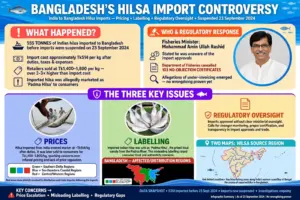
In July, about 29,000kg of hilsa entered Bangladesh through the Benapole border from India. Imports increased sharply in August, reaching about 323,000kg. Before the suspension of imports, a total of roughly 535 tonnes had entered the country, against an annual approved volume of 1,739 tonnes.
Much of the imported fish reportedly came from the Narmada estuary near Bharuch in Gujarat, around 1,500km from Bangladesh.
The explanation offered by traders is straightforward: domestic hilsa production has been falling while demand remains strong. Production declined by more than 12% over two years, according to figures cited in the sector, falling to around 500,000 tonnes. Overfishing, jatka fishing, pollution and weak enforcement of seasonal restrictions have all contributed to pressure on hilsa stocks.
The recent rise in diesel prices has added to fishermen’s costs, with the price increasing by Tk20 a litre. Importers argue that bringing in hilsa from India helped prevent further increases in domestic prices.
But the economics of the imported fish raise a different question.
According to figures cited by traders, one consignment had a letter-of-credit price of about Tk252 a kilogram. After duties of roughly Tk162 and around Tk100 in transport and other costs, the estimated landed cost came to about Tk514 a kilogram.
Yet imported hilsa has reportedly been sold in Dhaka markets for Tk1,400 to Tk1,800 a kilogram, with some fish allegedly being marketed as Padma hilsa at even higher prices.
The gap has prompted questions about who captures the additional margin and whether consumers are being misled.
There have also been allegations of mislabelling. In July, about 360kg of hilsa was reportedly intercepted at Benapole after being described in paperwork as ‘white fish’. Importers have argued that they cannot control how retailers label fish once it leaves the port.
That leaves a basic question for regulators: who is responsible for ensuring that consumers know what they are buying?
The controversy deepened in September when fisheries minister Mohammad Amin Ullah Rashid told the Pressenza.com he had not been aware that the imports had been authorised. He subsequently sought an explanation.
On 22 September, the acting director general of the Department of Fisheries cancelled 103 no-objection certificates linked to the imports. From the following morning, no new hilsa consignments entered through Benapole.
The department did not publicly provide a detailed explanation for the decision.
Several theories have circulated in the trading community, including concerns over mislabelling, pressure on domestic hilsa stocks and possible under-invoicing. Some consignments have reportedly declared hilsa prices as low as 48 US cents a kilogram, or roughly Tk60.
Such figures naturally raise questions about whether the declared import value accurately reflects the transaction. But allegations of under-invoicing or money laundering remain unproven, and no criminal case has been established on the basis of those claims.
The larger concern is institutional: how could a major import policy affecting one of Bangladesh’s most politically and culturally sensitive food products be implemented without the fisheries minister appearing to know about it?
The controversy is unfolding just weeks before Durga Puja, when demand for Bangladeshi hilsa traditionally rises in India, particularly in West Bengal.
Eighteen Bangladeshi companies have reportedly sought permission to export hilsa to India this year, although no final decision had been announced at the time of writing.
The longer-term issue, however, is not trade with India. It is the survival of Bangladesh’s own hilsa stocks.
A 22-day nationwide fishing ban is scheduled from 8 to 29 October during the peak breeding period. Effective enforcement will be critical if the country is to rebuild its hilsa population.
For consumers, identifying the origin of a fish is difficult. Traders and experienced buyers often say Padma hilsa tends to be shorter and broader, while some imported varieties are longer and slimmer. Texture, fat content and aroma after cooking are also commonly used as indicators, but none provides a foolproof test.
The hilsa controversy ultimately exposes a wider problem. A fish that can sell for Tk252 at the border and Tk1,800 in Dhaka is not simply a story about supply and demand. It is also a story about regulation, market transparency, fisheries management and consumer protection.
Bangladesh may import hilsa when domestic supplies are tight. It may also export hilsa when stocks permit. But neither policy will solve the underlying problem unless the country’s rivers and breeding grounds are protected.
The question is no longer simply where the hilsa comes from. It is whether Bangladesh can protect the fish that has made its rivers famous- and ensure that consumers are not paying a premium for a story that the market cannot prove.
 Asif Showkat Kallol:
Asif Showkat Kallol is the Head of News at Mirror Asia and a contributor to Pressenza. Mirror Asia is an online newspaper based in Bonn, Germany. A journalist with more than 25 years of experience, Kallol has worked for several leading English-language newspapers in Bangladesh, including New Age, Dhaka Tribune, The Daily Sun, and The Business Standard. He has a particular interest in Indigenous cultures and regularly writes about business and economic issues for local and international newspapers.
Asif Showkat Kallol:
Asif Showkat Kallol is the Head of News at Mirror Asia and a contributor to Pressenza. Mirror Asia is an online newspaper based in Bonn, Germany. A journalist with more than 25 years of experience, Kallol has worked for several leading English-language newspapers in Bangladesh, including New Age, Dhaka Tribune, The Daily Sun, and The Business Standard. He has a particular interest in Indigenous cultures and regularly writes about business and economic issues for local and international newspapers.
Asif Showkat Kallol:
Asif Showkat Kallol is the Head of News at Mirror Asia and a contributor to Pressenza. Mirror Asia is an online newspaper based in Bonn, Germany. A journalist with more than 25 years of experience, Kallol has worked for several leading English-language newspapers in Bangladesh, including New Age, Dhaka Tribune, The Daily Sun, and The Business Standard. He has a particular interest in Indigenous cultures and regularly writes about business and economic issues for local and international newspapers.
Read the full story at the source
Source: Pressenza