
World · Pressenza · · 2h
António Guterres proposed refocusing peacekeepers on their primary function: preserving a peace
English (original) · Read in Deutsch ⇄
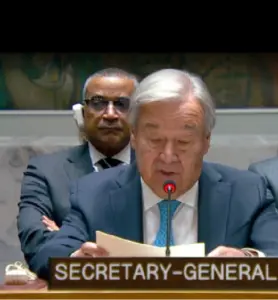
You cannot keep a peace that does not exist, stated the Secretary-General addressing the Security Counciul on Friday.
Faced with more numerous and complex wars, divisions among major powers, and shrinking resources, UN peacekeeping operations need a change in doctrine. Yesterday, António Guterres proposed refocusing peacekeepers on their primary function: preserving a peace that has already been negotiated, rather than indefinitely containing conflicts that no one manages to stop.
You cannot keep a peace that does not exist. Addressing the Security Council on Friday, the UN chief advocated for an overhaul of United Nations peacekeeping operations—one based less on the shortcomings of the peacekeepers themselves and more on the failings of those who mandate them. For nearly ten years, I have seen what UN peacekeepers can achieve when the Security Council stands united behind them—and what they endure when it is divided, the Secretary-General stated. “We do not lack tools. What we lack, all too often, is the political space to use them.
The report he presented describes an environment vastly different from the one in which the modern model of peacekeeping took shape.
Not since 1945 has the world seen so many conflicts. Combat fatalities over the past five years exceed the total recorded in the twenty years leading up to 2021. Between 2024 and 2025, the number of inter-state conflicts doubled. Roughly half of all internal wars now have an international dimension.
For three decades, the prevailing model involved deploying peacekeepers to support the implementation of a peace agreement following a civil war. Yet such agreements have become increasingly rare. Consequently, some missions find themselves tasked not with preserving a fragile peace, but with containing an ongoing war—sometimes one fueled by external actors.
At the same time, the nature of the battlefield has shifted. Drones, cyberattacks, autonomous weapons systems, and AI-driven disinformation now exist alongside missions facing shrinking budgets and personnel cuts. Peacekeepers themselves are being targeted, as are the very populations they are mandated to protect.
This leads to Mr. Guterres’s clearest proposal: a peacekeeping operation should be deployed only when a peace agreement—or at the very least, a “solid ceasefire”—is already in place. Peacekeeping must support a political solution, not replace it. In short, he argues, before peace can be kept, it must first be made. This entails prioritizing diplomacy at an early stage. The Secretary-General calls on the Council to make greater use of the tools already at its disposal: investigating disputes, visiting the countries concerned, establishing a shared understanding of the facts, and employing good offices, envoys, and political missions. Not every crisis requires a new operation, he insists, but all demand a political strategy.
Fundamentally, the reform seeks as much to redefine peacekeeping as to acknowledge its limitations. No mandate, no budget, and no technology, the UN chief warned, can replace the unity of the Security Council.
The Canadian Armed Force announced their withdraw from peacekeepers with the United Nations Mission in Africa
On July 17, the Canadian Armed Forces (CAF) announced they were withdrawing most of their peacekeepers from Africa to focus on other regions.
These changes will better align CAF resources with current defence priorities, including the defence of Canada, support for the Euro-Atlantic region, and contributions to stability in the Indo-Pacific, the Armed Forces stated in a press release.
The military plans to withdraw all nine peacekeepers deployed with the United Nations Mission in South Sudan, as well as the same number of soldiers participating in a UN stabilization mission in the Congo.
Canada is also scaling back its peacekeeping operation in the border zone between Egypt and Israel, reducing its contingent from 40 to 10 Armed Forces members. It is bringing home the five peacekeepers currently in Kosovo and the single officer stationed in Cyprus.
This decision has drawn criticism from former Foreign Affairs Minister Lloyd Axworthy, Canada’s former ambassador to the United Nations, Bob Rae and from various Canadian peace organization.
On July 17, the Canadian Armed Forces (CAF) announced that they were withdrawing most of their peacekeepers from Africa to focus on other regions.
“These changes will better align CAF resources with current defence priorities, including the defence of Canada, support for the Euro-Atlantic region, and contributions to stability in the Indo-Pacific,” the Armed Forces stated in a press release.
It is worth recalling that Lester B. Pearson, in his role as Canada’s foreign minister, played a pivotal role in the diplomatic efforts to resolve the Suez Crisis of 1956–57 and in establishing the first-ever UN peacekeeping operation—the UN Emergency Force (UNEF). Indeed, Pearson was awarded the Nobel Peace Prize following the creation of UN peacekeeping missions.
_______________________________________________________________________________________
Source: UN News and Journal La Presse
Read the full story at the source
Source: Pressenza