
Anti-fascism Perspektive Online
Between terror, streets and parliament: The fascist movement today
In 2011 the NSU was exposed. But the fascist movement has not disappeared since then - on the contrary. It has expanded its structures, anchored itself in parliament and has an extensive network
Deutsch (original) ·Auto-translated to English
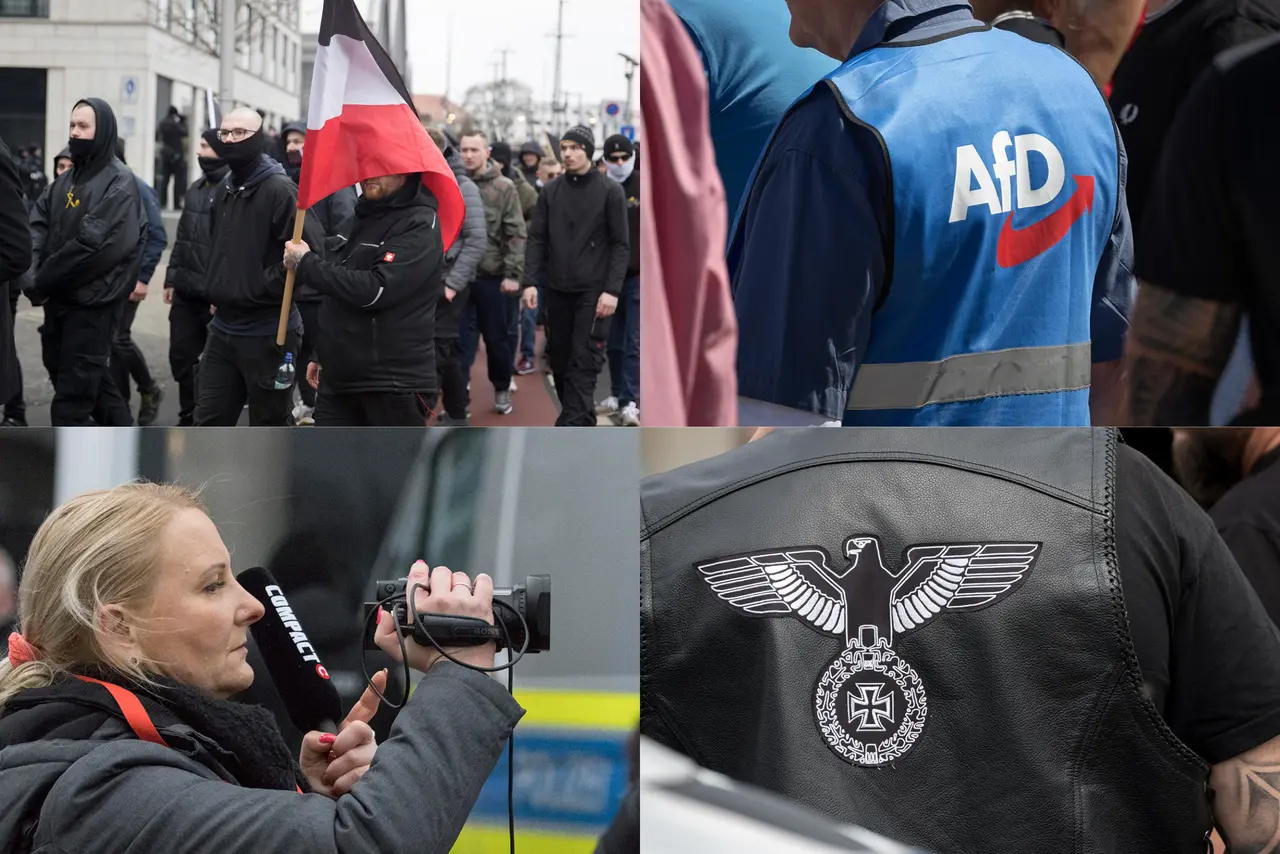
In 2011 the NSU was exposed. But the fascist movement has not disappeared since then - on the contrary. It has expanded its structures, anchored itself in parliament and created an extensive network of media, think tanks and political organizations. – A comment from Yuri Dolan.
Wednesday marked the 15th anniversary of the unmasking of the National Socialist Underground (NSU). In the 2000s, the neo-Nazi terrorist group committed a series of racist murders that killed at least ten people and injured many other people. Over the years it became known that the Office for the Protection of the Constitution kept information about the NSU secret for years and that its informants allegedly supported the group.
For many parts of the population, the NSU exposure was a shock at the time: it was unthinkable for many that such racist murder attacks would ever occur again in the Federal Republic of Germany, which had learned so much from its past - especially those in which the security authorities were so closely involved. But the NSU was not an isolated case. Since 2011, right-wing terror has by no means disappeared, but has been followed by a large number of other deadly attacks.
NSU: The entanglements of the security authorities and the prevention of clarification
What has remained unchanged since the NSU terror is the complicity of the security authorities. For example, the Ministry of the Interior20 yearsused to ban the right-wing terrorist organization Combat 18 (Adolf Hitler Combat Group). This is the armed wing of the fascist network Blood and Honor, which was banned 20 years ago. Combat 18 was co-founded and continued after Blood and Honor was banned by Stephan Lange, an undercover agent for the Office for the Protection of the Constitution. Both groups had close ties to the NSU. TheLKA ThuringiaThe NSU trio was part of the “hard core of the Blood and Honor movement”.
Fascist movement on the rise
After the NSU was exposed, fascist forces in Germany gained more and more momentum: in October 2012, the Identitarian Movement (IB) was founded in October 2012 in response to the book “Germany is abolishing itself” by Thilo Sarrazin - a German offshoot of the French Génération identitaire. The IB consists of various, loosely affiliated groups with the common goal of “purifying” Western cultures.
In the course of the popularization of the new right ideology by Thilo Sarrazin, the actions of the IB and the breakthrough of the AfD, the fascist movement was increasingly able to carry out active mass work. A first milestone was the start of the Pegida demonstrations (short for Patriotic Europeans against the Islamization of the West) in Dresden in October 2014, which were driven primarily by AfD members, the IB, militant neo-Nazis and other fascist activists.
Within a few weeks, the Pegida movement spread to West Germany and at times included tens of thousands of participants. Offshoots formed in various cities - including the "funeral marches" in Chemnitz in late summer 2018. They were triggered by the murder of a 35-year-old man on the sidelines of a city festival in Chemnitz, whereupon neo-Nazis, especially from the ranks of the Autonomous Nationalists, staged pogromsAttacksagainst migrants, members of the press and Jewish restaurants.
The delusion of an alleged “Islamization” of Germany, promoted by the Pegida movement, was widely taken up and reproduced in the bourgeois media, from which the AfD particularly benefited. In this way, fascist forces were able to successfully anchor themselves in the parliamentarism of the Federal Republic of Germany for the first time.
The underground of today
The subsoil has not disappeared, but it has been renewed and rejuvenated. It was only on August 5th that the Hanseatic Higher Regional Court sentenced seven members and one supporter of the terrorist group Last Defense Wave to prison terms of between one and a half and five years. According to investigations, the group was founded in April 2024.
Among other things, the arson attack on a cultural center in Altdöbern, Brandenburg, in October 2024 is attributed to her. The building burned down completely, but by chance no one was injured. Attacks on inhabited asylum accommodations in Schmölln and Senftenberg in January 2025 failed or were prevented by arrests. The youngest defendant was 14 years old when the trial began. The group spread the “great exchange” conspiracy narrative. At the end of June, the police in Thuringia arrested two more young people as suspected members.
TheConstitutional protection report2025 paints a picture of a growing scene. The “right-wing extremist potential” rose to 58,700 people, after 50,250 in the previous year. Around 15,600 followers are considered violent, and with over 25,600 “right-wing extremist crimes” there were more than 100 per day.
Fly again and againEntanglements of the German armed forcessuch as the police or the Bundeswehr in right-wing extremist terrorist groups such as Uniter e.V. The association, founded in May 2016, consisted primarily of active or former soldiers and reservists from the Bundeswehr's elite unit, the Special Forces Command (KSK). Their goal was to prepare for a fascist takeover, or as they call it “Day X”. The association's co-founder and former board member was also an employee of the Baden-Württemberg State Office for the Protection of the Constitution.
The KSK in particular seems to have a soft spot for right-wing shadow armies like thisDiscovery of numerous terrorist cellswithin the so-called cross network. For example, a group around Lieutenant Franco A. is said to have planned specific attacks on politicians and anti-racist activists. Another terror cell, at the center of which was the criminal inspector and AfD politician Haik J. and the lawyer and former FDP politician Jan-Hendrik H., is said to have created a death list with more than 5,000 names, which included public officials, journalists and around a hundred politicians.
Political and militant struggle on the streets
There are other groups on the street that can be assigned to the fascist movement. These are often founded and led by militant neo-Nazis. However, their sympathizers include not only neo-Nazis, but also a large collection of conspiracy theorists, separatists and anti-vaxxers. The latter were particularly able to win over the “Free Saxons” during the corona pandemic. The right-wing extremist state party was founded in 2021 by neo-Nazis and former officials of the Die Heimat party - the successor party to the NPD - in Schwarzenberg, Saxony. She was able to attract numerous people, especially with topics that have a high potential for outrage among the population - such as Corona measures, the war in Ukraine or climate policybring to the streets.
One of the more militant groups is the III. Way that for a whole seriesracist attacksresponsible for migrants. The neo-Nazi small party, which was founded in 2013 by former NPD officials in Heidelberg, Baden-Württemberg and is particularly noticeable for its pseudo-socialist appearance, strives for a so-called “German socialism” beyond communism and capitalism - hence the name III. Away. But even a cursory look at its party program reveals that the party has nothing in common with socialism. At one point, for example, the “peaceful restoration of Germany as a whole within its international borders” is called for. This includes, among other things, Polish and Russian areas that were once within the borders of the German Empire.
Militant groups like the III also look after their fascist offspring. Way: Young people should be addressed directly through action-oriented sports and leisure activities or social media appearances. They are then radicalized through martial arts training, graffiti campaigns or excursions and enter the fascist scene, which keeps itself alive through cultural offerings such as right-wing rock concerts and martial arts events and recruits more people.
Through these scene offerings, groups like the National Revolutionary Youth (NRJ) – a youth group of the III. Wegs – an arsenal of violent young people, whereby they aim for long-term anchoring in broader society. Supporters of youth groups like the NRJ or other groups practice again and againAttacks on anti-fascists, queer people and migrants, mob on the sidelines of anti-fascist demonstrations or organizeNazi marches against the CSD.
The reconstruction of a parliamentary arm
While for a long time the fascist scene was mainly organized on the streets and underground, today its arms extend into the depths of parliamentarism, which is particularly illustrated by the current success of the Alternative for Germany (AfD). But the AfD's success did not suddenly fall from heaven, but instead follows a series of failed attempts to establish a fascist party. Since the 1990s, various parties - including the Republicans (REP) and the NPD - have had brief moments of success, but they were unable to convert them into building a mass party.
After a machete attack: Hundreds demonstrate in Berlin against fascist violence
It was only with the AfD that fascists managed to firmly anchor themselves in parliaments. It owed its initial success primarily to the European sovereign debt crisis from 2011 onwards - which developed as a result of the global economic crisis of 2008/2009. At the time of the party's founding in 2013, Germany, together with other northern European nations, implemented a rigid austerity policy against southern Europe, which above all enabled German capital to gain increased power and competitive advantages.
But there remained a minority within German capital and bourgeois circles that had little economic interest in doing business with southern Europe and instead advocated for an exit from the Eurozone. Accompanied by a chauvinistic smear campaign against “lazy southern Europeans” by the Axel Springer publishing house, a newly foundedAnti-Euro partyimmediately gained popularity, whereupon reactionary and right-wing extremist forces in particular joined the party.
Over the years, the AfD gained more and more popularity: on the one hand, it was able to win over representatives and supporters of German capital through its West German, neoliberal wing around Alice Weidel, while on the other hand, with its East German, ethnic wing around Björn Höcke, it mainly convinced reactionary and fascist forces. Although one could once speak of a more neoliberal party with a fascist wing, today it is more likely to be categorized as a fascist party, as the dividing line between the two wings has now become significantly blurred.
However, the AfD's fascist tendencies are embodied not only by the ideological positions of some party members, but also by their involvement with extra-parliamentary groups, which means that the AfD has a broad fascist network. For example, Generation Germany – the youth organization of the AfD – has direct contacts and personnel overlaps with the Identitarian Movement.
“Metapolitics”: Cultural revolution through ideological training
It was only through a strong propaganda apparatus, consisting of media platforms, think tanks and publishers, that the AfD was able to win over so many people as voters - especially workers and other people whose material interests are actually diametrically opposed to those of the AfD.
The Institute for State Policy (IfS), which was founded by Götz Kubitschek and Karlheinz Weißmann in May 2000 in Schnellroda, Thuringia, played an important role in the ideological and theoretical anchoring of fascist ideas.Goal of the IfSAccording to Weißmann, it was to offer “intellectual orientation” and “influence people’s minds”: “And if the heads sit on the shoulders of those in power and elected officials, all the better.”
The fact that this goal has been put into practice is demonstrated in particular by the more than 5,000 people who have taken part in conferences, seminars and congresses at the IfS since 2000 and received ideological training. Numerous AfD decision-makers have already given lectures in Schnellroda, including Björn Höcke, Jörg Meuthen, Alice Weidel and Alexander Gauland. The head of the neo-Nazi Identitarian Movement, Martin Sellner, also lived in the cadre factory for several months - or, as Höcke calls it: “oasis of intellectual regeneration”. After 24 years, the IfS, which the Federal Office for the Protection of the Constitution classified as “safe right-wing extremist,” has officially dissolved, apparently in order to relieve itself of state repressive pressure. However, the IfS projects have been running since thenunder other namesfurther.
One of these other names is the Antaios publishing house, headed by IfS founder Kubitschek, which, with its headquarters right next to the IfS in Schnellroda, is not only ideologically but also geographically close to the think tank. Another project that is being continued from the Institute for State Politics is the new right-wing magazine Sezession, which was published by the associated Association for State Politics until the IfS was dissolved. Today the publisher Metapolitik is behind the magazine, represented by Erik Lehnert, who ran the association together with Kubitschek.
The fact that the publishing house is called “Metapolitik” is no coincidence. Lehnert, Kubitschek and Co. understand the concept coined by the French New Right to mean the strategy of “cultural revolution from the right” – which is based on the work on cultural hegemony of the Italian Marxist Antonio Gramsci. Metapolitics is not only about parliamentary anchoring, but also about the conquest of the “pre-political space” – that is, the ideological and cultural space. In the long term, this should fundamentally change the morals and values of the masses.
But the New Right's fight for cultural hegemony cannot be won simply by developing a theoretical and strategic construct. Rather, it is dependent on financing from capital, which creates the material conditions for mass work in the first place - be it through publishing magazines, running publishing houses or establishing political networks.
In addition to think tanks and publishing houses, the fascist movement's media empire also includes its own media platforms, which are specifically used to spread right-wing ideologies and influence public opinion. These include the magazine Compact, the campaign portal One Percent, the newspaper Junge Freiheit and the online portal Nius. They address current social debates, spread right-wing narratives and are increasingly pushing the boundaries of what can be said publicly. In this way, they contribute to normalizing fascist positions in society and expanding the movement's influence beyond parliaments and the streets.
Journalism in Germany is increasingly threatened by fascist and state attacks
Important donors in the background
The entrepreneur Frank Gotthardt, founder of the software company CompuGroup Medical, plays a central role. Through his investment company, he finances the Nius portal run by Julian Reichelt and has already invested tens of millions of euros in the project. This means that Nius has strong financial backing from entrepreneurship, which enables the long-term expansion of the right-wing media platform.
Other capitalists such as the banker August von Finck junior (1930–2021) also play an important role in financing fascist forces. He not only donated over 11 million euros to the FDP and the CSU, but also financed the AfD's various precursor projects such as the Republicans and the Association of Free Citizens. In 2021, for example, it became known that the right-wing networker Tom Rohrböck - who sees himself as a "mercenary" at the interface of "brown hordes, motorcycle-riding boys and former military men" - the AfD and important representativesNetwork of front companies and media organssupplied with money from Finck and other capitalists. More than half of the AfD parliamentary group is said to have been in contact with him.
Klaus-Michael Kühne and the Nazi assets of major German corporations
In recent years, tech billionaires have also flirted more and more openly with right-wing ideology and have blessed its advocates with small sums, especially Palantir co-founder Peter Thiel, for whom democracy and freedom are “incompatible”. But although “democracy” and “freedom” are repeatedly celebrated as inviolable fetish objects by the bourgeois press, Thiel himself received this year’s “Axel Springer Award” from Springer CEO Martin Döpfner – as the successor to OpenAI CEO Sam Altman. But the relationship between Döpfner and Thiel is not one-sided. According to research by Manager Magazine, Thiel is said to have invested $50 million in a fund run by Moritz Döpfner, the son of Martin Döpfner.
How the levels intertwine
How closely the neo-Nazi scene is intertwined with the parliamentary arm and other structures can be seen, among other things, in the overlapping personnel: In the environment of Ulrich Siegmund, who led the AfD in Saxony-Anhalt to the best result in its history in a state election at the beginning of September with 43.8 percent, there are several former active members of the Heimattreuen Deutschen Jugend (HDJ). The organization was banned in 2009 because of its proximity to National Socialism. AfD campaign manager Patrick Harr was a member there and Laurens Nothdurft, now general counsel for the AfD state parliamentary group, was second federal leader of the HDJ from 1999 and was responsible for its members' magazine.
The Potsdam meeting in November 2023, which Correctiv made public in January 2024, shows that this is not an isolated case. AfD politicians, neo-Nazis, entrepreneurs and two CDU members sat together there when IB leader Martin Sellner presented his concept of “remigration”. Gernot Mörig, former federal leader of the Homeland Loyal Youth Association, invited the event. The threads from the HDJ successor to the round table with the AfD ran through the same people.
The border with the banned neo-Nazi scene is also permeable: at the end of August, the police in five federal states searched the homes of suspected supporters of the banned art community. These included two AfD candidates for the state elections in Saxony-Anhalt, a good week and a half before the election. And Birgit Malsack-Winkemann, a former AfD member of the Bundestag and former judge, is also in the dock in the Frankfurt Reuss trial. The Federal Prosecutor's Office accuses the defendants of membership in a terrorist organization that is said to have planned a violent coup.
A movement on all levels
The developments since the NSU was exposed show that the fascist movement in Germany has changed and its structures have continued to expand. What used to be organized primarily underground and in militant neo-Nazi networks is now also present on the streets, in parliaments and in the media and cultural space.
The different levels intertwine: While militant groups cause intimidation and violence, parties like the AfD give the movement parliamentary influence. Media, publishers and think tanks, in turn, help spread and normalize their ideology across society. These structures are partly supported and financed by influential circles of capital.
The NSU was by no means a closed chapter in German history. Rather, the development of the past 15 years shows how the fascist movement has reorganized itself and now operates on a much broader basis.
The postBetween terror, streets and parliament: The fascist movement todayappeared firstperspective.