
Politics · Perspektive Online · · 3h
Social protests: tame DGB leadership, militant base
Deutsch (original) · Auto-translated to English
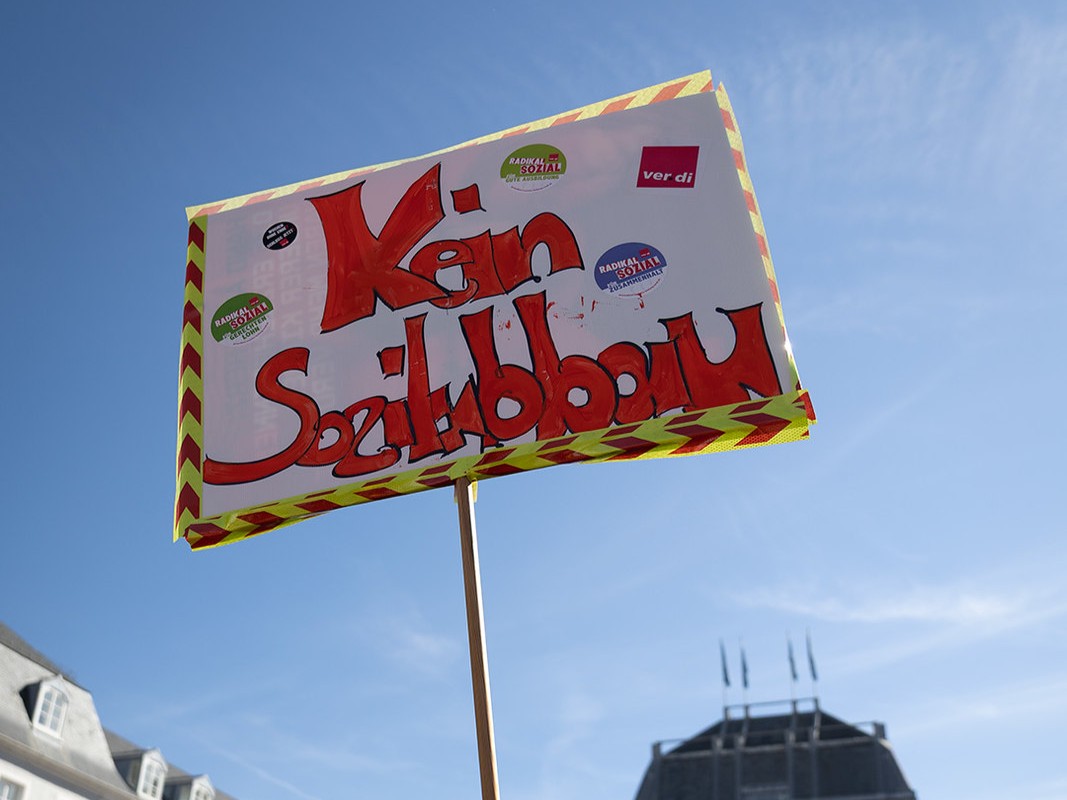
With 175,000 participants, the protest against the austerity policy was the largest of its kind to date. However, the DGB leadership still did not say that rearmament and social cuts were linked. A commentary on tame speeches and the need to keep fighting - by Alexandra Baer.
On Saturday, the German Federation of Trade Unions (DGB) called for the largest social protests to date since Chancellor Merz began the new wave of cuts. According to theDGBtook part to protest against the federal government's current austerity policy. The DGB called for it under the motto "Hard earned! Your work. Your health. Your pension." Overall, significantly more people took part in the protests than in June, when the first protests began. Around 4,000 people took to the streets there. At that time, the call was mainly made by the Left Party under the motto “It's enough!”, which also took part in the protest on Saturday.
Start of the protests: The fight against austerity policies has begun in several cities
The 15 demonstrations nationwide were primarily characterized by the flags of the DGB unions. Social associations such as Diakonie, Lebenshilfe, the German Paritätische Wohlfahrtsverband and Attac also took part in the demonstrations. In addition to various socialist organizations, members of the SPD and Alliance 90/The Greens were also represented at the demonstrations. This caused a lack of understanding among some participants, as these parties are involved in governments at the federal and state levels that support or implement the cuts criticized by the demonstrators.
Largest demonstration in Frankfurt, Berlin smaller than average
With over 30,000 participants, the largest took place in Frankfurtdemonstrationinstead of. While the head of the demonstration reached the final rally site, thousands were still waiting at the beginning site to be able to march through downtown Frankfurt to Opernplatz. A good 20,000 people demonstrated in Nuremberg, 18,000 in Essen and 16,000 in Stuttgart. However, the protest in the capital was rather small: According to the DGB, only around 12,000 people took part in the protest, while in Germany's second largest city, Hamburg, there were 13,000 people on the streets. 8,000 people were mobilized in Leipzig - the same number as in Saarbrücken and Bremen - and 4,000 people in Erfurt.
Mobilization was particularly successful in West Germany. In the Ruhr region, the DGB mobilized and organized forces from the entire region to Essen, which explains the above-average number of participants. In East Germany, however, the number of participants was somewhat lower, although Berlin in particular must have disappointed the organizations involved. After all, more than twice as many people were won over to protest against the cuts in Frankfurt than in the capital. However, dissatisfaction with current politics is particularly high in East Germany in particular, which was shown, among other things, in the election results of the state elections in Saxony-Anhalt and Mecklenburg-Western Pomerania, but also the election for the Red City Hall in Berlin, where the CDU and SPD lost.
The findings of the election results from Berlin and Mecklenburg-Western Pomerania
Cuts and upgrades – different topics? No.
At the protest on Saturday, the DGB leadership primarily demanded the preservation of the pension without deductions after 45 years of contributions as well as solidarity-based financing of the welfare state. Overall, however, the tone of many speeches remained moderate. The influencerHoney Balectasummarizes his observations from Nuremberg as follows: Essentially, the DGB leadership is demanding that the government make better reforms.
However, other forces sometimes went beyond these demands. In some cities, the DGB youth's speeches, for example, discussed the planned conscription, had a much more combative tone.
The DGB leadership, however, did not make the connection between the current militarization and rearmament in Germany and the austerity policy - although this contradiction is obvious. After all, by 2027 one in three euros in the German budget will be spent on the military, while cuts will be made in almost all other areas.
Budget draft for 2027: Almost one in three euros for armaments and cuts in climate and social issues
This perspective was mainly carried into the social protests by anti-capitalist or socialist forces. After the young people showed on Friday that they are by no means prepared to go to war for German interests, the German Communist Party (DKP) emphasized that they had to“capable of striking instead of capable of war”and counteract the social cuts. The Federation of Class Struggle Organizations also emphasizes in itscallas of September 26th, the cause of the cuts was the federal government's rearmament program.
DGB or SPD protests?
The DGB leadership also remained largely true to its social partnership line in speeches: District head of IG Metall Jörg Köhlinger appealed to the responsibility of employers and emphasized that we had to “pull the cart out of the mud together”.
There is also criticism - rightly - that among the speakers there were some DGB officials who are also SPD members themselves. In fact, of the 70 people who were given a speech at the social protests across Germany, at least 23 were officially known party members and 19 of them are part of theSPD– i.e. a government party that is currently playing a key role in promoting social cuts.
In Essen, participants in the Federation of Class Struggle Organizations therefore rightly asked the question via a highly transparent display as to which side the DGB was really on. “Fahimi, what interests do you represent?” was to be read on it. The chairwoman of the DGB, Yasmin Fahimi, was a guest in Essen herself.
September 26th is over – what happens next?
Now September 26th is over and what happens next is unclear. Is the DGB calling for protests again? Or was it a one-off day of action to release pressure that had accumulated with the health care reform passed?
One thing is clear: the federal government will certainly not let a single day of action and almost 200,000 people on the streets stop them from pursuing their course. On the contrary: the CDU wants theirs as early as next weekDraft lawon nursing reform in the black-red cabinet, even if the SPD is still having a bit of trouble approving the immense benefit cuts. But: The health care reform has shown that the SPD can ultimately get involved in pretty much anything. Further savings are also planned for housing benefit and parental allowance, the pension reform should also be implemented as soon as possible if Merz has his way, and they would also like to get rid of the eight-hour day and replace it with a maximum weekly working time.
So if you want to have a chance of stopping these reforms, you can't just stop at September 26th. Like the Initiative Not on Our Backs it in onevideocorrectly said: We must continue to build up pressure to build a movement here in Germany that can counter the attacks.
"It's good that the DGB has called for this day of action and it is necessary that organizations take part in it. And at the same time, we have to make it clear: these protests have to be supported from below by the grassroots and it is therefore necessary to organize ourselves as class struggle forces," said a spokesman for Not on Our Backs.
The postSocial protests: tame DGB leadership, militant baseappeared firstperspective.
Read the full story at the source
Source: Perspektive Online