
Germany · Perspektive Online · · 52m
Northern Ireland: Thousands block Unionist demonstration
Deutsch (original) · Auto-translated to English
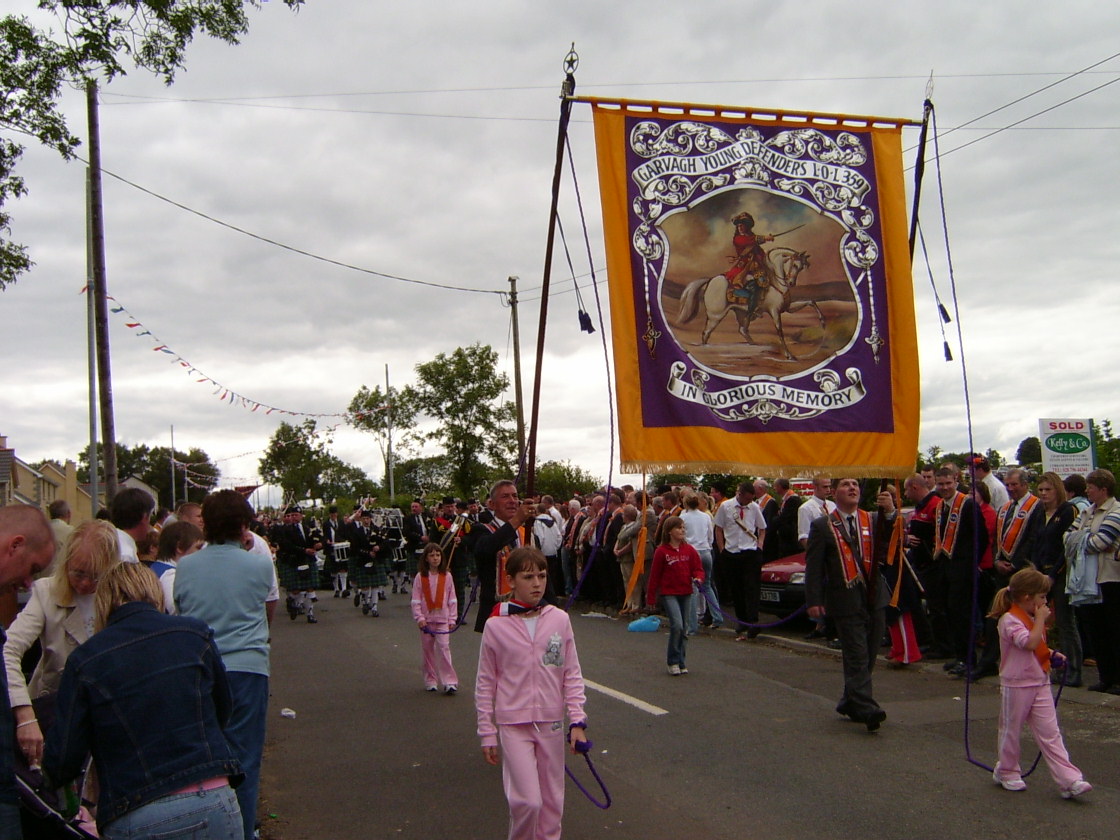
On Sunday, thousands of Northern Irish blocked Garvaghy Road in the Republican-leaning town of Portadown. A demonstration by the Orange Order, a Protestant organization that played an important role in the Irish War of Independence and the Northern Ireland conflicts, was blocked.
This was preceded by a ruling by the Supreme Court of Northern Ireland in the early hours of the morning. The judges overruled a decision by the Parades Commission that had banned the Orange Order from crossing Garvaghy Road with their traditional march for almost 30 years.
Garvaghy Road is particularly explosive. At the end of the 1990s it became the scene of serious clashes between Unionists and the Republicans who lived there.
To understand the scope of the demonstration and blockade, it is necessary to look into Ireland's past for more than a century. Since the Middle Ages, Ireland - or at least large parts of the island - has been under British rule in one form or another.
This rule was accompanied by enormous levels of exploitation and oppression, which culminated in the Great Famine in the middle of the 19th century, in which around a third of the Irish population died or fled the country.
In the 19th century, an Irish independence movement emerged that fought against British oppression and rule. This eventually formed the Irish Republican Army (IRA), which won a fight for independence against the British occupiers from the late 1910s onwards. After the signing of the Anglo-Irish Treaty in 1921, Northern Ireland remained in the Kingdom of Great Britain - a condition for the peace agreement.
Pogroms in Northern Ireland: Organize resistance against right-wing agitation and racist division!
Northern Ireland was more heavily populated by English and Scottish settlers than other parts of the country. Accordingly, there was greater support for the English crown there. In particular, a movement of Ulster nationalists emerged in Northern Ireland - long before the War of Independence - that combined Protestant doctrine and settler ideology.
The Orange Order has played an important role in this movement since its founding in 1795. In addition, the order also took part on the side of the British army in the fight for independence.
After 1921, Northern Ireland remained a flashpoint in the conflict. The religious differences between the Protestant settlers and the primarily Catholic population of Ireland became increasingly important. Northern Ireland had the largest demographic differences.
Over the next decades, English Protestants implemented discriminatory laws against Catholics, which in turn sparked massive protests. Attacks by the Unionists on the peaceful demonstrations resulted in almost thirty years of fighting between the Unionists and the Republicans from 1969 onwards.
In these disputes, too, the Orange Order was again and again the focus. Among other things, he maintained numerous personal connections with the Northern Irish Police and the Northern Irish Regiment of the British Army. In particular, the traditional demonstration through Catholic neighborhoods and streets like Garvaghy Road were targeted measures to incite confrontations with Republicans.
Ex-IRA front “Sinn Fein” wins election in Northern Ireland
Northern Irish people were accordingly shocked and ready to protest on Sunday after the Supreme Court allowed this traditional demonstration again. It had previously been banned every year under the 1998 Good Friday Agreement. The agreement ended the fighting between republicans and unionists and decided on some special regulations for Northern Ireland.
Among the demonstrators were the president of the ruling Sinn Féin party, Mary Lou McDonald, and her party colleague Michelle O'Neill, the head of government of Northern Ireland. She deeply condemned the Orangemen's demonstration: "This march is steeped in a history of hatred, sectarian violence and murder and is championed by unionist leaders."
O'Neill also accused the Unionists of sowing fear in the population and specifically among residents of the Garvaghy Road area: "The concern that was felt in this community yesterday came from what the leaders of the political union were displaying there. [...] What they saw was something ugly. What they saw was a longing for times gone by."
Politicians from the unionist DUP, however, accused O'Neill and the commission that banned the demonstration of trying to flout the law: "It will not have escaped anyone how the 'First Minister for All' has no problem with a public body acting against the law," explained DUP leader Gavin Robinson. In his opinion, Unionists felt discriminated against by the ban on demonstrations and “[Michelle O’Neill] cannot wish their rights away and she shouldn’t try to.”
Efforts for independence: The collapse of the United Kingdom is not (yet) imminent
In the context of the demonstration and the subsequent blockade, concerns arose inside and outside the island of Ireland that the Northern Irish conflict would worsen again. It remains to be seen whether the Unionist demonstration, which is taking place for the first time in almost 30 years, is actually a harbinger of increased willingness to use violence.
The context in which this demonstration took place is also explosive for other reasons. The ruling party Sinn Féin has always had open aspirations for reunification with the Republic of Ireland, but recently these have been expressed more aggressively again.
Michelle O’Neill recently attended a meeting with John Swinney of the Scottish National Party and Rhun ap Iorwerth of Plaid Cymru. The three heads of government of the nations dependent on London exchanged ideas about their aspirations for independence and emphasized their right to break away from England.
Read the full story at the source
Source: Perspektive Online