
World · Perspektive Online · · 54m
Peace Prize for NATO? The path to war against Russia is honored
Deutsch (original) · Auto-translated to English
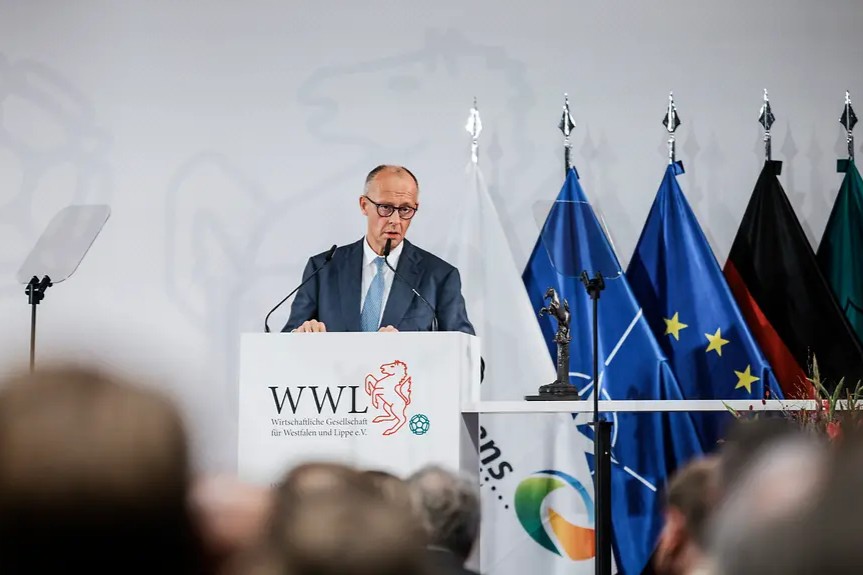
The largest war alliance in the world will receive the Westphalian Peace Prize 2026. But there is a remarkable contradiction between supposed peace rhetoric, massive rearmament and geopolitical interests. – A comment from Bruno Schüller.
The Westphalian Peace Prize is awarded every two years in the historic town hall of Münster. The host Economic Society for Westphalia and Lippe (WWL) is a non-partisan think tank that loudly...Self-imagefor the “preservation of the free economic order” and deals with “socio-political and economically relevant issues”.
The focus is primarily on the Westphalia region, one of Germany's economic centers. The work of the think tank includes regular business days that serve to network aspiring capitalists with monopolies and large capitalists. Another goal is to anchor capitalism even more firmly in the education system. He sits next to itAssociationalso for “resolving conflicts” and “securing peace”.
NATO – A bastion of international peace?
In the context of this commitment to securing peace, the WWL awards the Westphalian Peace Prize every two years. This year NATO received this award. The international military alliance has been led by the USA since its inception and used to maintain and expand the power of imperialist states.
Carsten Breuer: Inspector General of the Bundeswehr becomes NATO military chief
“Merz, Wüst and Rutte demonstrate strength against Russia,” writes theWWLproud of this year's award. NATO is recognized as a “stabilizing and reliable partner in a time of global uncertainty.” It is precisely the member states of the military alliance that are maintaining the Ukrainian war in the region for their own interests and have been artificially keeping Ukraine alive for years.
In this context, stability and reliability are recognized towards those states that have the same or similar interests in global competition or that require military support in view of their own sovereignty and therefore sell out their own economic performance for foreign administration.
With war for the price of peace
The fact that NATO is obviously not an alliance made up of peace-loving states that are solely concerned with their own defense in the event of an attack should not have only become clear since the US and Israel's war of aggression against Iran.
The Bundeswehr's new strategy paper prepares Germany for a major war in Eastern Europe
In June 1999, various NATO member states bombed Belgrade, the capital of what was then the Federal Republic of Yugoslavia. Among other things, the German Air Force took part in its first armed mission since the Second World War. Hundreds of Yugoslav civilians were killed and thousands injured.
The only time that the alliance declared a case of alliance, i.e. the defense of a member state, was as a result of the attacks of September 11, 2001 in the USA. Almost 20 years of war in Afghanistan followed. Over 45,000 civilians were killed, and the NATO operation ended with a hasty withdrawal, which was followed by the Taliban taking power again.
Operations in Bosnia and Herzegovina from 1992 and in Libya in 2011 can also be listed here. In addition to these NATO operations, there are countless other acts of war and attacks by individual member states such as the USA, Turkey and France. So how do you decide to award the Westphalian Peace Prize to such an organization?
Imperialists and anti-communists in league
NATO is a historical product of the Second World War. At that time it included many Central European states that were looking for allies in the fight to preserve capitalism against the socialist Soviet Union in the East. The USA, which was seen primarily as an economic but also as a military counterpart to the Soviet Union, established patronage over the founding members. NATO therefore fulfilled the role of an anti-communist military alliance against the Soviet Union.
Today, in a world in which socialist states no longer exist, it is primarily used to assert interests against smaller, independent states or to make economic and military preparations for war with China.
The Economic Society for Westphalia and Lippe also had its name shortly after it was founded in 1919Goalformulated to “create a bastion against advancing Marxism”. Similar to NATO, the focus changed with the gradually decreasing influence of Marxist ideas towards representing the interests of German imperialism, for example by politically and ideologically supporting the war against Russia.
Merz in NATO mode
In this way, the awarding of the Peace Prize can be placed into the overall picture and it becomes more understandable why NATO and the WWL complement each other. In this way, NATO maintains international imperialist conditions in the interests of German and US capital. The WWL creates local networks in Westphalia between different capitalists and awards prizes with which companies and military alliances can adorn themselves in the public eye.
The ceremony also offered the German state an opportunity to reflect on its own role in the transatlantic military alliance and to sharpen its own war course. So the Chancellor left itannouncethat Germany is willing, able and ready to take on more responsibility in a renewed alliance. With regard to Russian “cyber attacks, drones and online propaganda,” Merz announced that he would “respond quickly and very clearly, as he did in Leipzig.”
With the threatened withdrawal of the USA from Europe, Merz wants to consolidate Germany's role within Europe and NATO and is once again emphasizing the announcement that he wants to make the Bundeswehr the strongest conventional army in Europe by 2039.
Protest under the motto “NATO out of Münster”
Protests against the event were organized under the motto “NATO out of Münster – no peace prize for warmongers”. Among others, the Left Youth Münster and the Aufbruch Münster group took part in the five-hour rally on Michaelisplatz.
Their announcement said: "We are becoming poorer and are then supposed to go to war and die for the rulers. The priorities are frighteningly clear: cannons instead of hospitals, tanks instead of care, rearmament instead of social security. The state uses its resources where it secures existing power and property relations - not where it improves our living conditions."
The postPeace Prize for NATO? The path to war against Russia is honoredappeared firstperspective.
Read the full story at the source
Source: Perspektive Online