
Politics · Perspektive Online · · 55m
External armament, internal control – but resistance is growing!
Deutsch (original) · Auto-translated to English
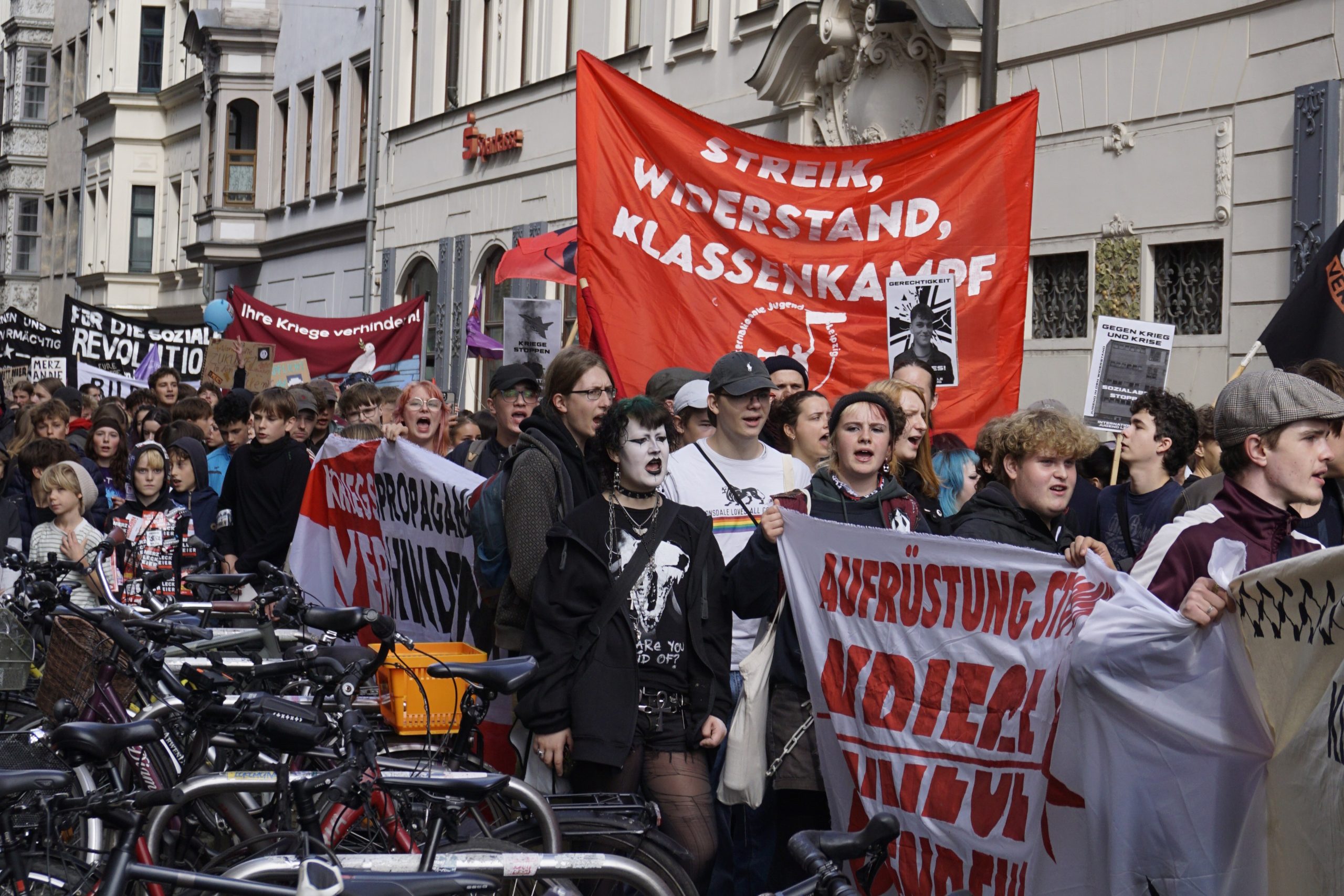
While thousands of people in Germany took to the streets last week against conscription, cuts and the Hamburg NATO maneuvers, sometimes with strong repression, internal armament was further expanded in the Bundestag. Let's oppose it even more broadly! – A comment Fevzi Ayçiçek.
Germany continues to arm itself. Internally and externally While the federal government is mobilizing billions for the Bundeswehr, savings and cuts in the social sector are being implemented at the same time. At the same time, conscription and muster training are being prepared and the state security apparatus is also being expanded.
But the past week has also shown that these developments will not remain unanswered. Around 100 cities took place45,000 students and young peopletook to the streets against conscription. At the same time, around 175,000 people demonstrated nationwide on SaturdayDGB action daysagainst social cuts.
And in Hamburg, internal rearmament and preparation for war met with direct resistance. For the third time, the port city held the civil-military exercise, in which the event of war is specifically practiced in connection with civilian infrastructure and its participation.
Red Storm Charlie: War in the middle of the city
After Red Storm Alpha (2024) and Red Storm Bravo (2025), the exercise took place on Sunday afternoonRed Storm Charlieover. From September 24th to 26th, the Bundeswehr exercised in Hamburg with around1,700 forces, including 500 soldiers and around 60 participating organizations, in the event of war. More than 70 armored military vehicles were on the roads. Military helicopters could also be seen throughout the day.
The relocation of troops and material towards NATO's eastern flank was tested - together with authorities, aid organizations and companies, such as EDEKA, but also daycare centers and schools. As in previous years, dealing with demonstrators and blockades was also part of the exercise. Last year and this year, the employment agency provided “fake activists” who had to be evicted by officials for training purposes. Dealing with chemical and sabotage attacks was also rehearsed.
However, there were numerous protests against this militarization. Educational and cultural events, demonstrations, color campaigns and a blockade of the harbor railway. Around 60 activists from Ende Gelände blocked the tracks on Friday and prevented rail traffic to the port of Hamburg for hours and thus also prevented the transport of weapons during this period.
The police cleared the blockade after more than twelve hours. According to the alliance, police violence was used. Representatives of the press and paramedics also reported obstructions and aggressive behavior on the part of the officers.
Days of action against Bundeswehr maneuvers: “Just the beginning!”
Large demonstration on Saturday
On Saturday, around 2,500 people took to the streets at the demonstration by the “Rheinmetall Disarmen” alliance under the motto “Hamburg remains unfit”. Protests were also held at Jungfernstieg under the motto “No to NATO port” and at five other locations.
There was no joint demonstration. Instead, the various alliances protested in parallel in different places in the city, with different focuses. The NATO maneuver was not the only thing the people of Hamburg protested against. The DGB action day and the school strike against conscription also brought thousands of people onto the streets. The connection between militarization, cuts and interventions on the livelihood of all people was sometimes more and sometimes less strongly linked.
The political decisions that are being protested against are directly related: the German state wants to expand its military capabilities and is increasingly organizing civilian structures for this purpose. In order to finance this rearmament internally, social cuts are being made and reduced, young people are, if necessary, brought into the army by force, and anyone who stands in the way of the federal government's war course must expect ever more state power.
Edeka Group and Schwarz Group support the Bundeswehr exercise “Red Storm Charlie”
Repression against school strikes
Repression does not just begin with police violence and state arbitrariness. It often starts where protest is to be restricted, intimidated or criminalized.
According to reports, the school strike resulted in letters from parents, expulsions, threats of lower ratings and complaints. In Bonn, students were locked in the school building. In Karlsruhe, the police took the personal details of students after a teacher called the police.
In Hamburg, too, the state's repressive apparatus was massively ramped up over the weekend. It didn't stop with the violent evacuation of the port's rail blockade. Numerous activists were taken into custody for several hours.
Preventive custody in Hamburg
The intimidation effect became particularly clear on Friday evening: two young people were taken into custody for more than twelve hours simply because they were carrying red tube scarves. When they were taken into custody, they were told that they could be held until the end of the maneuver on Sunday afternoon.
This makes it clear: repression is not directed against specific actions. Even the visible affiliation with a protest movement can become a reason for police action. The long duration of the detention and the announcement that the young people will be held until the end of the maneuver also serve as a signal to other activists.
So while the state is practicing war scenarios and military mobilization, it is simultaneously testing in practice how to deal with those who disrupt or publicly reject this mobilization.
This fits with political developments at the federal level: While protests against conscription, social cuts and militarization are increasing, at the same time the legal and technical options of the police and secret services are being expanded.
The repression of protest is therefore not isolated from rearmament. It is part of the same development: external armament requires internal control.
Rheinmetall Disarm: 2,000 war opponents defy police violence and cauldrons
New police law: More rights, more control
On the pastFridayThe Bundestag passed the new Federal Police Act. The reform expands theThe powers of the federal police are clear: In the future, real-time facial recognition, AI-supported video analysis, cell phone tracking and new options for detention pending deportation and random checks are planned, among other things.
The federal government justifies the reform with changed security situations, cyber attacks, drones and organized crime. Instead they criticizedOpposition parties support the reform. Irene Mihalic (Greens) expressed legal concerns about real-time biometric surveillance. Left-wing MP Clara Bünger classifies the new federal police law as a “massive expansion of state power while at the same time weakening fundamental rights”. The law will normalize comprehensive surveillance.
Authorities are being expanded preventively
In addition to the security check, there will also be increased nationwide inquiries to the Office for the Protection of the Constitution in the future. Standard requests are standardized review procedures for applicants in the public service. This is intended to weigh up whether there could be doubts about people's loyalty to the constitution. In Hamburg there have been more than4,000 like thatInquiries made. There was a hit in five cases.
What is striking is that the powers are not only expanded when a specific state of emergency has occurred. They are already being created now - while Germany is simultaneously expanding its military capabilities and preparing society for possible crises and wars.
This means that rearmament is not just a question of weapons and soldiers. The police and security authorities are also being technically and legally geared to new threat scenarios. Among other things, to keep the civilian population under control. Even before upcoming protests.
Reform of the BND is coming
And also in thesecret servicesinternal rearmament is progressing. After the new legislative proposal, which was over 600 pages long, became public in June, it was debated for the first time in the Bundestag on Thursday about the reform of intelligence law.
According to the Federal Government, the BND and the Office for the Protection of the Constitution should be given new and expanded options for gathering information and averting danger. Among other things, more extensive technical monitoring options and interventions in IT systems are planned. “Intelligence services are becoming real secret services” – said Federal Interior Minister AlexanderDobrindt.
The bill is still going through the parliamentary process. The opposition and civil rights activists are currently particularly criticizing the planned expansion of secret service powers and see this as a further shift in the relationship between state surveillance and individual freedoms.
Also from theMedical professionThere is criticism, particularly with regard to the protection of medical confidentiality. This is jeopardized by the planned reform, as doctors and psychotherapists are not protected from surveillance by secret servicesexceptedshould be.
Clara Bünger, domestic policy spokeswoman for the Left in the Bundestag, criticized that the reform violated the requirement of separation between the police and secret services. In the Bundestag she warned: “Basic rights are being trampled on here.” Green party deputy Konstantin von Notz welcomed the reform in principle, but criticized the planned expansion of the constitutional protection powers as excessive and constitutionally problematic.
Disappeared service weapons - and the Interior Ministry is silent about the numbers
Secret services as part of internal warfare
This makes the direction of development clear, regardless of whether the law is passed in its entirety or not. While the state's military capabilities are being expanded externally, the instruments for surveillance and control are being expanded internally.
This does not happen independently of military developments. The more the state prepares society and infrastructure for war, the more important it becomes to control possible disruptions to this mobilization.
The protests against Red Storm Charlie at the weekend, as well as the protests around Rheinmetall Disarmen, but also the nationwide school strike, show that there are such disruptions that the state is gearing up to counteract in parallel.
This means that two developments come together directly: There are protests on the streets - at the same time, the state is expanding the instruments with which it can monitor and control protests, possible dangers and social conflicts.
Reform of the intelligence services: Interior Minister Dobrindt wants to massively rearm
Resistance increases with increasing armament
The new laws are not expressly directed against anti-militarist protests. However, they create additional opportunities for state control at a time when resistance to rearmament, social cuts and conscription inevitably grows.
However, these developments are taking place simultaneously and touch on a common question: to what extent should a society be restructured to prepare for possible wars, and how should those who reject this development be dealt with?
The past week has shown that we are in the middle of this conflict. Tens of thousands of young people against conscription, hundreds of thousands of trade unionists against cuts and thousands more against the NATO maneuver show the growing discontent. But only a mass, organized and militant protest movement will be able to take on the highly armed German imperialism. Let’s keep building this movement!
The postExternal armament, internal control – but resistance is growing!appeared firstperspective.
Read the full story at the source
Source: Perspektive Online