
Politics · Perspektive Online · · 55m
36 years after the fall of communism: The long-term political consequences of annexation
Deutsch (original) · Auto-translated to English
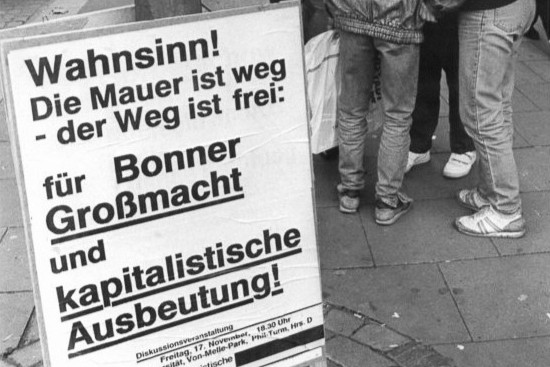
The official historiography of the Federal Republic of Germany calls it “reunification”. For many people, especially from the former GDR, it was annexation. On October 3, 1990, the former German Democratic Republic joined the scope of the Federal Republic of Germany's Basic Law in accordance with a resolution of the last People's Chamber. This meant that the GDR was dissolved as an independent state and was absorbed into capitalist West Germany.
Its government parties had previously intervened in the last GDR election campaign with considerable financial resources, advisors and appearances by Chancellor Helmut Kohl (CDU), thereby making the “Alliance for Germany” alliance led by the eastern CDU the strongest political force. The introduction of the monetary union on July 1, 1990 also played its part.
Economic conquest
After the end of the GDR, West German capital and its federal government did not hesitate for long. Especially between 1990 and 1994, Western investors appropriated large parts of the formerly state-owned assets in the East, carried out the systematic deindustrialization of the new federal states and pushed millions of former GDR citizens into unemployment, especially women. Of the approximately 9.7 million jobs that existed in the GDR in 1989, around 3.5 million had been destroyed by the end of 1992.
The D-Mark and the larger range of goods offered by the Federal Republic of Germany also turned out to be a poisoned “gift”: the 1:1 exchange rate suddenly increased the production costs for the GDR companies and made it easier for them to be privatized and broken up as a result of bankruptcies.
The economic plunder of the former GDR was accompanied by its political conquest. As in previous onescolonial systemsWest German politicians, civil servants and business officials moved into the new federal states after 1990 and took on leadership roles there. Between 1990 and 1994 alone, 35,000 administrative specialists and civil servants went to the former GDR as “development helpers” or temporary civil servants.
GDR plate in Berlin-Mitte is to be torn down: “Those up there don’t care about us”
AfD is the strongest force in the East
The destruction of the East German state and the conquest of West German capitalism in the new federal states after 1990 is a decisive factor in the development of class relations and political forces in East Germany.
The ultra-right AfD is now the strongest political force in all of the states there: In Saxony-Anhalt, it achieved a historically strong result of 43.8 percent in the state elections on September 6th and could soon be the prime minister there. Already at theFederal election 2025She won by far in Brandenburg, Mecklenburg-Western Pomerania, Saxony, Saxony-Anhalt and Thuringia. It has already dethroned the CDU as the leading political party in East Germany, and it is not apparent today that the old “Chancellor’s Party” could reverse this development in the next few years.
However, this does not apply to the CDU, but to the entire traditional “center” of the Federal Republic of Germany. In none of the five eastern German states do the majority ratios still suffice for a classic two-party coalition from the CDU, SPD, Greens or FDP camps. In addition to the strengthening of the AfD, the entry of the BSW into the state parliaments of Brandenburg, Thuringia and Saxony-Anhalt also contributed to this.
The left replaced
Both parties have also benefited from a weaker left. The former PDS, which emerged from the SED in 1990, was able to retain voters in East Germany for a long time who were dissatisfied with the economic and social consequences of the annexation. At theFederal election 2009The Left reached its peak in the new federal states with 28.5 percent of the East German second votes.
Antimilitarist summer festival in Lichtenberg “in the spirit of Aenne Saefkow”
Her participation in several state governments, in which she helped implement austerity measures and social cuts, as well as her temporary federal political development towards identity politics have contributed to the fact that she has now lost this position to the AfD.
This is primarily gathering votes with a radical anti-migration policy and opposition to arms deliveries to Ukraine. And it is by far the strongest force among workers in the EastSaxony-Anhaltto 61 percent and inMecklenburg-Western Pomerania52 percent voted “blue”. In a post-election survey by Infratest Dimap in Saxony-Anhalt in September, 25 percent of all respondents said that the issue of social security was a decisive factor in their voting decision, followed by peace in Europe (17 percent) and the economy (15 percent).
86 percent of East German respondentsRTL surveyalso rejected the federal government's current plans to abolish pensions at 63. The East German working class would be particularly hard hit by this measure: proportionately more people, and especially women, meet the requirement of 45 years of contributions because they have fewer gaps in their employment history due to their GDR history.
Annexation continues to have an impact today
The aftereffects of the annexation of the GDR are not only reflected in the discussion about pension reform. On Wednesday, the Federal Government's Eastern Commissioner presented the new onereporton the situation in East Germany. This comes to the conclusion that East and West Germans are increasingly viewing their living conditions and opportunities for advancement in similar ways. At the same time, the wealth differences between the two parts of the country continue to exist, which means that people from East Germany often start out with poorer financial conditions.
75 years of the Federal Constitutional Court: The guardian of capitalism
In order to reduce the differences that still exist between East and West, the Eastern Representative called for improvements in the education system, jobs and infrastructure and the necessary financial resources. East Germans also continue to be underrepresented in leadership positions in Germany.
When Helmut Kohl implemented the annexation of the GDR in 1990, he spoke of transforming the new federal states into “blooming landscapes”. 36 years after political conquest and economic clear-cutting, the conditions in East Germany are instead contributing massively to the political crisis of German imperialism. It is a task for revolutionary forces to weaken the AfD in the new federal states - not in order to artificially revive the dead "center" of the Federal Republic of Germany, but in order to win over the resistant potential in the former GDR for progressive and socialist politics.
The post36 years after the fall of communism: The long-term political consequences of annexationappeared firstperspective.
Read the full story at the source
Source: Perspektive Online