
World Mother Jones
More and More Veterans Say Their Duty Is to Resist Trump
On the 250th anniversary of the United States, as temperatures in Philadelphia climbed high enough to warp sneaker rubber, Michael McPhearson marched. The city had canceled its official parade due to
English (original) ·Read in Deutsch ⇄
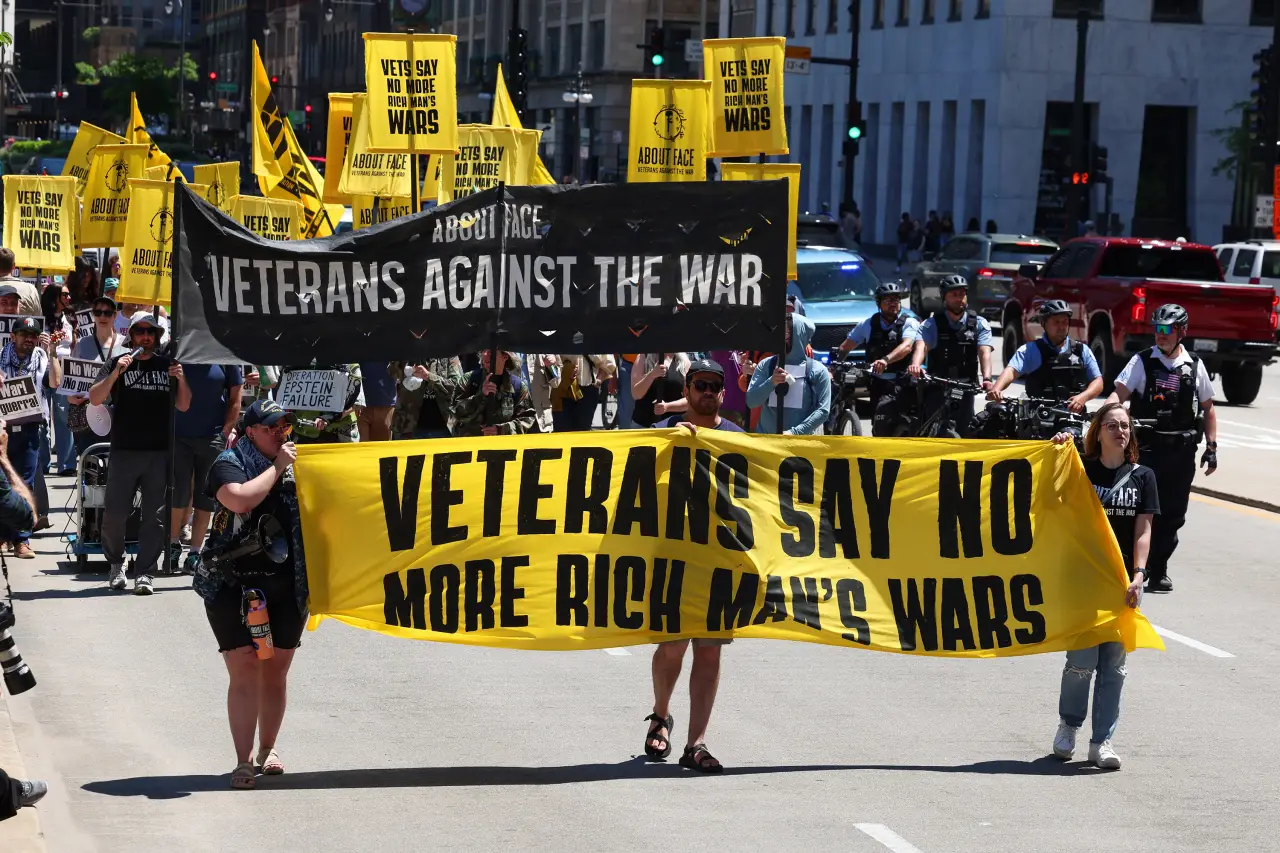
On the 250th anniversary of the United States, as temperatures in Philadelphia climbed high enough to warp sneaker rubber, Michael McPhearson marched. The city had canceled its official parade due to extreme heat. But McPhearson, a 62-year-old Gulf War veteran, was undeterred. He had traveled across the country from Seattle to march alongside more than 500 of his fellow veterans, active-duty service members, and military families. They gathered near Independence Hall—America’s birthplace—but they didn’t come to commemorate a mythic nation untouched by contradiction. Instead, protesters stepped into the streets and unfurled a banner that read Veterans Against Fascism.
The Fourth of July march was the largest anti-war veterans protest since the Vietnam War, according to organizers. And as President Donald Trump’s war with Iran drags into its ninth month, the veterans’ resistance movement is only growing. From Gulf War officers and post-9/11 Marines to Vietnam-era elders and active-duty troops, many Americans who once saw military service as the highest form of patriotism are arriving at the same conclusion: Their duty to this country may no longer be to fight, but to refuse.
The vets’ hotline saw “a huge bump in calls” when Trump deployed the National Guard into Los Angeles to support ICE.
Since February 2025, McPhearson has been at the helm of Veterans For Peace, a St. Louis-based nonprofit focused on exposing the true causes and costs of war. Since its founding in 1985, VFP has grown into a global network of veterans and allies with more than 140 chapters.
But Trump’s second term has been a turning point: According to McPhearson, roughly 1,000 of VFP’s 3,500 active members have joined since the president returned to office in early 2025. More and more veterans now see the US as locked into a generational addiction to war, McPhearson says, and are deciding that “we can’t go back to the way it was.”
The reckoning is reaching active-duty troops, too. At Quaker House—a peace organization in Fayetteville, North Carolina—Lenore Yarger has counseled service members with the GI Rights Hotline for 25 years. Yarger says the hotline saw “a huge bump in calls” last June, when Trump announced he was sending National Guard troops into Los Angeles to support Immigration and Customs Enforcement operations.
Then came Trump’s strikes on Venezuelan boats, which sparked fears among service members that they were being ordered to commit war crimes. Callers began asking whether the orders were legal, and if they’d be held accountable for following them.
But what Yarger witnessed this past spring represents, by her accounting, the highest call volume in the hotline’s history. In the months directly following Trump’s first strikes on Iran, calls more than doubled.
Some callers were active-duty service members who’d deployed with Operation Epic Fury—the codename for America’s joint military operations with Israel that began on February 28—but now wanted to file for conscientious objector status. They said what they experienced during their deployment changed their beliefs about war.
“We can’t promise them that they won’t be accused of doing something illegal” if they follow military orders, Yarger says, “and we also can’t promise them that they won’t be punished if they refuse. It’s a really hard time to be in the military right now.”
Trump’s war with Iran is deeply unpopular; voters made that clear on November 3, when they turned out in droves to reject Republican candidates at the ballot box. As of late October, the war has cost an estimated $47 billion, and US and Israeli attacks have killed more than 3,500 people in Iran, many of them civilians. The Pentagon now counts 21 American service members killed and 865 wounded, numbers it has revised upward repeatedly, with no public announcement.
Against this backdrop, McPhearson has traveled to city after city trying to make visible what he argues the Trump administration is working hard not to see: the people on the receiving end of American bombs.
Twice since Trump’s return to office, McPhearson’s work has landed him in handcuffs. Last June, on the eve of Trump’s military birthday parade, McPhearson joined roughly 60 veterans and military family members in a sit-in on the Capitol steps, demanding that the administration pull the National Guard off American streets.
This past April, he was one of more than 150 veterans and military family members who filled the rotunda of a congressional building to demand an end to the Iran War. Vietnam veterans stood alongside those who served in Iraq and Afghanistan, folding a flag for fallen American soldiers and holding red tulips for the Iranians killed by US and Israeli strikes. Capitol Police arrested 66 people that day.
McPhearson grew up in Fayetteville, next to the Fort Bragg military base. His grandfather, stepfather, and several uncles all served overseas. In a military town, McPhearson told me, the Army was one of the few reliable paths to a good living, so he joined the Army Reserve at 17. He went on to join the Reserve Officers’ Training Corps (ROTC) in college, then became a field artillery officer in the 24th Infantry Division during the first Gulf War. He left active duty as a captain in 1992.
“You don’t want to be thinking about illegal orders for the very first time when you receive them.”
Twelve years after McPhearson’s military service ended, his own son enlisted and deployed to Iraq. Those months were “some of the worst times in [his] life.” Across four generations, his family had gone to war.
But it isn’t simply the accumulation of forever wars that’s driving today’s veterans’ resistance movement, McPhearson says. It is how little effort has been made to justify the violence, without even the manufactured case that preceded the invasion of Iraq.
“We’re talking about 36 years of the U.S. being constantly at war [in the Middle East],” McPhearson says. “We’re constantly killing people.”
McPhearson’s fatigue appears to be widely felt among voters: On election night, Democrat Richard Ojeda, a retired Army major, flipped a House seat in North Carolina’s 9th congressional district, which includes Fort Bragg and most of Fayetteville.Ojeda has repeatedly slammed the Iran War and called Defense Secretary Pete Hegseth “a war criminal [who] deserves to be impeached.” He is the first Democrat to win the district since 1963.
“I carry the names of 13 brothers I lost in war tattooed on my body,” Ojeda posted on X in August. “I know exactly who pays the price when the people at the top screw up.”
At Quaker House, the pace of calls has eased only slightly since the start of the Iran War. From March on, the GI Rights Hotline has averaged about 320 calls a month, up from an average of about 150.
The hotline doesn’t tell callers what to do, because “that’s what the military [does],” Yarger says. Instead, counselors lay out options: discharges, delays, exemptions. For those who object to this war but not all war, those options are narrow, since conscientious objector status requires opposition to war in any form. But many callers begin researching the history of American wars and come back changed.
Most of the people Yarger talks to are “not afraid of dying, but afraid of killing.” Above all, she tries to tell people they aren’t crazy. The military, she says, “can make you feel like you’re bad and weak or cowardly if you question what you’re being asked to do. We try to just reinforce that that isn’t the case.”
Matt Howard, an Iraq War veteran and former Marine Corps helicopter mechanic, has taken a more direct approach. He serves as the interim organizing director of About Face: Veterans Against the War, a network of post-9/11 service members and veterans organizing to end “a foreign policy of permanent war and the use of military weapons, tactics, and values in communities across the country.”
Last September, along with Win Without War and Veterans For Responsible Leadership, About Face launched a billboard campaign telling National Guard members and active-duty service members that refusing unlawful orders is not a radical position—it is, in their view, an obligation.
The billboards went up first in Washington, DC, then in Chicago, Memphis, and outside Fort Bragg and Marine Corps Base Camp Lejeune.
“Did you go to Airborne just to pull security for ICE?” asks one billboard in Fayetteville. Others pose the question at the heart of the campaign—”Is this what you signed up for?”—and point troops toward legal help.
Veterans For Peace chapters have since put up their own billboards from San Diego to Tucson, telling active duty and National Guard members: “You have a duty to refuse illegal orders.”
“You don’t want to be thinking about illegal orders for the very first time when you receive them,” Howard says. About Face wants to encourage service members to plan ahead for that moment.
Howard is clear-eyed about what distinguishes today from previous moments of veteran dissent. The Iraq War produced an anti-war movement, he notes, but one that was largely reactive to a single administration, a single catastrophic decision.
But the billboard campaign, the Capitol sit-ins, and the marches are not the actions of people who expect the problem to resolve itself with the next presidential election, or even a blue Congress. What is happening now is something more structural and difficult to contain.
“This is a very much a moment where the Trump regime is mask off in their pursuit of raw power,” Howard says, “and the way that’s showing up is in their military aggression overseas, but also here at home.”