
World Mother Jones
Can Kansas Voters Get Democratic Religion?
The Fox Theater on East 1st Avenue in Hutchinson, Kansas, is a classic Art Deco movie palace, an icon of the golden age of cinema. Hutchinson, the Reno County seat of 40,000, famous for its undergroun
English (original) ·Read in Deutsch ⇄

The Fox Theater on East 1st Avenue in Hutchinson, Kansas, is a classic Art Deco movie palace, an icon of the golden age of cinema. Hutchinson, the Reno County seat of 40,000, famous for its underground salt mines, is located 39 miles northwest of Wichita. I was there on October 8 because the US Senate campaign of Democrat Adam Hamilton had rented the venue for a meet-and-greet with attendees.
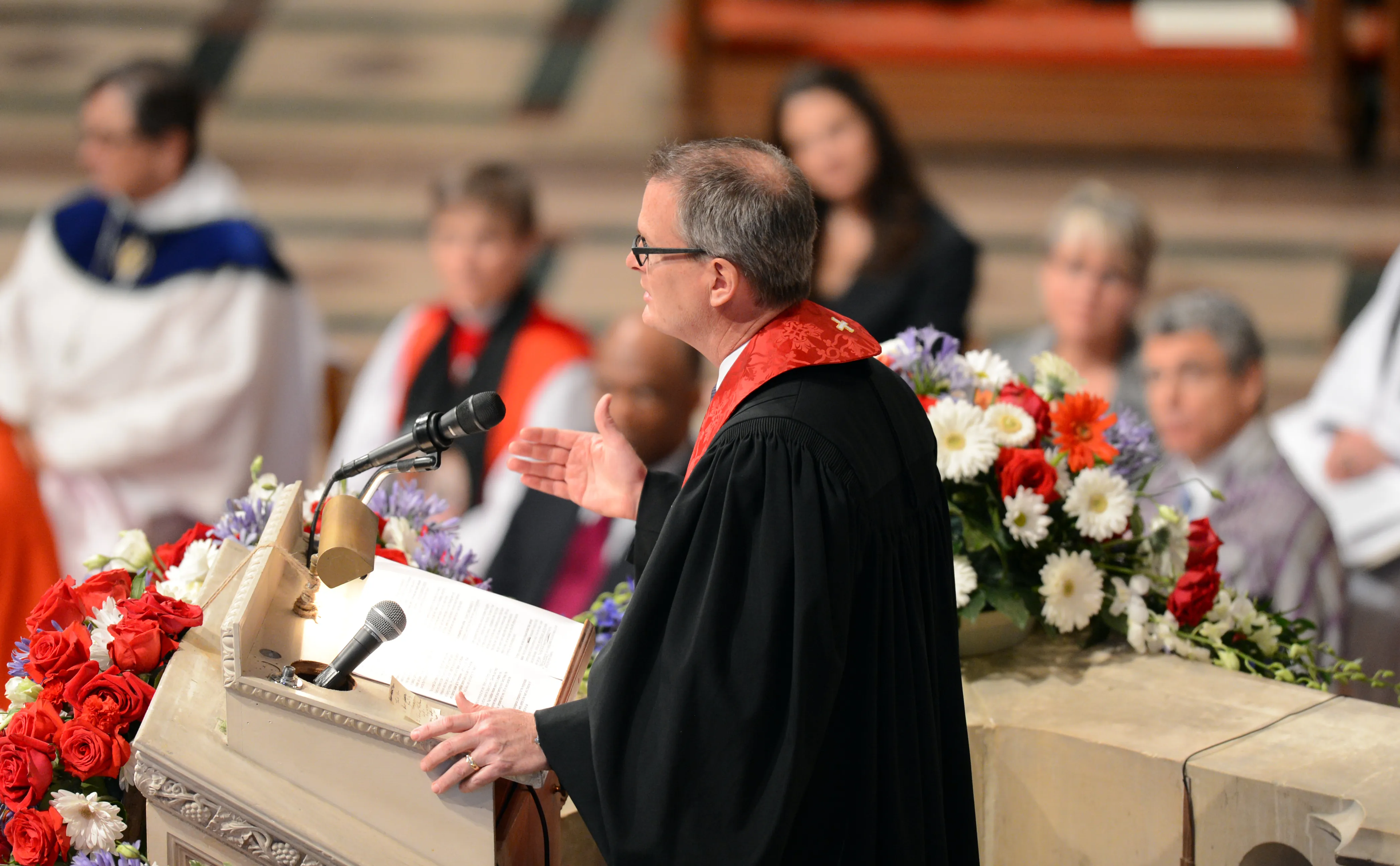
I’ve admired Hamilton since meeting him after he delivered the sermon at former President Barack Obama’s second inaugural prayer service inside the Washington National Cathedral in 2013. The founding pastor of the Church of the Resurrection in Leawood, Kansas, the country’s largest United Methodist Church, with 24,000 members gathered on five campuses in and around Kansas City, he was both a model of a successful minister and a memorable pulpit orator. Today, he has turned what should have been a completely uncompetitive race for US Senate in Kansas into a contest that the Cook Political Report has characterized as too close to call.
Inside the 1200-seat auditorium, a mostly older crowd of about 400 people slowly found their seats or stood in small clusters chatting. As we waited for Hamilton’s arrival, I spoke with Darrell Pope, who appeared to be in his mid-70s and was the only Black attendee I had seen in the room. He is the chairman of the deacon board of the Macedonian Missionary Baptist Church in Hutchinson, he said, a majority-African-American congregation, but with some white and Hispanic members as well. What did he think about Hamilton? I asked. As a minister myself, I was curious about how this preacher-turned-politician might have been seen by such an active layman. Pope found him “refreshing,” he said, because Hamilton, as a pastor, “looks at everybody as an equal person rather than just certain people.”
Pope and I had just ended our conversation when Hamilton entered the theater, walking down the center aisle and waving almost shyly, as the room erupted into enthusiastic applause, and then a standing ovation. Longtime Kansas Democratic activist Betty Taylor and retired Kroger Company Chairman Dave Dillon, a Republican who grew up in Hutchinson, introduced Hamilton from the podium. “He is willing to reach across the aisle to solve problems,” Dillon said, to affirmative nods by Taylor. “Two former Republican governors have endorsed Adam, and he has earned our vote.” Their bipartisan endorsement highlighted not only Hamilton’s remarkable success in making a Senate race in deep-red Kansas competitive, but also his pastoral work over the last 38 years, with a focus on bringing people together rather than emphasizing, even exaggerating, their differences.
Hamilton went to the podium to address the crowd. He may have become a politician, but his identity as a shepherd of souls is indelible. Nonetheless, as white and as Christian as much of Kansas is—according to the Pew Research Center, 70 percent of the population in Kansas identifies as Christian, with over half identifying as Evangelical or mainline Protestant—he was determined to disabuse anyone there of the sense that he was any kind of Christian nationalist, which has so dominated the Trump administration and GOP. “I’m not running for the US Senate to make everybody else believe what I believe about God, about who Jesus is, or what it means to be a Christian,” he said. “I’m running for the United States Senate because things are broken in our country.”
“I’m not running for the US Senate to make everybody else believe what I believe about God, about who Jesus is, or what it means to be a Christian. I’m running for the United States Senate because things are broken in our country.”
He deftly navigated between religious camps, alluding to authoritative instruction from the Bible at some points, “What does the Lord require of you?” he asked. “Not, what does he suggest? What is your requirement? But to do justice. Justice is making sure there’s fairness for powerless people. To do justice, and to love kindness, and to walk with humility before God.” I wondered if others there would have recognized this text from the Book of Micah, where the prophet makes clear that God values virtuous behavior toward others over hypocritical religious ritual.
He explained how he came to organize his mega church in 1990. His bishop assigned him to start a congregation that would welcome “thinking people who didn’t go to church. Critical thinkers who had questions and doubts at a place where it was okay to not check their brains at the door, or the place where it was okay to ask questions and have doubts.” And he assured his audience that his was fundamentally a political campaign and not a religious crusade.
I was there that night for a few reasons—and not because I’m a Kansan. I am a Hamilton supporter and even donated to his campaign. I have admired his message and style, and his identity as a Methodist minister resonates with me. While we hold our clergy affiliations in two distinct bodies—his in the liberal-leaning United Methodist Church and mine in the conservative-leaning Methodist Evangelical Church—we share more than a common branch of the Christian tree. We are both ordained ministers in our 60s and were Republicans for most of our adult lives. He, of course, is now a Democrat, and I am an independent who now votes for the Democratic ticket. He spent most of his professional life building up his congregation with astonishing success. I spent much of my professional life as an activist in the religious right—work that I have spent more than a decade doing my best to reverse.
Hamilton received his B.A. from Oral Roberts University in Tulsa, Oklahoma, an institution at the center of the Pentecostal and Charismatic Evangelical universe that I inhabited for 45 years. For Evangelical Christians, Oral Roberts University is as close to a Harvard or an Oxford as we can get—often producing celebrities as well as scholars. In our Christian subculture, the school has the imprimatur of greatness. As something of a celebrity pastor with both conservative and liberal bona fides, Hamilton’s background seems to have prepared him to connect easily and convincingly with religious Kansans, as Darrell Pope suggested.
I was eager to watch Rev. Hamilton on the campaign trail in the final weeks before voting during his quest to repair what is broken in our country and defeat incumbent Sen. Roger Marshall—a pro-life OB-Gyn who is deeply loyal to President Donald Trump. (He also appears to share a Trump-like inclination for bare-knuckle conflict, by suing more than 700 of his patients, whom he said did not pay their bills. When some did not appear in court, they were arrested.) But my return to the state was also a deeply personal collision between my past identity as a right-wing activist and my present self as a progressive Christian. When Mother Jones asked me to write about Hamilton, I returned to Wichita for only the second time since the summer of 1991, when, as a militant anti-abortion activist, I was a leader in Operation Rescue’s efforts to shut down the city in what we called, a Summer of Mercy.
The second visit was in 2001 to celebrate the event’s tenth anniversary and spend time in a kind of spiritual retreat with Norma McCorvey, who was “Jane Roe,” of Roe v. Wade. She, too, was an anti-abortion foe back then, but, like me, would later renounce her pro-life identity—in her case she said her coversion into an anti-abortion poster child was a mere pretense to make money. Needless to say, Wichita was a highly-charged place in my life, and as I revisited the locations where I had demonstrated in 1991, where I had been arrested, where I had truly believed that I was doing God’s work in opposing abortion and shutting down a midwestern city for nearly a whole summer, I realized that so many of the tensions at play back then—including on abortion rights—are reflected in America’s political reckoning today.
In 1991, I had helped move thousands of activists to blockade clinic doors and driveways. My cohorts and I also spoke in many church pulpits, urging congregants to take their contempt for abortion and its supporters not just into the streets, but also into polling places. I told them God meant for them to run for public office themselves, so we could secure pro-life city councils, state legislatures, future Congresses, White Houses, and even reverse Roe v. Wade at the Supreme Court. We could never have dreamed of our ultimate success. Nor could I ever have imagined what tragedies—big and small, national and personal—that success would have resulted in.
Before arriving in Hutchinson, I had spent several hours in Wichita revisiting this anti-abortion past, and because of this reckoning, I felt a special connection with Hamilton as he spoke. We had both journeyed a long way from our initial fundamentalist introductions to Christianity and our youthful moral certitude. During my visit, I began to wonder if after all this time as a solidly conservative state, Kansas may be on a path toward a similar change.
My arrival at Wichita’s modest Dwight D. Eisenhower National Airport on October 8, 2026 was utterly uneventful compared to what I remember from my arrival in the summer of 1991. Back then, I didn’t know what to expect because one of our prominent movement figures, Rev. Patrick Mahoney, had been arrested earlier as he stepped out of the jetway. He and two of our other colleagues were sitting in jail for failing to obey a court order issued by federal judge Patrick Kelly that prohibited them from staging the clinic blockades. True to form, we all defied the order, and Mahoney was one of the first to pay the price. After scanning the area for anyone who looked like law enforcement, I sprinted from the terminal to a rental car counter, jumped into a car, and sped to the downtown Plaza Hotel, Operation Rescue’s headquarters for our Kansas operation.
In those days, I was giddy with self-importance, certain that what we were doing was at least as significant as the storied lunch-counter sit-ins during the Civil Rights Movement of the 1960s. I believed passionately in our cause, which I saw as restoring respect for human life, and purging the nation of what we called its “culture of death.” I was also flattered by attention from our biggest media headliner, a former Bible college classmate of mine named Randall Terry, who told me he valued my presence in Wichita. Terry had founded Operation Rescue in 1986, and I joined him for my first sit-in at the doors of a suburban Buffalo, New York clinic in 1988. I would go on to become something of a pastoral adviser to the group for the next 20 years.
Though my involvement in that summer’s demonstrations was costly, both in time and financial resources, it was also rewarding, feeding my own sense of the importance of what we were doing and, frankly, my own role in it. Each time we staged one of these blockade exercises, dozens of reporters, some from the most prestigious media outlets in the country, including the New York Times, the Christian Science Monitor, AP, ABC, and CBS, trained their microphones and cameras on me, relentlessly peppering me with questions. A few days after I arrived, I too was arrested outside one of the clinics we had targeted, but only for trespassing, escaping the more draconian penalties for contempt of Kelly’s federal court order.
During that same summer, Adam Hamilton was also in Kansas, but in his hometown of Kansas City, as a 27-year-old, newly commissioned United Methodist pastor holding worship services in a rented funeral chapel for a handful of parishioners. The explosive growth of his congregation was still years away.
Born in 1964, and raised in a mostly non-religious home, when he was 14 years old, Hamilton first encountered the evangelical gospel in an Assemblies of God congregation. This denomination practices speaking in tongues. It is thought that God gives believers a heavenly language in which to pray, sing, and deliver divine messages, and miraculous healing, often after an “anointed” evangelist lays hands on them. The church also adheres to the organizing principle of End Times, beginning with the Rapture, when all true Christians will be swept into heaven with the help of an archangel. Meanwhile, the remaining population would be under the Devil’s control until a final apocalyptic battle called Armageddon, after which Jesus would return to establish a 1,000-year reign of peace and harmony on earth.
Hamilton speaks often of his teenage conversion experience, after he was invited to church by a man who knocked on his family’s door, and how he later challenged himself to read through the entire Bible. After finishing the Gospel of Luke, which focuses on a Jesus who cared about the marginalized and forgave the people who crucified him, Hamilton says he knelt by his bed and asked God to use his life. He would soon become spiritually restless. In his 2016 book, Making Sense of the Bible, Hamilton reflected on how the complex questions and moral dilemmas he encountered as a young convert forced him to seek an intellectually honest faith rather than check his brain at the church door.
“Oral Roberts was too structured, too black-and-white. It seemed to me there was some gray in the world.”
After earning a B.A. in Pastoral Ministry from the Pentecostal Oral Roberts University in Tulsa, Oklahoma, Hamilton decided that this kind of fundamentalism was not for him, saying he had too many questions about his faith that were not welcome in that setting. As he told the Kansas City Pitch news site in 2002, “Oral Roberts was too structured, too black-and-white. It seemed to me there was some gray in the world.” He switched to the liberal Perkins School of Theology at Southern Methodist University, where he earned a Master of Divinity in 1988 and was subsequently ordained by the United Methodists. Married a year after their high school graduation, Hamilton and his wife, LaVon, raised two daughters as he completed his education and as they built their megachurch ministry in Kansas City. She spent 37 years as a college sign-language interpreter before retiring in May of this year. They now have one grandchild.
Had I known Hamilton back in 1991, I would have written him off as a driveling liberal whose lukewarm pronouncements about religious gray zones were the reason why women were killing their babies, and America was falling apart. Indeed, Sen. Marshall’s strong position would have been one I would have supported. Now, ten years after my official break with the fundamentalists, following their cynical but enthusiastic support of Donald Trump’s first presidential run, I see Hamilton as part of the solution to the social divisions I helped foster.
Being in Wichita and looking back on Operation Rescue’s Summer of Mercy also forced me, once again, to confront the most glaring contradiction in our movement, one that still continues today: unjustifiable and immoral violence against abortion providers. One of the main reasons Wichita was selected for such a large-scale action was that it was home to the Women’s Health Care Services, operated by Dr. George Tiller, who was known for performing late-term abortions. We called him “Tiller the killer.” I joined others in repeating the unsubstantiated claim that he maintained an Auschwitz-like crematorium on his clinic property, and that cars parked on the street outside were regularly covered with “human ash” from its chimney. We preferred to call it a “smokestack.”
Even though I knew that Tiller’s property had been pipe-bombed in 1986—five years before our mass demonstration—fortunately without injury to him or others, I was sure our people were committed to non-violence. I refused to acknowledge how much our harsh and aggressive rhetoric justified the actions of unapologetically violent anti-abortion groups like the Army of God, and stoked the violent imaginations of some on the fringes of our movement who destroyed clinic property, menaced personnel, and murdered abortion providers.
“I acknowledge there is a moral tension surrounding the topic of abortion, but I do not believe that politicians should be making these decisions for women.”
My first stop was at the United States Courthouse on Market Street. It was a quiet day in downtown Wichita, with virtually no pedestrians in sight, and no one entered or exited the building while I was there. That was a far cry from what I remember back in 1991, when the place was bustling with lawyers on both sides of our case, pro-choice and pro-life activists monitoring the proceedings, our own leadership, who were defendants, and plenty of reporters and media satellite trucks outside. As I looked up at its distinct 1930s architecture, I recalled the clamor that went on as Judge Kelly thunderously denounced Operation Rescue’s presence in his city and condemned the advocacy of President George H.W. Bush’s Justice Department on our behalf as “disgusting.” Several DOJ lawyers had been sent from Washington to argue against Kelly’s injunction barring many of our activities.
One of the briefs was authored by a young Deputy Solicitor General, John Roberts, who vigorously defended our constitutional rights to protest. Kelly ruled against Roberts, but we knew that it was only a matter of time before a case would reach the Supreme Court and overturn orders like Kelly’s nationwide. (As it turned out, that happened when our same lawyers argued Bray v Alexandria Women’s Clinic in 1991; after a deadlocked 8-member court bumped the case into its next term so that retired Justice Thurgood Marshall’s replacement could be seated, we did indeed win in a 5-4 decision in 1993). I remember meeting Chief Justice Roberts at a Supreme Court gathering many years later, and thanked him for intervening on our behalf in Wichita. With a strained smile, he said something like, “And that’s the last time we’ll discuss that,” and then turned to talk to others.
The drama in Kelly’s courtroom and in the streets outside Dr.Tiller’s clinic was the polar opposite of the philosophy that has guided Adam Hamilton—from his beginnings back then until now. Over the years, Hamilton’s position on abortion has become more nuanced. In his 2010 book, Seeing Gray in a World of Black and White: Thoughts on Religion, Morality, and Politics, Hamilton described himself as “pro-life with a heavy heart.” But today he includes an explicitly pro-choice plank in his campaign platform. When he launched his campaign, and his opponent was emphatically anti-abortion OB-Gyn, Hamilton said, “I acknowledge there is a moral tension surrounding the topic of abortion, but I do not believe that politicians should be making these decisions for women.”
As in most states since the Dobbs decision, abortion has been very much on the agendas of lawmakers, and the courts in Kansas, and the tensions between GOP lawmakers and many of their constituents have come into broad relief. The longstanding Republican majority in the state legislature continued to enact more and more restrictions on abortion access. A landmark August 2026 state court ruling in Kansas, which struck down years of carefully engineered obstacles like mandatory waiting periods and mandated “pill-reversal” scripts, dealt a blow to the anti-abortion machinery I once helped drive. Yet, the legal right to an abortion remains under siege. Driven by the same zealotry that animated my own past work, state legislators are now attempting to transform the current judicial selection process itself so that it favors anti-abortion appointments to the state’s appellate courts and Supreme Court.
A month after the Supreme Court overturned Roe v. Wade in 2022 and transferred the power for abortion policy to the states, Hamilton convened a panel at his church. They were charged with discussing a proposed amendment to the Kansas constitution that would have overturned the state’s 2019 Supreme Court ruling, which confirmed the fact that the state’s constitution protects a woman’s right to personal autonomy, including access to abortion. During Hamilton’s program, two of his members shared their experiences as activists on opposite sides of the issue; one as an escort for patients at an abortion clinic, and the other as a volunteer for an anti-abortion crisis pregnancy center across the street from the clinic. I would have considered this to have been a preposterous encounter in a religious context back in 1991.
During that “Conversation About Faith and Abortion,” Hamilton maintained a neutral stance, saying that he structured the program strictly to educate his politically diverse congregation on the medical, legal, and legislative nuances of the upcoming referendum rather than to persuade anyone how they should vote. In his concluding remarks, he emphasized that abortion is a complex “gray” issue, encouraging church members to understand opposing viewpoints and to treat each other with love regardless of how they voted. In 1991, I would have ridiculed that approach as being “lukewarm,” and justified my response with a New Testament Book of Revelation passage in which the resurrected Christ warns believers that if they are not zealous or oppositional enough, “I will spit you out of my mouth.” (Rev. 3:16)
Sen. Marshall would have been my kind of lawmaker back in 1991. In August 2022, Kansas voters overwhelmingly defeated proposed Constitutional Amendment 2 that asserted the state constitution did not protect reproductive freedom. In response, Marshall wrote an op-ed for USA Today, expressing his unhappiness at the voters’ decision. “As an OB-GYN who delivered more than 5,000 babies over a 25-year career,” he wrote, “I cannot begin to find words to express the sadness that I and many others are feeling after Kansas voters dealt an enormous blow Tuesday to efforts to protect the sanctity of life.” And he assured voters that he was “as dedicated as ever to doing everything in my power as US senator to protect life at all costs.”
In more than thirty years, it seems the battle I’ve known so well has not changed at all. And once again, it is playing out in Kansas.
In more than thirty years, it seems the battle I’ve known so well has not changed at all. And once again, it is playing out in Kansas.
It was less than a ten-minute drive from the courthouse to the Trust Women Clinic, a reproductive healthcare facility that housed George Tiller’s Women’s Health Care Services in 1991. Its current owner, the Trust Women Foundation, acquired the nondescript, windowless, one-story structure in 2012 dormant for several years. Then, after a brief period, it resumed providing abortion care in 2024.
As I stood at the corner of East Kellogg Drive and South Bleckley Drive, scenes from 35 years ago began playing vividly in my mind. I saw myself kneeling with several Catholic nuns in front of what looked like the same chainlink-style rolling gate we festooned with anti-abortion slogans, and that other protesters would sit up against, hoping to immobilize it so the entry doors and parking area would be inaccessible to staff and patients. As the day wore on, police officers in riot gear had appeared, some mounted on horses, and bore down on the nuns and me, binding our hands behind our backs with cable ties, and escorting us into the back of a yellow Ryder truck before transporting us to a nearby high school gymnasium for processing. Along the way, we recited the Lord’s Prayer.
But clearly, some things have changed in those 35 years. A solid, cedar-colored wood privacy fence seemed to replace what had been an open-rail steel security fence. And as has been the case throughout the country, an anti-abortion crisis pregnancy center called Choices Medical Clinic Abortion Alternatives had opened in a building immediately adjacent to the Trust Women’s parking lot. On its website, Choices Medical Clinic states that it is a “Christian non-profit” that “neither performs nor refers for abortions, nor does it administer the abortion pill.” In a 1999 Christianity Today article, their then-executive director, Tim Wiesner, said, “Our purpose is to save babies, but our goal is to save souls.”
This juxtaposition of the two facilities represented all I would have hoped for 35 years ago. A fully operational, unapologetically Christian, pro-life, anti-abortion mission next to what we thought of as the most notorious “abortuary” in the country, and the crisis pregnancy center actually looked better and more inviting than its next-door nemesis. What could be better proof that God is on our side?
But now, I see the Choices Medical Clinic as perpetuating one of the greatest failures of my former movement: an unwillingness to face the reality that confronts so many people, and our failure to support them. These crisis pregnancy centers fail to acknowledge the true nature and magnitude of the crisis that an unwanted or unintended pregnancy is for many women, not to mention the tragic ones involving fetal abnormalities.
Instead of humbly listening, empathizing, and helping women in a real crisis, these groups prioritize giving birth and either raising or putting the child up for adoption. They got a big boost from the conservative supermajority in the Kansas state legislature in March when it overrode Democratic Governor Laura Kelly’s veto of the Pregnancy Center Autonomy and Rights of Expression Act, a bill that prevented government agencies from requiring crisis pregnancy centers to offer information about abortion or perform abortion procedures. Once again, what was past, is present.
Just four miles from Dr. Tiller’s old clinic, my final stop in Wichita was the Reformation Lutheran Church, where he served as an usher and his wife, Jeanne, sang in the choir. It was where he had worshipped and where he had been murdered—leaving a wife, four children, ten grandchildren, and a community of people who had relied on him for his care. Back in 1991, Operation Rescue protesters had disrupted a Wednesday night service there, and there were demonstrations planned outside on a Sunday morning. As I got out of the car and walked around the church, I felt sick knowing that in 2009, George Tiller was shot dead in the foyer as he was greeting worshippers, while his wife was in the sanctuary. 52-year-old Scott Roeder had walked into the building after having apparently stalked Tiller there for some time, and raised a pistol, firing one bullet into Tiller’s forehead at point-blank range.
Roeder fled but was captured a few hours later and eventually sentenced to life in prison. At the time, I joined with all the Operation Rescue leaders in denouncing the assassination, and, needless to say, we refused to accept any culpability for having created the climate that encouraged such an act. Why did I fail to guide the people under my influence towards empathy, curiosity, and generosity towards those seeking and providing abortion services? Not for the first time did I ask God to forgive me for my need to dichotomize the world, so that what were doing was all good, and what George Tiller and his pro-choice Democrats were doing was all bad.
In Seeing Gray in a World of Black and White: Thoughts on Religion, Morality, and Politics, Hamilton argued that many Christians and politicians mistakenly categorize complex issues as purely righteous or evil. He asserts that while foundational moral atrocities— racism, for instance, or child abuse—are clear-cut, the vast majority of public policy and political issues cannot conform to binary divisions. Rather, they require navigating “shades of gray.”
In a 2017 conversation with commentator David Brooks at the Aspen Ideas Festival in Colorado, he expanded on this theme, saying that as a pastor, he must be careful. “I’m not just poking you in the eye,” he said. Irritating people, he continued, “takes no skill.” In contrast, “If you want to influence people then you’ve got to figure out what could I do or say about this particular thing that would actually lead people to go, ‘hm, I never thought of it that way before, maybe I need to spend some more time thinking about it.’”
In this way as well, Hamilton is an exception. He seems unusually comfortable occupying the gray areas surrounding religious, moral, and policy questions. He works with this theme in his preaching, his interviews, and his writing. After visiting Tiller’s church, I was even more anxious to learn how to translate these concepts into political action.
The 50-mile drive to Hutchinson offered a view of the iconic Kansas landscape: wide-open fields against a long, low horizon, interrupted from time to time by rows of trees that look more like shrubs against such a massive sky. I passed road signs for small midwestern towns like Maize, Mount Hope, Eagle, and Haven. Occasionally, I passed a Hamilton or Marshall campaign yard sign, but for the most part, the tectonic shift their contest may portend for the country was not visible along Route 96. Living in well-populated Northern Virginia and dealing with the seamless, gridlocked, stop-and-go traffic, the open Kansas road was a peaceful interlude after having just relived the chaos I experienced in Wichita 35 years ago.
“How much does the letter behind each person’s name matter, versus competency, character, and values? I have been both Republican and Democrat, but I always look to see what is the character, what is the competency, and what are the values of that person? And I vote for both Republicans and Democrats.”
When he spoke at the Fox Theater that night, I could see the sincerity of Hamilton’s beliefs, well-practiced over his 38 years as a pastor. He came off as warm, genuine, and very smart. He also seemed quintessentially Kansan: understated, even-keeled, and, well, a nice guy–with an appropriately folksy sense of humor. After his session was over, I introduced myself, saying that I was writing a story for Mother Jones, but unlike other reporters I was also head of a smaller Methodist evangelical denomination. I reminded him that we were last together in Washington for that Obama prayer service, lest he think I was some kind of conservative Marshall-supporting plant.
Knowing he would understand the context of my question, I asked him what advice he would give to my fellow clergy who thought they were stuck voting only for Republicans, even if they didn’t like the particular candidate or his agenda. He told me to explain to my conservative colleagues that he’s an “independent-minded Democrat,” and that he planned to “work across the aisle.” As part of his answer, he showed me a large crystal of salt from the famous Hutchinson mines. “I carry this everywhere I go,” he replied, “to remind me that this is my defining story.”
For many people outside of our tradition, this would seem a cryptic remark. But I understood his reference to Jesus’ teaching that his followers are to be the “salt of the earth,” commonly understood by evangelicals as Christ referring to an ancient preservative against decay and a flavor enhancer for things that would otherwise taste flat. In other words, Christians are called to improve the world around them.
Hamilton continued to explain his recent conversion to the Democratic Party. “I would say, this is a guy you don’t have to agree with him on everything,” he told me, “but he’s striving to try to follow Christ, and he’s going to do that in how he leads.” And then he continued, “How much does the letter behind each person’s name matter, versus competency, character, and values?” he asked. “I have been both Republican and Democrat, but I always look to see what is the character, what is the competency, and what are the values of that person? And I vote for both Republicans and Democrats.”
As I left the theater, I approached a few attendees standing outside and asked what they thought of the candidate’s message. Much to my surprise, Brenda and Leland Hanavan, who looked to be in their late 30s, told me they were Republicans and had just started attending what they described as a non-denominational evangelical church. Did they like what they just heard from Hamilton? “Yes, very much,” Brenda replied, “I like that he wants to hear everyone’s thoughts, not just his party, not just the other party. He doesn’t want there to be a division in the parties, and that’s what I’m tired of in this country.” Leland appreciated a sports analogy that Hamilton had used. He described “two teams trying to kill each other when it’s really supposed to be offense and defense on the same team working together,” Leland said, “and we’re just not seeing that right now.”
Another couple, Susan and Sam Buttram, married for 42 years, told me they were actively involved in their local Presbyterian church. When I asked if they thought Hamilton’s references to his faith and ministry career added anything to his substance and message, Susan told me, “He clearly has experience listening and responding. And he’s very thoughtful, and I think his faith has made him such. And it’s just, I mean, he’s a decent human being.” Sam added, “He believes in treating people the way they ought to be treated. So, yeah, I think it informs a lot about who he is and how he will act, you know, in Congress.”
I thought of my quieter evangelical siblings who know the MAGA brand of Christianity is corrupting both faith and politics. Younger evangelicals in my circles are rejecting the often vile words and actions of their elders and are looking for a more congenial, conciliatory, and accepting form of spirituality.
After I had just turned 18 in 1976, my first vote for president was for a fellow evangelical, Jimmy Carter, because he was, to me, most like Jesus. Compassionate and caring, gentle and respectful.e. After I took a sharp right-hand turn religiously and figuratively, and jumped aboard Ronald Reagan and Jerry Falwell’s Republican bandwagon, I wouldn’t vote for another Democrat for any office until I voted for Joe Biden in 2020–even as he lost by 15 points in Kansas. Clearly, faith does not belong to a single political party. People can change later in life, and even the most deeply divided religious and political battlegrounds can evolve to meet the current moment.
Lynnette Krieger-Zook, who is also a candidate running as a Democrat for a seat in the statehouse, was the last person I spoke with that evening. She was raised an evangelical Quaker in Denver, but had long since dropped the adjective evangelical, and even Christian, “because of the harsh labels, and the legalism that brings about.” Today, while she still identifies simply as a Quaker and attends a progressive Mennonite church, she didn’t seem quite as convinced of Hamilton’s character as the others. “Understanding where I live in the heart of Kansas, I certainly understand his message,” she told me. “The proof will be in accountability. When he says, ‘I’m here to represent everyone.’ When you’re running for office, you say a lot of things. The question is, will you follow through?”