
World · Middle East Eye · · 1h
'Non-lethal': How India and Israel's brutal use of pellet guns spread worldwide
English (original) · Read in Deutsch ⇄
'Non-lethal': How India and Israel's brutal use of pellet guns spread worldwide
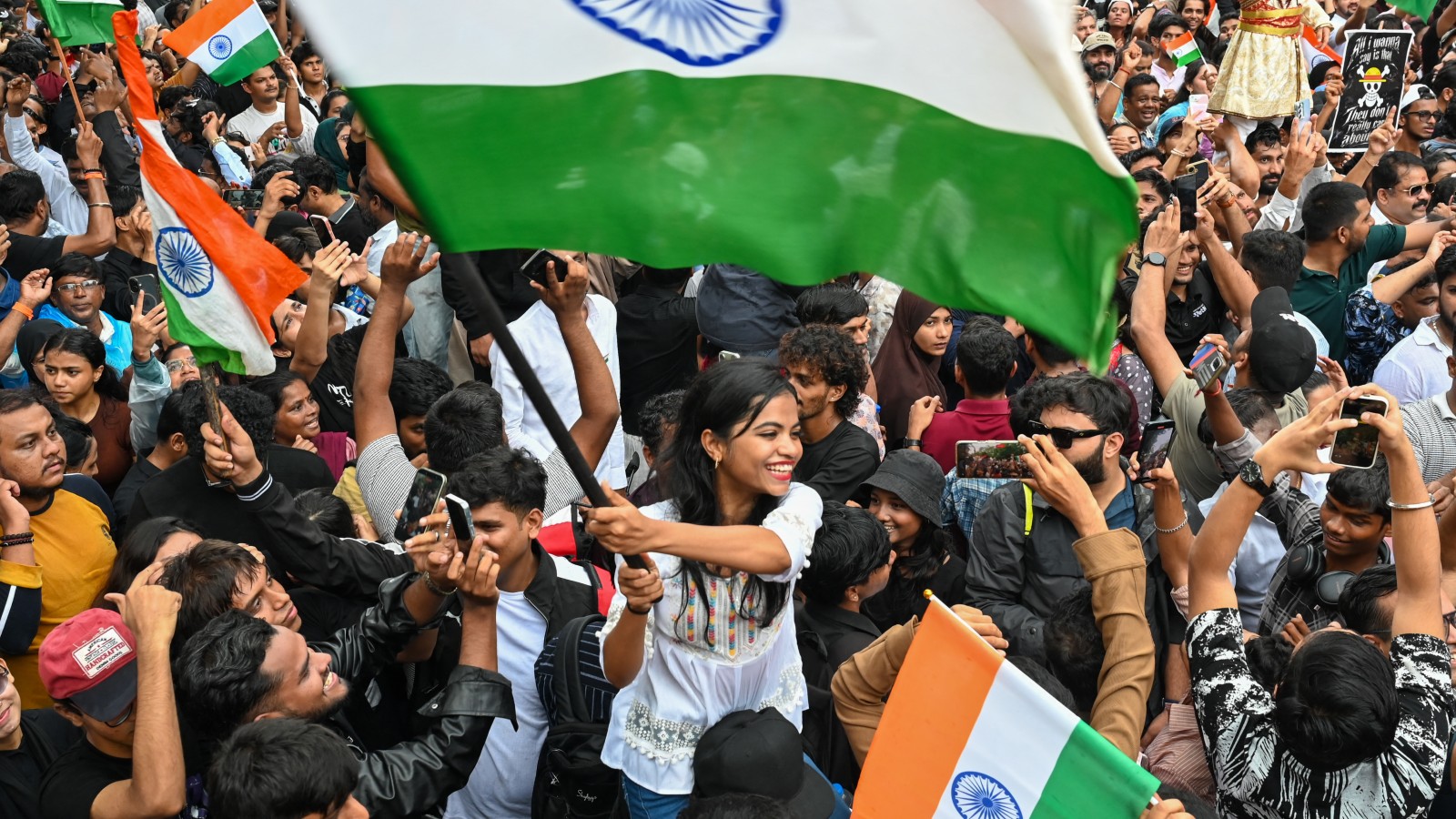
Submitted by Anuradha Bhasin on Wed, 09/23/2026 - 11:36 The real danger isn't in how these lethal technologies, including pellet guns, are exported and shared; the greater peril is in the precedent their use against civilian protesters sets Cockroach Janta Party (CJP) supporters wave national flags a day after the resignation of India's Education Minister Dharmendra Pradhan in Mumbai, India, 26 July 2026 (Punit Paranjape/AFP)
On
Cockroach Janta Party (CJP) supporters wave national flags a day after the resignation of India's Education Minister Dharmendra Pradhan in Mumbai, India, 26 July 2026 (Punit Paranjape/AFP)
On
In July 2026, Amnesty International published a report Made in India: the supply of weapons and munitions to Israel. It found India shipped hundreds of thousands of weapon parts and munitions components to Israel throughout its Gaza offensive, and it warned the exports carry a "substantial risk" of contributing to what it calls Israel's "ongoing genocide".
The real danger isn't only in how these lethal technologies are exported and shared. The greater peril is in the wrong precedent their use against civilians sets.
A telling example is the use of pellet guns by police in Delhi to control a student’s march to the Indian parliament in protest against an examination leak scam, which injured at least 10 civilians, including a young man who may lose his vision forever.
The journey of the use of pellet guns for crowd control from Kashmir to New Delhi reminds us that any battleground is always a testing ground. What gets legitimised in one place does not stay there.
India introduced pellet guns in 2010 in Kashmir and framed it as a "non-lethal" or "less-lethal" weapon for crowd control. Between 2010 and 2019, 24 people were killed. Most casualties happened after their widespread use to control violent protests following the death of militant commander Burhan Wani, who was killed in an encounter in 2016. Between July 2016 and February 2019, metal pellets killed 18 people, blinded 139, and resulted in 2,942 injuries, of which 1,459 were serious eye injuries.
A pellet gun is a .12-bore pump-action shotgun, normally used in bird hunting, that fires a cartridge loaded with several hundred metal pellets that disperse over a wide area rather than travelling as a single projectile.
Each cartridge holds up to several hundred small pellets. On firing, the pellets scatter outward in a wide spray at about 100-150 metres per second. Because of this spread, one shot can strike multiple people in a crowd at once.
In short, it doesn’t choose its target. It can hit anyone within that range. The enormous scale of injuries, even deaths, caused by pellets in Kashmir and the people they hit - a girl sitting by her window, a baby in her mother’s arms - made no distinction between allegedly violent protesters and those who just happened to be in the wrong place at the wrong moment.
Opening old wounds
The brutality of the pellet guns cannot be fully comprehended without understanding how the lives of the majority of the victims are scarred forever.
Despite the "less-lethal" tag, the pellets are sharp enough to pierce the skin and stay embedded in the body, causing permanent pain in some cases. On occasion, they have caused permanent blindness. The psychological wounds they inflict are irreparable. There have also been cases of injuries resulting in deaths.
Yet, the use of pellet guns in Kashmir was justified under a manufactured broad consensus built entirely through a security prism.
The state embraced the weapon, framing it as "non-lethal", despite documentary evidence of hundreds blinded, scores killed, and many others permanently disabled. It invited no uproar or outrage. This nationwide tendency to see Kashmir as a state of exception has also encouraged a shameful mocking of its victims - the latest example being the forthcoming Bollywood film Chauhaan.
It was used with the bland justification: terrorism, national security. This, even as there is no documentary evidence of the weapon ever being used against insurgents - only on civilian protesters. A security doctrine, borrowed from international playbooks, and built for a region on the pretext of insurgency, is now being exported.
History of violence
Before its use in Delhi, pellet guns were used during the farmers’ protest and in Manipur. Their use in Delhi against protesting students evoked nationwide outrage, with the framing "they were students, not terrorists’". That framing never extends to the community the national imagination has already conflated with terrorists - Kashmir, Manipur and Punjab (whose farmers led the protests). The presumption of innocence isn't universal. It is assigned by identity.
 Lethal weapon: How Bollywood's 'Chauhaan' trivialises the suffering of Kashmiris maimed by Indian forces
Read More »
Lethal weapon: How Bollywood's 'Chauhaan' trivialises the suffering of Kashmiris maimed by Indian forces
Read More »
Far more problematic is the state response that is still relying on old tactics of skirting questions about pellet injuries. It has moved from denial to deflection but no accountability.
As opposition leaders led by Congress, a party that ironically introduced pellet guns in 2010, are uniting and demanding answers to who ordered the pellet guns and why, India’s home minister Amit Shah has refused to attend parliament.
Zero accountability automatically translates to a continuum of use of pellet guns or other weapons framed as "non-lethal’". In Kashmir, there is a documented record of young men killed when tear gas shells were directly aimed at their upper bodies in 2010.
Even the Supreme Court has refused a total ban on the use of pellet guns and has deflected the question to examining the gaps between standard operating procedures and realities on the ground. The debate on whether lethal weapons can be used for crowd control is incomplete if restricted to these issues.
The debate also needs to take into account the impact of weapons that are projected as "non-lethal" or "less-lethal" but kill people nonetheless. It needs to weigh up the fact that a bad precedent travels from one geography to another and beyond borders.
Lethal export
Pellet guns have already travelled the globe. The United Kingdom is the first known country to have deployed shotguns with rubber and plastic pellets during the Troubles, the 30-year violent conflict in Northern Ireland, and inspired the United States police to adopt similar versions of the weapon for crowd control.
Pellet guns are just another demonstration of how quickly any state learns that civilians can be treated as acceptable targets once the first wrongful justification goes unchallenged
Pellet guns, along with other so-called "non-lethal" weapons, have been used with impunity in Palestine. Whether India borrowed this method of repression from Israel or not, the list of countries now using it to target their own citizens is growing.
In Chile in 2019, 230 people lost their vision. Bangladesh used it in 2024, killing 22 student protesters and blinding 400. They were used in the recent Iran protests, with at least 74 documented cases of pellet injuries in vital parts of the body. A man’s lung was damaged by 174 pellets tightly packed inside his right chest cavity.
The pellet guns are just another demonstration of how quickly any state learns that civilians can be treated as acceptable targets once the first wrongful justification goes unchallenged.
Nuclear strikes may be a rare exception, but there are enough examples, like the use of white phosphorous and drone air strikes that reveal a brutal truth: what is used in one place doesn’t stay there; it travels wherever the next authority wants the same cover of impunity.
The views expressed in this article belong to the author and do not necessarily reflect the editorial policy of Middle East Eye.
Gaza aftermath Opinion Post Date Override 0 Update Date Mon, 05/04/2020 - 21:29 Update Date Override 0Read the full story at the source
Source: Middle East Eye