
World · Middle East Eye · · 2h
Muqtada al-Sadr says US should compensate Iraqis as last American forces leave
English (original) · Read in Deutsch ⇄
Muqtada al-Sadr says US should compensate Iraqis as last American forces leave
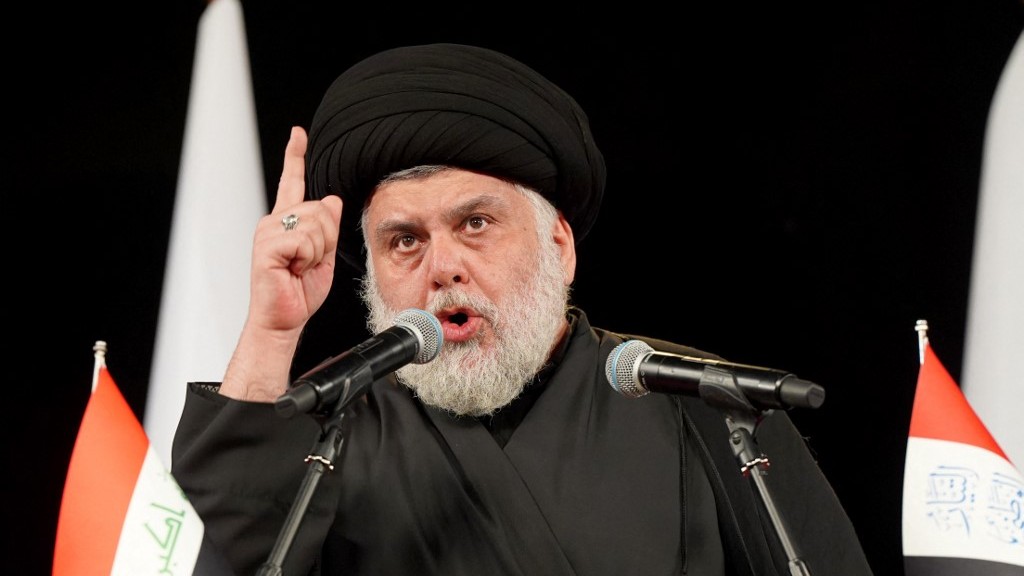
Submitted by Alex MacDonald on Wed, 09/30/2026 - 10:36 Influential cleric urges Iraqis to file legal claims over two decades of 'occupation' Iraqi Shia cleric Muqtada al-Sadr delivers a speech during a ceremony marking the death anniversary of his father Grand Ayatollah Mohammed Sadeq al-Sadr, in the southern Iraqi city of Najaf on 1 May (Qassem al-Kaabi/AFP)
Off
Iraqi Shia cleric Muqtada al-Sadr delivers a speech during a ceremony marking the death anniversary of his father Grand Ayatollah Mohammed Sadeq al-Sadr, in the southern Iraqi city of Najaf on 1 May (Qassem al-Kaabi/AFP)
Off
Influential Shia cleric Muqtada al-Sadr has said the US should compensate Iraqis for the damage inflicted on the country, as the last American troops pull out of Iraq.
In a statement on Wednesday, which is the deadline for American forces to end their 12-year presence in the country, Sadr hailed the "independence of Iraq" and praised those who fought against the US.
"We demand compensation from the American army for all the damages that occurred as a result of its occupation of Iraqi lands," he said.
"Everyone should file legal complaints regarding this."
The US first occupied Iraq in 2003 following the overthrow of Saddam Hussein, before pulling out its forces in 2011.
They returned at the request of the Iraqi government in 2014 to tackle the spread of the Islamic State group, which had seized around a third of the country.
The US-led invasion in 2003 was widely regarded as illegal, and American forces in Iraq were accused of committing frequent war crimes and human rights abuses.
 US-Saudi strikes test Iraq's balancing act between Riyadh and Tehran
Read More »
US-Saudi strikes test Iraq's balancing act between Riyadh and Tehran
Read More »
Different accounts of the death toll from the invasion have been reported, with most ranging from hundreds of thousands of violent deaths to more than a million excess deaths.
Sadr said in his statement that the US, as well as "neighbouring countries", now needed to refrain from interfering in Iraqi affairs.
"This may lead to the severing of relations and reciprocal treatment, especially in political and ideological matters, and the dragging of Iraq into regional conflicts," he said.
"We hope that the United States will reciprocate diplomatically and not act arrogantly towards Iraq, its government, and its people."
No foreign interference
During the original US-led occupation of Iraq, Sadr led the Mahdi Army (later revived as Saraya al-Salam or Peace Brigades), an armed group that fought against the coalition forces, Iraqi security forces and al-Qaeda in Iraq, among others.
Sadr and his supporters have long framed themselves as an Iraqi nationalist group, opposed to both US influence on the country and interference from its powerful neighbour Iran.
On Wednesday, Sadr said the remnants of the Mahdi Army would be retooled as the Supporters of Imam al-Mahdi Foundation, a reference to Muhammad al-Mahdi, whom Shia Muslims believe is in hiding and will return alongside Jesus to usher in the end times.
He also suggested that all current politicians in Iraq step down from their positions to usher in new blood - to "end corruption and work towards reform" - as well as reiterating a need for all weapons in Iraq to come under the control of the state.
 As the US pulls its forces out of Iraq, what happens to Iran-backed armed groups?
Read More »
As the US pulls its forces out of Iraq, what happens to Iran-backed armed groups?
Read More »
The question of the integration of powerful armed groups in Iraq into the regular security forces has been linked to the US troop withdrawal.
Though the process was originally tied to the 30 September deadline, last week Prime Minister Ali al-Zaidi extended the deadline to June 2027.
A number of the most powerful Iran-backed groups - including Kataeb Hezbollah, Harakat al-Nujaba and Kataeb Sayyid al-Shuhada - have already indicated that they will not disarm, and the ongoing US-Israel war against Iran has made it unlikely the Islamic Republic will exert any pressure on them to do so.
"Disarmament needs a political agreement inside Iraq, a credible way of integrating fighters and command structures into the state, and some answer to the political, economic and ideological power these factions have built up over years," said Hayder al-Shakeri, a research fellow with the Middle East and North Africa programme at Chatham House, speaking to Middle East Eye.
"For the groups closest to Iran, it will also be extremely difficult without Iranian agreement or a broader regional de-escalation. Otherwise, you risk simply moving the weapons into another institution while leaving the same networks and chains of command intact."
Iraq War News Post Date Override 0 Update Date Mon, 05/04/2020 - 21:19 Update Date Override 0Read the full story at the source
Source: Middle East Eye