
World · Middle East Eye · · 2h
Israel chokes West Bank movement amid Jewish holiday
English (original) · Read in Deutsch ⇄
Israel chokes West Bank movement amid Jewish holiday
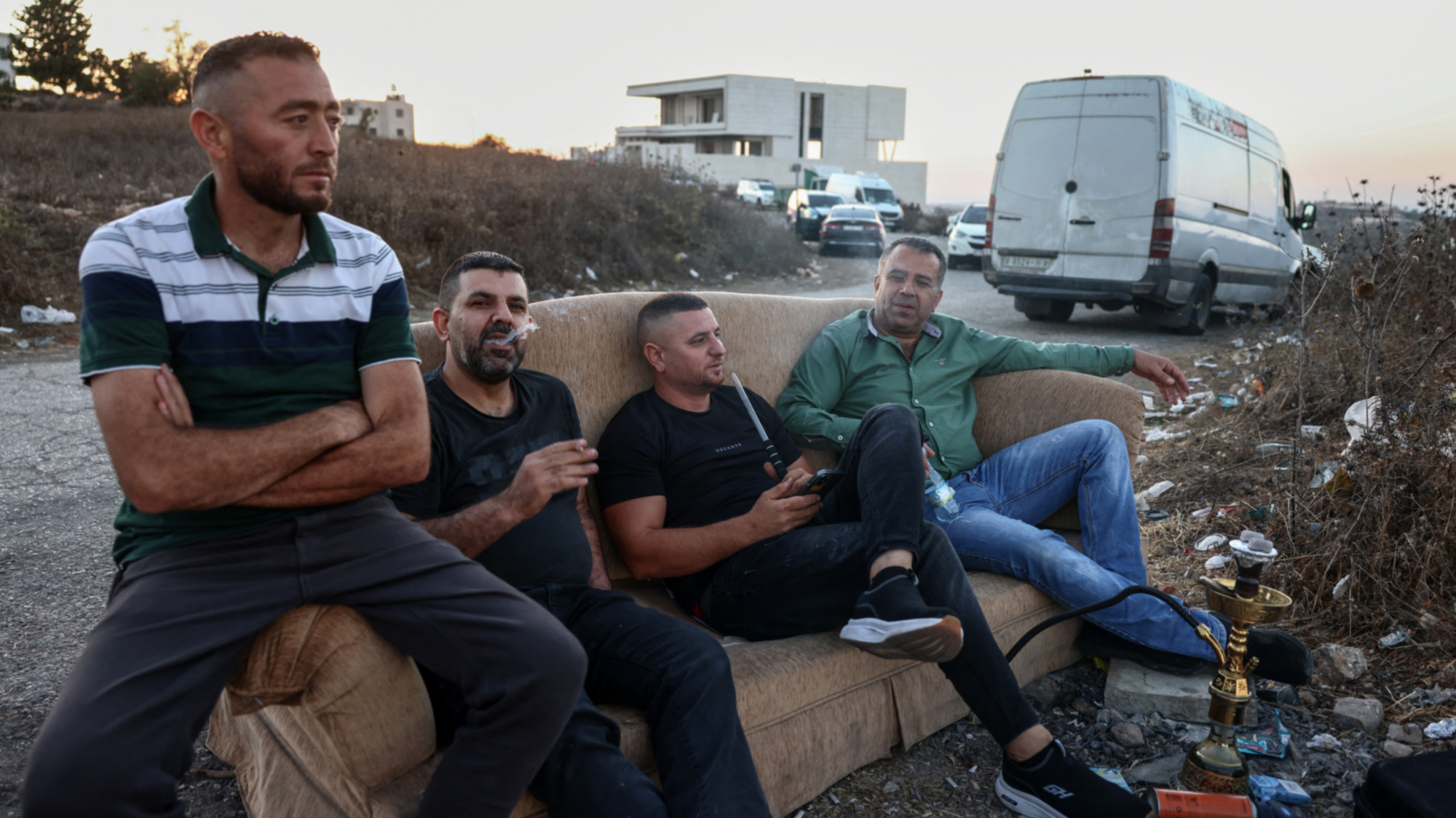
Submitted by Fayha Shalash on Mon, 09/28/2026 - 13:21 Roadblocks and checkpoints delay Palestinians and hamper ambulance crews reaching patients People sit on a sofa with a waterpipe to watch as commuters wait in their vehicles at the Israeli Atara checkpoint on Route 465 near Ramallah, occupied West Bank, 27 September 2026 (Zain Jaafar/AFP)
Off
People sit on a sofa with a waterpipe to watch as commuters wait in their vehicles at the Israeli Atara checkpoint on Route 465 near Ramallah, occupied West Bank, 27 September 2026 (Zain Jaafar/AFP)
Off
Israeli forces have stepped up restrictions on Palestinians in the occupied West Bank during the Jewish holiday of Sukkot, blocking roads, limiting movement and causing hours-long waits at checkpoints.
The army has blocked entrances to several towns and villages with iron gates and earth mounds, including on secondary roads, since the Jewish holiday of Sukkot began on 25 September.
Checkpoints have also been tightened across the territory, as a comprehensive closure of the West Bank is set to remain in place until the holiday ends on 3 October.
The Atara and Ein Siniya checkpoints north of Ramallah, along with the Jaba’ checkpoint northeast of Jerusalem, stand out as prominent examples of checkpoints characterised by long waiting times, particularly during peak hours.
These checkpoints slow the movement of Palestinians between villages, towns and cities, with delays often extending further depending on inspection procedures and conditions at the site, thereby creating major bottlenecks on routes used daily by thousands of Palestinians.
Attaf Abu Aliya, a taxi driver from the village of al-Mughayyir east of Ramallah, said he is forced to wait hours every day at checkpoints that soldiers frequently set up at the village entrance.
Under normal circumstances, the trip from al-Mughayyir to Ramallah takes only 30 minutes, but the tightened closure has turned the journey into an ordeal lasting many hours.
"Waiting for hours has become the norm; soldiers stand there without conducting searches or allowing vehicles to pass, simply to make our lives miserable,” Abu Aliya told Middle East Eye.
“Students miss university classes, and everyone's affairs are disrupted, all because of the whim of a single soldier," he added.
Abu Aliya said the situation becomes even more difficult when settlers take control of the checkpoint.
'Waiting for hours has become the norm'
- Attaf Abu Aliya, Palestinian taxi driver
At times, he said, settlers stop vehicles, block passage, smash windows and spray pepper spray at passengers waiting to cross.
Abu Aliya said he has been searched and beaten by soldiers several times while waiting at the checkpoint.
Waiting for more than four hours a day has become routine, he said.
“Our situation is truly tragic. That is the most accurate description of the lockdown and the tightened restrictions we are facing,” he explained.
Ambulance delays
According to data published on 25 September by the Commission Against the Wall and Settlements, the West Bank now has 942 checkpoints, closure points and other obstacles.
The figure includes 824 permanent checkpoints and closure points, as well as 118 barriers such as earth mounds, trenches and roadblocks.
The United Nations says the restrictions extend beyond existing checkpoints. New obstacles have been erected in recent months, further disrupting movement between Palestinian communities.
The restrictions are also hampering ambulance crews and medical teams, who need rapid access to patients across the West Bank.
 Israel attacking hospitals and blocking medical aid in the West Bank, warns MSF
Read More »
Israel attacking hospitals and blocking medical aid in the West Bank, warns MSF
Read More »
With village and town entrances closed, and checkpoints causing lengthy delays, paramedics are facing growing difficulties reaching emergencies and transporting patients to hospital.
Ahmed Jibril, director of the Emergency Medical Services Department at the Palestinian Red Crescent Society, said ambulances are given no priority or special status, and are often subjected to stricter checks.
Last week, an ambulance crew was unable to reach an elderly woman near Salfit because of closed checkpoints and iron gates, Jibril said. She later died.
“Checkpoints might open after long waits, but the greater challenge lies in the iron gates, which are sometimes permanently closed,” he told MEE.
“We are forced to find rough, alternative routes, which affects how quickly paramedics arrive and, consequently, the lives of thousands of patients.”
Jibril also accused soldiers at military checkpoints of mistreating medical crews.
He said soldiers sometimes open ambulance doors and enter the vehicle under the pretext of checking a patient's condition. Medical workers are then forced out of the ambulance, while soldiers confiscate the vehicle keys, he said.
The UN Office for the Coordination of Humanitarian Affairs (Ocha) said Israeli movement restrictions affect Palestinian access to healthcare, education, work, agricultural land and basic services.
Closures can also lengthen journeys, delay humanitarian aid and, in some cases, leave communities isolated for extended periods.
Occupation Ramallah, occupied Palestine News Post Date Override 0 Update Date Mon, 05/04/2020 - 21:19 Update Date Override 0Read the full story at the source
Source: Middle East Eye