
World · Middle East Eye · · 2h
Houthi attacks expose gaps in Pakistan's defence pact with Saudi Arabia
English (original) · Read in Deutsch ⇄
Houthi attacks expose gaps in Pakistan's defence pact with Saudi Arabia
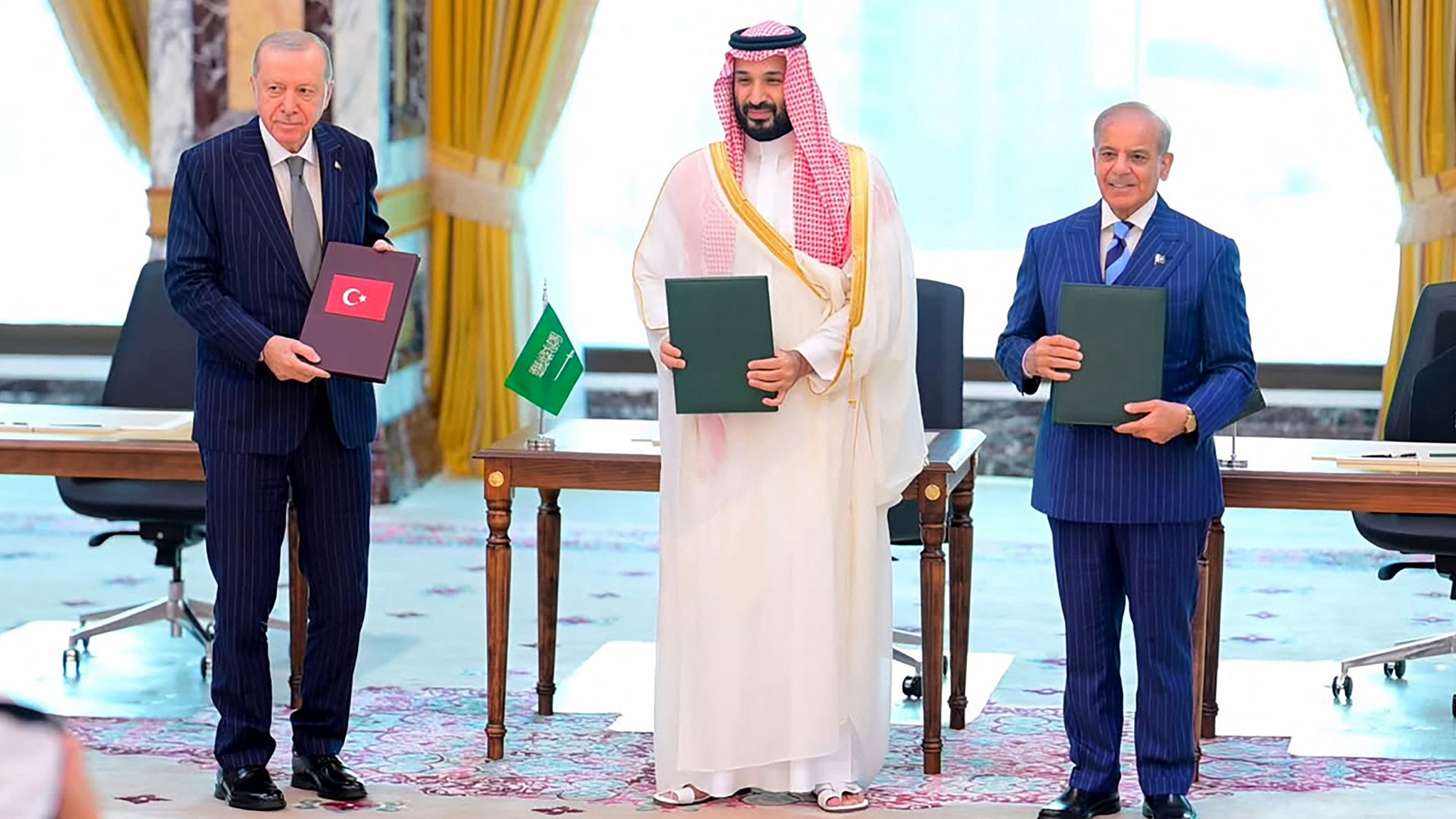
Submitted by Zia Ur Rehman on Mon, 09/14/2026 - 20:27 The attacks are the first test and have revealed some distance between the Mecca agreement’s promise of collective defence and allies’ lack of military plans Left to right: Saudi Crown Prince Mohammed bin Salman, Turkish President Recep Tayyip Erdogan and Pakistani Prime Minister Shehbaz Sharif posing after signing the Mecca Joint Defence Agreement in Mecca, Saudi Arabia, on 7 August 2026 (Handout/Pakistan prime minister's office/AFP)
Off
Left to right: Saudi Crown Prince Mohammed bin Salman, Turkish President Recep Tayyip Erdogan and Pakistani Prime Minister Shehbaz Sharif posing after signing the Mecca Joint Defence Agreement in Mecca, Saudi Arabia, on 7 August 2026 (Handout/Pakistan prime minister's office/AFP)
Off
After positioning itself as a regional mediator by facilitating talks between Washington and Tehran, Pakistan marked a major milestone in its expanding diplomacy last month: the signing of a trilateral defence pact with Saudi Arabia and Turkey in Islam’s holiest city.
Signed in Mecca on 7 August, the Joint Defence Agreement states that an attack on one signatory will be treated as an attack on all, drawing immediate comparisons to Nato’s Article 5, even as analysts cautioned against taking the clause too literally.
That commitment was quickly tested on 8 September, when Iran-backed Houthi forces launched a massive drone and missile barrage into Saudi Arabia, striking critical military and energy infrastructure. Overnight, an abstract commitment turned into a high-stakes operational question.
Neither Islamabad nor Ankara launched military counter-operations alongside Riyadh, choosing firm diplomatic statements instead.
For Pakistan, the dilemma is a serious one: how can Islamabad honour its security commitments to Saudi Arabia without being dragged into a wider Middle Eastern war?
Immediately after the Houthis’ attack, Pakistani Defence Minister Khawaja Muhammad Asif told the media that Pakistan is “bound by the terms and conditions of this pact, and we will honour them in case there is a need”.
However, foreign ministry spokesperson Sajjad Haider Khan clarified that direct military action against the Houthis was not under active discussion.
“Pakistan has signed a joint defence agreement, which is a fact... But as of now, there is no discussion of this kind,” he said on 10 September, during his weekly media briefing in Islamabad.
This response exposes a widening gap between political solidarity and direct military action, leaving Pakistan balancing its Saudi alliance against delicate ties with neighbouring Iran.
Pakistan walks a tightrope
Pakistan has a longstanding military presence in Saudi Arabia and has deepened defence cooperation with Riyadh considerably in recent years.
Under a separate bilateral defence framework - the Strategic Mutual Defence Agreement, signed in September 2025 - Saudi authorities in April confirmed the arrival of Pakistani troops, including fighter and support aircraft from the Pakistan Air Force, at King Abdulaziz Air Base in the kingdom amid rising regional tensions, to “support regional and international security and stability”.
 Pakistan says no plans for military action in Yemen after attacks on Saudi Arabia
Read More »
Pakistan says no plans for military action in Yemen after attacks on Saudi Arabia
Read More »
But there is a fundamental difference between helping Saudi Arabia protect its territory and infrastructure and joining an offensive campaign against the Houthis inside Yemen.
One Pakistani official familiar with Gulf affairs described the emerging position as a repeat, in some respects, of Islamabad’s dilemma in 2015.
In that instance, the Pakistani Parliament voted to remain neutral rather than join the Saudi-led coalition in Yemen, a decision that severely strained ties with Riyadh.
Experts familiar with the developments said that both Pakistan and Saudi Arabia appear determined to avoid being drawn into a wider regional war.
Qamar Cheema, head of the Islamabad-based Sanober Institute think tank, said neither country wanted the conflict involving Israel, the US and Iran to spill over into Saudi territory.
“This alliance will fight with state actors and work as a deterrent and a clear case of strategic depth, which Saudi Arabia is searching for,” Cheema told MEE, adding that Saudi Arabia wants to avoid a repeat of the crisis facing the Strait of Hormuz.
Maintaining this fine line between static defensive support and active military participation may prove increasingly difficult if Houthi missile strikes escalate further.
The Houthi factor
The situation for Pakistan remains volatile and largely tied to Houthi activity. A new geopolitical crisis has erupted along the Bab el-Mandab Strait after the Houthis announced a naval blockade against Saudi Arabia in July, invoking a strategy they term “blockade for blockade”.
'This alliance will fight with state actors and work as a deterrent and a clear case of strategic depth'
- Qamar Cheema, Sanober Institute
The move came as a direct response to Saudi-imposed restrictions on Houthi-controlled infrastructure, and followed an escalation that saw strikes on Sanaa Airport alongside drone and missile launches targeting Saudi air facilities.
According to the Pakistani official, Riyadh has concluded that political negotiations with the Houthis are no longer viable, forcing the kingdom to prepare for an extended military engagement.
Pakistan joined the Saudi-led Multinational Maritime Defence Alliance, launched on 30 July at a meeting in Riyadh attended by military representatives from more than 40 countries.
Fourteen countries, including Pakistan, Saudi Arabia, Turkey, Egypt, Qatar, Kuwait, Bahrain, and Jordan, backed the initiative to protect shipping lanes through the Bab el-Mandeb Strait, the Red Sea and the Gulf of Aden.
Beyond this, Pakistan actively participates in regional maritime security operations through US-led Combined Task Force 150, a multinational naval coalition operating in the Red Sea and Bab el-Mandab Strait.
The immediate priority for Pakistan appears to be avoiding escalation.
“If Houthi missile strikes escalate further or result in mass casualties among Pakistani personnel stationed at strategic sites in Saudi Arabia, public and political pressure in Islamabad could force the government’s hand [to act],” the Pakistani official warned.
That possibility could turn the current ambiguity into a direct test of the trilateral pact.
Cheema said attacking the Houthis was not an option for Pakistan at this stage.
Having positioned itself as a peacemaker, he said, Islamabad was “seeking to use dialogue to help contain the crisis, particularly as the closure of the Strait of Hormuz and the potential disruption of the Gulf of Aden could put other vital maritime routes and global supply chains at risk”.
The Iran factor
For Pakistan, the most complex element in this strategic equation is Iran.
Sharing a porous 900-kilometre border, both nations routinely seek to contain friction, especially after exchanging cross-border missile strikes in January 2024.
A Pakistani offensive against the Houthis would risk reigniting direct conflict with Tehran, the group’s primary backer, though the nature and extent of its support remain contested.
 Qatar and Pakistan carry Trump’s message to Iran: He won't return to the MoU
Read More »
Qatar and Pakistan carry Trump’s message to Iran: He won't return to the MoU
Read More »
Directly engaging an Iranian proxy could severely strain bilateral ties and create new security pressures along Pakistan’s western frontier, experts fear.
Domestic stability adds further complexity. Pakistan hosts one of the world’s largest Shia populations outside Iran, many of whom look to Tehran for religious guidance under the Wilayat-e Faqih doctrine.
Though Pakistan's military leadership managed internal unrest in the country following violence after Supreme Leader Ayatollah Ali Khamenei’s killing in US-Israeli air strikes on Iran on 28 February, sectarian sensitivities remain an ever-present constraint whenever relations with Tehran sour.
Economic fallout also poses an immediate threat. Pakistan relies heavily on Middle Eastern energy and critical shipping corridors like the Strait of Hormuz and the Red Sea.
Regional instability can rapidly spill over into domestic markets; recent Middle East hostilities triggered an abrupt spike in domestic fuel prices within a single week.
Three countries, three security priorities
The alliance also faces a deeper problem: Pakistan, Saudi Arabia and Turkey do not share identical threat perceptions.
Pakistan’s principal military concern remains India, with tensions with Afghanistan’s Taliban regime over cross-border militancy adding another layer to its security calculations.
Saudi Arabia’s priorities are different. Riyadh is primarily concerned with protecting its territory, energy infrastructure and maritime routes while managing threats from Iran and armed non-state groups, such as the Houthis, particularly along its southern frontier.
Turkey has an even broader security perimeter, extending across Syria, Iraq, the Eastern Mediterranean and the Caucasus.
These divergent priorities raise a fundamental question: would each member be prepared to incur major economic and geopolitical costs to defend another against a conflict that it does not regard as its own?
This operational friction is further compounded by disparate military hardware platforms across the three armies.
Saudi Arabia depends heavily on sophisticated western and US-supplied defence platforms. Pakistan operates a large inventory of Chinese-origin systems alongside western equipment, while Turkey has invested heavily in its indigenous defence industry.
An alliance still taking shape
The trilateral arrangement itself remains a work in progress.
Ministers and military officials from Saudi Arabia, Pakistan and Turkey met in Istanbul on 31 August to establish a permanent secretariat in Saudi Arabia and pledge cooperation on defence technology.
 Why the Mecca defence pact hasn’t triggered action against the Houthis
Read More »
Why the Mecca defence pact hasn’t triggered action against the Houthis
Read More »
But experts say the pact is still a general framework rather than an integrated military command.
Specifics of the pact, including air defence assistance, intelligence sharing, and protection of Saudi military installations or naval operations, are yet to be seen, as well as the question of participation in offensive operations against the Houthis.
“A lot of institutional development is required at the moment, particularly in inter-military planning and interoperability among the armed forces of the three countries,” Cheema said.
The countries also need to establish clear procedures for responding to threats from both state and non-state actors, he said.
Khan, Pakistan’s foreign ministry spokesman, acknowledged the limitations last week, describing the pact as an “umbrella agreement” whose institutional mechanisms would take time to develop.
“At this stage, I don’t think we should be discussing this topic in the context of its operationalisation,” he told journalists.
War on Iran Islamabad News Post Date Override 0 Update Date Mon, 05/04/2020 - 21:19 Update Date Override 0Read the full story at the source
Source: Middle East Eye