
World · Middle East Eye · · 2h
Flock cameras are the latest weapon of America's post-9/11 surveillance state
English (original) · Read in Deutsch ⇄
Flock cameras are the latest weapon of America's post-9/11 surveillance state
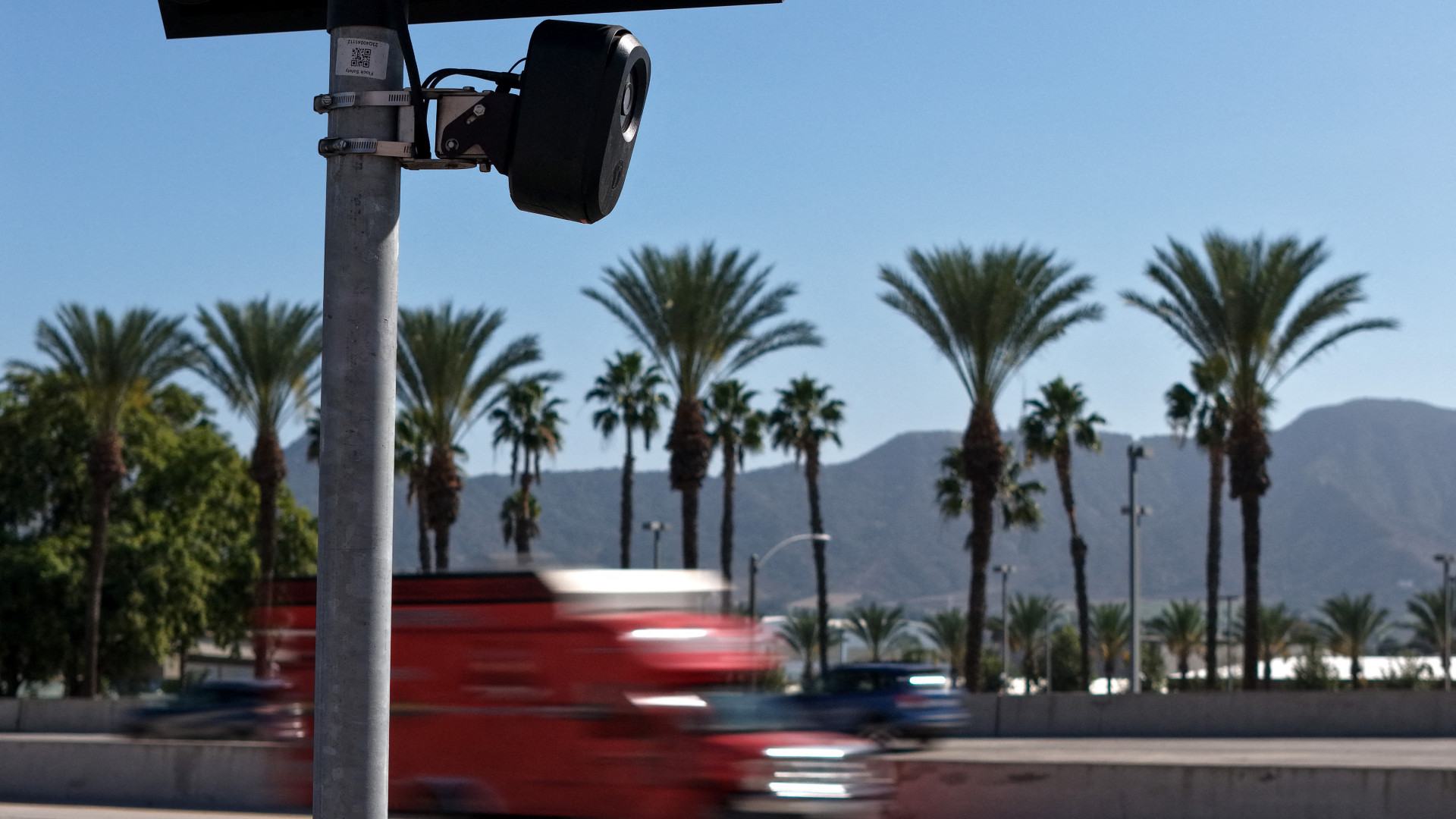
Submitted by Belen Fernandez on Mon, 09/21/2026 - 22:53 Bipartisan outrage over roadside tracking will do little to undo decades of government spying and the lucrative trade in technologies tested on Palestinians A Flock camera monitors passing traffic in Burbank, California, on 14 September 2026 (Justin Sullivan/Getty Images via AFP)
Off
A Flock camera monitors passing traffic in Burbank, California, on 14 September 2026 (Justin Sullivan/Getty Images via AFP)
Off
In December 2021, nearly two years into the coronavirus pandemic, I flew from Mexico, which had become my de facto place of residence, to the United States, my country of birth and the place I had spent nearly two decades avoiding like the plague - the short explanation for which was that I found it incredibly creepy.
Arriving at Dallas Fort Worth International Airport, I discovered that things had become even creepier than usual when, in the immigration line for US citizens, I was told to simply look at the camera rather than produce my passport.
A sign on the wall sponsored by US Customs and Border Protection (CBP) featured a smiling grey-haired man and the assurance to air travellers that this was all in their best interest: "Our policies on privacy couldn't be more transparent. Biometric Facial Comparison. Faster meets more secure."
Of course, hardly anyone bats an eye anymore at such technology. Last year, the US government's Federal Register cited CBP's calculation that only about 0.13 percent of US citizens arriving in the country by air opted out of biometric processing.
Surveillance state
The normalisation of mass surveillance and tracking mechanisms was put on the fast track following the attacks of 11 September 2001, when the George W Bush administration hurriedly pushed through that infamous legislation known as the Patriot Act, paving the way for a full-fledged surveillance state and the evisceration of basic rights.
Among its myriad provisions, the act called for a particular focus on "the utilization of biometric technology" in the development of "the integrated entry and exit data system for airports, seaports, and land border ports of entry".
The gradual countrywide onslaught of facial recognition technology would go on to make life hell for numerous Black people, Latinos and others who faced disproportionate misidentification by error-prone software.
In the aftermath of 9/11, Arabs and Muslims bore the brunt of antagonism by the new-and-improved security state
And yet that was just the tip of the iceberg. The Patriot Act enabled the US government to engage in wanton spying on its own citizens - including through the mass collection of phone records - and to indefinitely jail immigrants.
As the American Civil Liberties Union (ACLU) noted, the legislation furthermore authorised the government to "collect information about what books you read, what you study, your purchases, your medical history, and your personal finances".
On top of that, it prohibited the "holders of this information, like librarians, from disclosing that they [were] ordered to turn over such records - a gag order provision backed by... the threat of jail time".
One can only hope that some library patron with the misfortune to be told on by their librarian might have had the ironic foresight to check out a copy of Orwell's Nineteen Eighty-Four.
It goes without saying that, in the aftermath of 9/11, Arabs and Muslims bore the brunt of antagonism by the new-and-improved security state, as an array of domestic law enforcement outfits had a field day violating rights left and right.
In one case that I've written about before but that bears returning to in light of its utter preposterousness, the notoriously misbehaved New York City Police Department (NYPD) issued a report in 2007 titled "Radicalization in the West: The Homegrown Threat".
According to the NYPD's keen anthropological analysis, one sign of potential radicalisation and eventual "jihadization" among young Muslims was the renunciation of "cigarettes, drinking, gambling and urban hip-hop gangster clothes". (Given that such attire was liable to instead make the wearer a target of invasive stop-and-frisk policies, it seems the NYPD might have devoted more time to thinking through its wardrobe guidelines for Muslims.)
Tested on Palestinians
No discussion of the post-9/11 mass surveillance panorama would meanwhile be complete without a mention of Israeli companies like Elbit Systems, which, with their extensive experience testing out oppressive technologies on Palestinians, were well-positioned to cash in on lucrative opportunities in the US.
A 2020 infographic courtesy of the Visualizing Palestine website illustrated some of the contributions made thus far along the southern US border by Elbit Systems, whose US subsidiary goes by the name Elbit Systems of America.
Since 2014, the website noted, Elbit Systems had installed 53 surveillance towers in southern Arizona, each of them "up to 160 feet tall, employing a 7.5-mile camera range and 13-mile radius of ground-sweeping radar".
Not only did "these instruments of human control expand a layered system of US border militarization", but they also reinforced a system that "violates the rights of indigenous Hia Ced O'odham and Tohono O'odham citizens, kills migrants, and represses freedom of expression".
Anyway, no one commits indigenous rights violations and territorial infringement like the Israelis.
Unfortunately, repression is an industry that keeps on giving, and in July this year, the Jerusalem Post reported that Elbit Systems had just racked up more than $370m in additional CBP contracts.
It's worth recalling, too, that American tech companies like IBM, Microsoft, Google, and Amazon took advantage of the fertile terrain in Israel to fine-tune their own surveillance know-how in the service of domestic dystopia.
Now, the explosion of artificial intelligence (AI) has taken dystopia to a whole new level, as existing and aspiring billionaires appear more determined than ever to accelerate humanity's demise.
Mass stalking
Amid the sudden plunge into an AI-dominated world where there's little room for oversight or transparency, one issue that has managed to capture a bit of the spotlight in the US is that of the automatic licence plate readers (ALPRs) that have proliferated along highways and roads, many of which are manufactured by a firm called Flock Safety.
While police claim that Flock cameras are used only for crime-fighting and other noble pursuits, many members of the public remain decidedly unconvinced that it's a good thing to have their every vehicular movement surveilled and analysed by ubiquitous AI-powered devices.
 Trump's war on dissent uses powers tested on Muslims
Read More »
Trump's war on dissent uses powers tested on Muslims
Read More »
In light of the public backlash, politicians from both parties have also found it handy in the run-up to the November midterm elections to speak out against this egregious violation of privacy.
The cameras' case has not been helped by their rampant misuse for stalking purposes by law enforcement officers countrywide - like the policeman in Kentucky who was arrested after allegedly using the Flock system to track his ex-girlfriend more than 2,000 times.
But what is surveillance in the end if not a form of mass stalking by the government?
A quarter of a century after 9/11 set the stage for the present moment, it's safe to say that some bipartisan hullabaloo over Flock cameras is not enough to stop the surveillance state.
And as we hurtle down the camera-lined highway to doomsday, it's way too late to put on the brakes.
The views expressed in this article belong to the author and do not necessarily reflect the editorial policy of Middle East Eye.
9/11 Attacks Opinion Post Date Override 0 Update Date Mon, 05/04/2020 - 21:29 Update Date Override 0Read the full story at the source
Source: Middle East Eye