
World · Middle East Eye · · 3h
Athen’s rebel quarter Exarcheia fights gentrification and state repression
English (original) · Read in Deutsch ⇄
Athen’s rebel quarter Exarcheia fights gentrification and state repression
Submitted by Elvis Takahashi Mantello on Fri, 09/25/2026 - 09:45 Influx of foreign capital and law-and-order crackdowns threaten legendarily left-wing neighbourhood A man runs from police in Athens on September 14, 2019, after a rally held to protest against police raids on migrant squats in Exarcheia neighbourhood (AFP)
Off
A man runs from police in Athens on September 14, 2019, after a rally held to protest against police raids on migrant squats in Exarcheia neighbourhood (AFP)
Off
For decades, Exarcheia has been one of the most politically and socially distinctive neighbourhoods in central Athens.
The area has been a gathering point for grassroots organisations, anti-authoritarian and left-wing groups, and migrants and refugees who found community support there.
But Exarcheia is changing, and the people who made it what it is are being pushed to the edge.
Rising rents, tourism, foreign property investment, redevelopment, and an expanding police presence are reshaping the neighbourhood and pressuring the community that has sustained its character.
“The human geography of Exarcheia is changing a lot,” says Nikos, a resident of Exarcheia and a member of the No Metro in Exarcheia Square assembly who has been in the movement since its beginnings around five years ago.
“The cost of living crisis is rampant at the moment,” he says.
Some people active in the neighbourhood’s social movements had to leave because of rising prices, he says, diminishing “the dynamics and the force of the community and of the neighbourhood”.
Exarcheia’s transformation began before the centre-right New Democracy government came into power in 2019.
During and after Greece’s turbulent economic crisis, short-term rentals such as Airbnb expanded across central Athens as international investors entered the property market. At the same time, prices remained relatively low.
The introduction of the Golden Visa programme - which grants a five-year, renewable permanent residence permit to non-EU nationals and their families - further encouraged foreign investment.
In Exarcheia, the shift was especially visible. A study by Athens Social Atlas found that foreign nationals accounted for 42.5 percent of property purchases in the area in 2018, with Israeli nationals the largest foreign buyer group during the period.
The government has since pursued a policy of increased state presence in Exarcheia alongside redevelopment projects. Tourism, foreign property investment, short-to medium-term rentals, and construction projects have accelerated the neighbourhood's transformation.
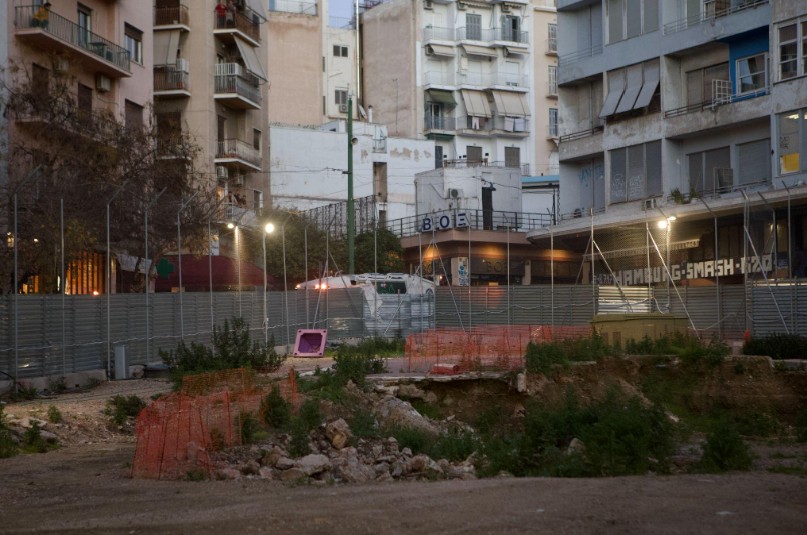
One major transformation is the construction of Metro Line 4 at Exarcheia Square.
Construction began in 2022, turning what had been a community gathering place into a hostile, fenced-off construction site.
The construction barriers raised safety concerns, at one point leaving only 1.5 meters of space between the site and surrounding buildings, which residents and activists said was insufficient for people and emergency vehicles to move safely.

For activists opposing the project, the square has become a symbol of what they see as the neighbourhood's wider transformation. It had long served as a meeting point for political organising and community life.
The construction has also brought an aggressive police presence. Nikos says the movement has faced “extreme police presence and police repression” around the construction, which he sees as a way of suppressing dissent.
The movement has responded through a range of tactics. “We have organised cultural activities, protests, and demonstrations; we have blocked the square; we have clashed with the police,” Nikos says.
Restoring 'normality'
Greek officials have increasingly framed Exarcheia in terms of restoring “normality” and state authority.
Days before New Democracy came to power in 2019, Thanos Plevris, now migration and asylum minister, filmed a widely publicised video at Exarcheia Square early in the morning, pledging a tougher approach to the neighbourhood’s self-governed and anti-authoritarian character.
The video became part of a law-and-order message around Exarcheia, with the incoming government promising to reassert state authority over a neighbourhood long associated with leftists and anti-fascist movements.
Years later, that approach is visible in the expanded police presence, the metro construction at the square and other redevelopment projects that have reshaped the area.
Activists reject the framing of this as simply restoring “normality”, arguing that the changes are also altering who can use the neighbourhood and who can afford to remain there.
 Turkish spy chief makes secretive visit to Greece amid rising tensions with Israel, report says
Read More »
Turkish spy chief makes secretive visit to Greece amid rising tensions with Israel, report says
Read More »
The pressure goes beyond the metro in Exarcheia. Nikos describes tourism, real estate investment and gentrification as part of the same broader transformation, as rising property values make it difficult for some longtime residents to remain.
The neighbourhood’s transformation is apparent as you wander around the square. Adjacent to the construction site, at the corner of Themistokleous and Solomou streets, stands the newly rebranded Square Hotel by X&N, formerly Hotel Exarchion.
The 93-bed hotel is being leased for 12 years through a tender by the Vasileios Exarchou Endowment. The only company to submit an offer was Aura 1 Monoprosopis SA, represented by Dan Israel Hineson. Greek financial outlet Dnews describes Hineson as a partner of Ficus Investments, an Israeli company.
The hotel is one example of Israeli investment in the Greek property market. Property transactions during the economic crisis showed that Israeli nationals had purchased 74 properties in the neighbourhood, more than any other foreign nationality.
Israeli investment has also remained significant in the Greek real estate market in recent years, reaching €129 million in 2024, a 46.5 percent increase from the previous year. Israeli buyers have also remained among the leading foreign property buyers in both Athens and Greece’s second-largest city, Thessaloniki.
Tourism has become an important part of Exarcheia’s changing economy. As tourist accommodation expanded beyond Athens’ traditional tourist districts, such as Plaka, Monastiraki and Psyrri, Exarcheia became increasingly accessible to visitors drawn to its alternative bars, restaurants, street art and reputation as a politically distinctive counterculture neighbourhood.
Researchers have described this process as the “touristification” of the area, with short-term rentals contributing to changes in the local housing market.
For some residents and activists, the issue is not tourists simply visiting Exarcheia, but how they engage with the neighbourhood and its political character.
Palestinian solidarity
Exarcheia has long been associated with Palestinian solidarity and opposition to Israeli state policy, and Israel’s military campaign in Gaza since October 2023 has given those politics renewed urgency. For some activists, Israeli visitors who openly express support for the Israeli government, its military campaign or Zionism can become a source of tension.
Pro-Palestinian posters and graffiti are visible throughout the neighbourhood, while demonstrations and solidarity actions have become part of its ethos.

For Ahmed, a Palestinian activist originally from Gaza who lived in Exarcheia, that connection becomes personal. “Exarcheia for me means to fight for your right,” he says.
Ahmed says his involvement in Palestinian solidarity organising grew partly from his time in the neighbourhood, where he built relationships with people who shared his ideas about freedom and resistance.
Whether Exarcheia can sustain what made it distinctive is uncertain. Nikos does not believe the neighbourhood can return to what it was a decade ago.
“I think, importantly, it is the fact that memory doesn’t fade away. There is a community that is eager to uphold this memory and to preserve it in a way,” he says.
“We are doomed to win,” Nikos says. “In a way, it is a necessity for us, for our community."
But as Exarcheia changes, the question remains: where will the people who made the neighbourhood go, and what will be left of the identity that made the place unique in the first place?
Culture Athens 'We are doomed to win': Athen’s rebel quarter Exarcheia fights gentrification and state repression News Post Date Override 0 Update Date Mon, 05/04/2020 - 21:19 Update Date Override 0Read the full story at the source
Source: Middle East Eye