
World · Middle East Eye · · 43m
Who gets to be Italian? The rise and rise of Islamophobia in Italy
English (original) · Read in Deutsch ⇄
Who gets to be Italian? The rise and rise of Islamophobia in Italy
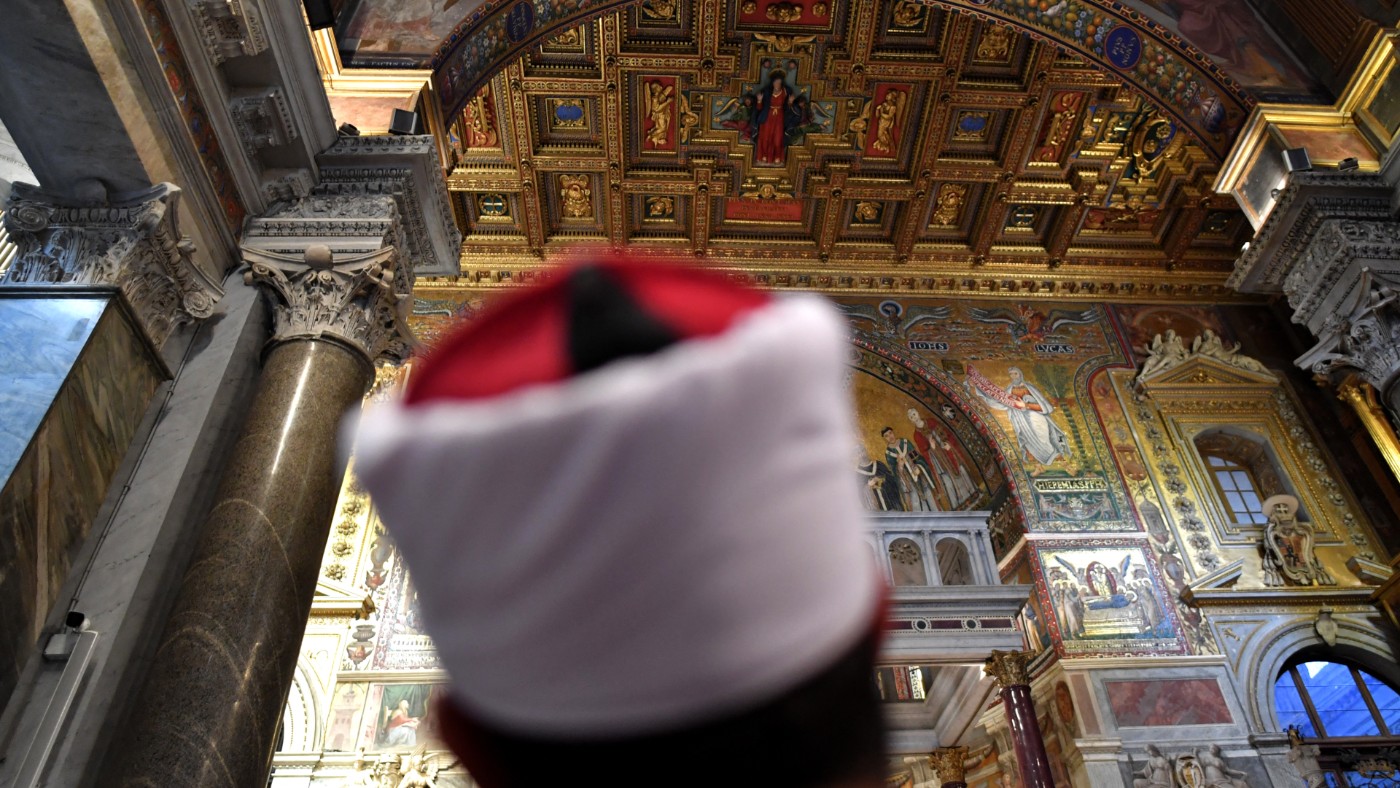
Submitted by Dalia Ismail on Fri, 09/25/2026 - 13:30 Giorgia Meloni's announcement of a ban on the burqa and niqab in schools comes as the Italian right competes over the demonisation of Muslims A Muslim takes part in a mass in Santa Maria in Trastevere church in Rome on 31 July 2016 (AFP)
Off
A Muslim takes part in a mass in Santa Maria in Trastevere church in Rome on 31 July 2016 (AFP)
Off
When Giorgia Meloni addressed hundreds of young supporters of her Brothers of Italy party in Rome on Sunday, she chose the school as a way of illustrating who she thought was and was not Italian.
“It cannot be that, in an Italian classroom, Italian children are the ones who feel cornered because they have become the minority. It cannot happen,” the prime minister told Fenix, the annual festival organised by National Youth, Brothers of Italy’s youth wing.
On Wednesday, Meloni’s government approved a ban on the burqa and niqab in schools and announced that a 30 percent cap will be imposed on children without Italian citizenship or poor knowledge of the Italian language in the first year of primary, middle and high school.
Meloni described the measures as “common-sense tools that do not divide but really help to integrate”.
The announcement comes as Italy moves towards an expected national election in 2027, with immigration, Islam and national identity once again central battlegrounds on the political right.
Meloni’s speech and the legislation immediately raised practical questions: who exactly is “foreign” and who is Italian?
Italy already has guidelines recommending a 30 percent ceiling for pupils without Italian citizenship. The distinction between “Italian” and “foreign” children also rests on citizenship, rather than on where children were born or have grown up.
Italy's citizenship system is based primarily on descent: children born in the country to non-Italian parents generally do not acquire Italian citizenship automatically.
As a result, children who were born in Italy and have spent their lives there can still be officially classified as foreign citizens. And Meloni's intervention did not come in isolation.
A mosque in Mestre
Last week, a banner declaring “Your integration is our ruin” appeared outside a school in Mestre, on the mainland opposite Venice, in an area with a large Bangladeshi community. Nearby, at a public park used by Muslims for Friday prayers, “No Islam” and Christian crosses were painted on the ground and on a wooden structure.
The incidents come as a dispute over plans by members of Mestre's Bangladeshi community to build a permanent mosque and Islamic centre on the site of a former sawmill becomes increasingly heated. The community has bought the land, but the project requires approval from local authorities.
We cannot allow an immigrant to become an Italian citizen so easily because then this citizen votes
- Roberto Vannacci, Futuro Nazionale
One of the project's most vocal opponents has been Anna Maria Cisint, a European parliament member for the right-wing Lega party who has repeatedly campaigned against the construction of new mosques.
In February, during a Lega protest outside the proposed site in Mestre, Cisint declared that the mosque would not be built if her political camp remained in power.
On the same Sunday that Meloni announced her school measures, Cisint appeared at the Lega’s annual rally in Pontida, the northern Italian town that has hosted the party's symbolic gathering for decades.
She was joined on stage by four activists from Nemesis, a French far-right group that describes itself as feminist. The activists were wearing full-face veils. As people on stage and in the crowd chanted “take it off”, the women removed them.
“The threat is radical Islam,” Cisint told the rally. “We will never allow them to Islamise our home. Never.”
The convergence was striking. In Rome, Meloni warned that Italian children could become a minority in classrooms; at Pontida, a coalition politician warned of the country’s “Islamisation”; and in Mestre, a mosque dispute was enflamed by anti-Muslim slogans.
The rogue general
At the same time, another political force is trying to carve out space further to the right.
Roberto Vannacci, a former army general who first became a national figure after publishing a book attacking immigration, feminism and LGBTQ+ rights, entered the European Parliament in 2024 with the Lega.
The “rogue general” later broke with the party and founded Futuro Nazionale, a new far-right movement that has made “remigration” - the removal of migrants from Italy - one of its defining themes.

The party is now registering around eight percent in some opinion polls ahead of the next general election, while the Lega, still led by Deputy Prime Minister Matteo Salvini, has fallen below six percent. The figures have intensified a struggle over voters on the Italian right and over how far its politics on immigration and national identity can move.
It was against this backdrop that Vannacci made one of his most explicit statements yet about who should be allowed to become Italian. Speaking at a conference on urban security organised by a police union in Turin on 18 September, he argued that Italy should not make citizenship easier for immigrants.
“We cannot allow an immigrant to become an Italian citizen so easily because then this citizen votes,” Vannacci said. “And when he votes, he does not vote for the good of Italian citizens but for his own good.”
When challenged over whether he was simply worried that naturalised citizens would not vote for him, Vannacci replied: “I'm not afraid that they won't vote for me. I'm afraid that they won't vote for Italy.”
Who gets to be Italian?
The former general’s argument raises a fundamental question: what happens when the person born or raised in Italy actually becomes Italian.
Fioralba Duma, an Italian-Albanian activist with the campaign group Italians Without Citizenship, told Middle East Eye that Meloni's remarks were particularly troubling because many of the children described as “foreign” have never known another country.
“It is sad, because you realise how little responsibility those in power take when dealing with such important issues, and how little they do to protect children and guarantee them equal opportunities,” she said.
'Petrol is approaching three euros a litre, and she is talking about girls wearing the niqab at school when there are no girls wearing the niqab at school'
- Ahmed Vall, Islamic Community of Rome
“Our struggle started 10 years ago - and for many people even earlier - but instead of reducing the number of people who are foreigners only on paper, that number continues to grow every year. We used to talk about newly arrived migrants. Today we are talking about third generations: the grandchildren of immigrants, born in Italy.”
Duma’s comments point to a contradiction that has become increasingly visible in Italy's political debate.
Politicians can speak of “foreign pupils” in classrooms even when those pupils were born in Italy, have spent their lives in the Italian education system and may speak Italian as their first language.
Italy's citizenship law remains largely based on jus sanguinis, or citizenship by descent. A referendum in June 2025 sought to reduce from 10 to five years the period of legal residence required for non-EU adults to apply for citizenship.
Around two-thirds of those who voted backed the proposal, but turnout was only around 30 percent, well below the 50 percent required for the result to be valid.
The Muslim threat narrative
The controversy over the proposed mosque in Mestre shows how these arguments are playing out beyond the classroom.
Part of the city's large Bangladeshi community wants to turn the site of the former sawmill into a permanent Islamic centre capable of hosting up to 1,500 worshippers. But the project requires a change in the area's planning designation, and Venice's centre-right mayor, Simone Venturini, has opposed the project.
Muslim organisations, meanwhile, accuse politicians of turning Islam into a political threat by focusing on issues that have little bearing on the everyday reality of Muslims in Italy.
 ‘Our land is not for sale’: Italian activists challenge Israeli-linked solar projects
Read More »
‘Our land is not for sale’: Italian activists challenge Israeli-linked solar projects
Read More »
Ahmed Vall, president of the Islamic Community of Rome, described Meloni's announcement on the niqab as “propaganda”. “We have never seen girls going to school wearing the niqab. It is a false problem,” he told MEE.
“Petrol is approaching three euros a litre, and she is talking about girls wearing the niqab at school when there are no girls wearing the niqab at school,” he said.
Vall said his organisation was prepared to challenge discriminatory measures through legal means, pointing to a complaint already filed against Lega MEP Silvia Sardone after she filmed and confronted a woman wearing a niqab in Turin.
Rula Mohamed, another Islamic Community of Rome activist, described the situation more starkly, telling MEE that Islamophobia in Italy had reached “extreme levels”.
“What we are seeing today is the extreme result of something that has been cultivated for years,” she said. This climate, Mohamed argued, had been built not just by the right wing, but through years of Muslims being portrayed in the media as dangerous and incompatible with Italian society.
This, she said, had been compounded by the failure of much of the centre-left to seriously confront Islamophobia.
Islamophobia Milan, Italy News Post Date Override 0 Update Date Mon, 05/04/2020 - 21:19 Update Date Override 0Read the full story at the source
Source: Middle East Eye