
World · Middle East Eye · · 57m
As the US pulls its forces out of Iraq, what happens to Iran-backed armed groups?
English (original) · Read in Deutsch ⇄
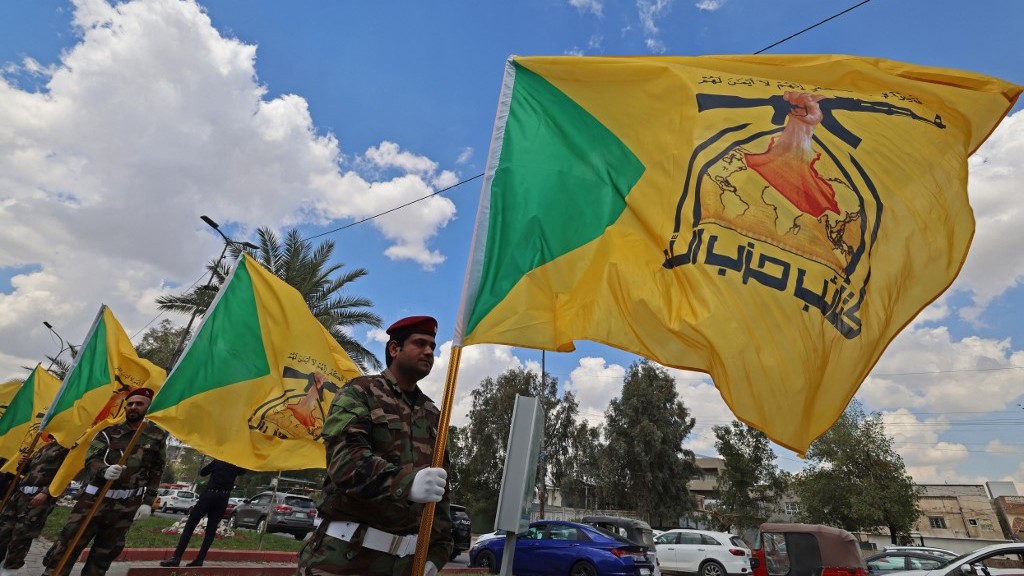
As the US pulls its forces out of Iraq, what happens to Iran-backed armed groups?
Submitted by Alex MacDonald on Tue, 09/29/2026 - 10:27 Powerful groups celebrate withdrawal of US forces as government sets new deadline for them to integrate and disarm Members of Iraq's pro-Iran paramilitary group Hezbollah Brigades (Kataeb Hezbollah) gather in a mourning procession for one of their comrades who was killed the previous day in a strike in Basra, Iraq, 8 April 2026 (Ahmad al-Rubaye/AFP)
Off
Members of Iraq's pro-Iran paramilitary group Hezbollah Brigades (Kataeb Hezbollah) gather in a mourning procession for one of their comrades who was killed the previous day in a strike in Basra, Iraq, 8 April 2026 (Ahmad al-Rubaye/AFP)
Off
The US has announced the withdrawal of its forces from Iraq, 23 years after the invasion that overthrew Saddam Hussein.
The development has been hailed by the Iraqi government as a final return to "national sovereignty" after years of American involvement in the country.
"October 1 will be a new day in the course of the Iraqi state, with the country free of any foreign military presence and the completion of national sovereignty over its territory," Iraq's Prime Minister Ali al-Zaidi said in a statement.
His statement is not quite accurate - Turkey still maintains a military presence in the country, though it has also pledged to soon hand over its Bashiqa-Zilkan military base in northern Iraq to the government.
The end of the US presence in Iraq, the deadline for which was 30 September, had originally also been tied to the disarming of the extra-government armed groups that, since the overthrow of Saddam, have been among the most powerful forces in the country.
Last week, however, Zaidi said a new deadline had been set for 30 June 2027 for the groups, some of which are financially and ideologically tied to Iran, to disarm and/or come under direct state control.
But the most powerful of these groups - Kataeb Hezbollah, Harakat al-Nujaba and Kataeb Sayyid al-Shuhada - have already said they are unwilling to do so.
"There is a realistic prospect for several armed groups to disarm and integrate within the state, some have already made it public that they are willing to do so and that is because their leaders see a political future for themselves," said Hamzeh Hadad, a visiting fellow with the Middle East and North Africa programme at the European Council on Foreign Relations.
"For the other armed groups, they have a different raison d’être, which is fighting for Iran’s political vision throughout the region. Therefore, they see no reason to disarm or integrate, and so the Iraqi state will have a more difficult time addressing them."
Deep links
There are a range of armed paramilitary groups in Iraq. Most of them were formed in 2014 after a call from Shia religious leader Ali Sistani to mobilise and defend the country from the Islamic State (IS) group.
That same year, the government also invited US forces to return to the country after having pulled out in 2011, also to fight IS.
But the most powerful armed groups are older and though they officially come under the authority of the state as part of Hashd al-Shaabi, or Popular Mobilisation Forces (PMF), they are effectively independent and (for the most part) loyal to Iran.
Since Saddam's overthrow the groups have established control over much of Iraqi society, with deep links to the political establishment, military and organised crime.
'For the army and security forces maybe they will have clashes with the militias and that's a very, very dangerous thing'
- Hisham al-Mozani, Al-Amal Association
During the US-led occupation and the war against IS, the groups were responsible for killing, kidnapping and torturing thousands of Iraqis, and helped suppress the pro-democracy Tishreen movement that erupted in 2019.
In recent years, a number of them have also grouped together under the heading of the Islamic Resistance in Iraq to target Israeli and US assets over the ongoing genocide in Gaza.
Overall, the ability or willingness of the Iraqi state to rein them in is in question, despite Zaidi's repeated promises to do so.
"I'm not optimistic about that honestly, the situation in Iraq is very complicated," said Ali al-Bayati, former Commissioner of the Iraqi High Commission for Human Rights.
He also said there was every chance the US could return to Iraq in the future as they did before.
Bayati, who now lives in Switzerland after being threatened and harassed for his work exposing rights abuses in Iraq, told MEE that the power of the armed groups was down in part to the US's own failings in building effective institutions in Iraq after 2003.
"The US-led international mission, yes, overthrew Saddam, and helped to establish a democratic constitution, but they failed to establish real democratic institutions," he explained.
"They fought IS and prevented its expansion in Iraqi territories and stopped its crimes, but the important question is why IS controlled a third of Iraq and the militias [had to be] formed?
"The answer is simple - they failed to form professional security and military institutions in spite of huge budgets."
'Blood of the martyrs'
The armed groups and their supporters have been jubilant at the US withdrawal.
A call went out on social media for Iraqis to gather outside the PMF's Media Directorate on Wednesday to celebrate the US withdrawal from Iraq, in what they said would be the "first annual festival".
"We invite you to attend to commemorate this occasion, which has come about through the blessing of the blood of the martyrs, the patience of the mujahideen in the Iraqi Islamic Resistance, and their steadfastness in the field," they said.
 Why does the US control Iraq's oil revenues?
Read More »
Why does the US control Iraq's oil revenues?
Read More »
However, with the Israeli-US war on Iran raging next door, the US has been upping the pressure on the Iraqi government to rein in Iran-linked forces.
Last week, US Secretary of State Marco Rubio warned that Iraq risked “Balkanisation” unless the state brought armed factions under its control. Washington has also increasingly intervened to warn against continuing or deepening ties with Iran.
Hisham al-Mozani, an activist with al-Amal Association rights group, told Middle East Eye that the push to disarm the groups risked returning the country to "civil war".
"For the army and security forces, maybe they will have clashes with the militias and that's a very, very dangerous thing - it will affect the economy, affect security in all of Iraq," he said.
He said he believed the process of disarming and integrating the groups would take around five years, even if the process began at all.
"Some of these militias are more than 40 years old, since the Iran-Iraq war in 1980, so they've had a long time and they're in the political parties, are present in the parliament and some of them are in the ministries," he said.
He added that ultimately, Iran would also have make the call, too.
Iraq War News Post Date Override 0 Update Date Mon, 05/04/2020 - 21:19 Update Date Override 0Read the full story at the source
Source: Middle East Eye