
World Left Voice
What If Generation Z Were Communists?
The ongoing high school student rebellion has sparked references to revolution everywhere. What if Generation Z were the ones to open up the possibility of a break with the past and a new horizon? The
English (original) ·Read in Deutsch ⇄
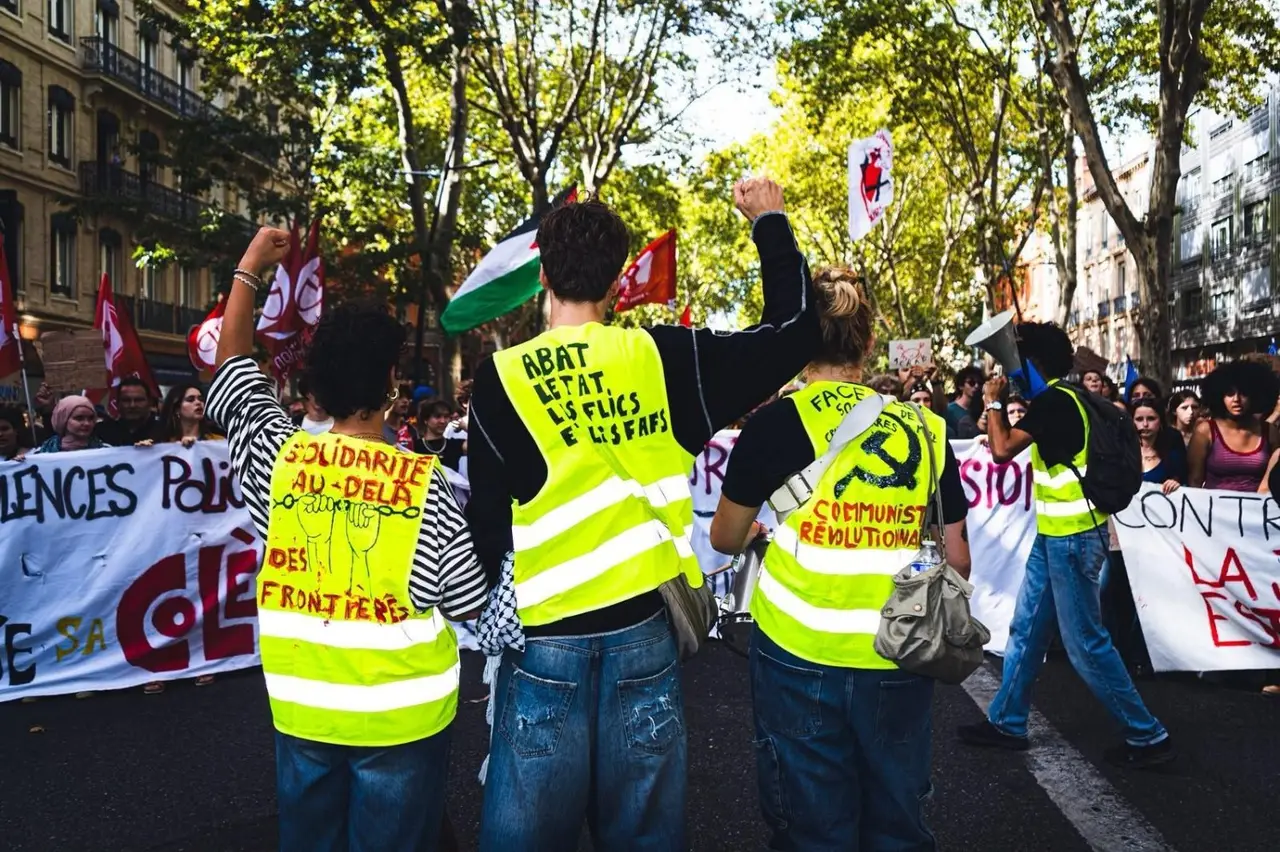
The ongoing high school student rebellion has sparked references to revolution everywhere — on posters and in slogans. Everywhere, capitalists seek to discipline the youth, subjugate them, and lock them away in isolation, brutality, and violence. What if Generation Z were the ones to open up the possibility of a break with the past and a new horizon? What if the future to which Gen Z aspires were, quite simply, communism? This article stems from a reflection fueled by (and intended for) the debates organized in the strike classes at the University of Mirail, which has been occupied since the start of the high school students’ blockades and mobilizations.
References to revolution flourished everywhere on the posters and slogans of the rebellious high school students. The mobilizing Gen Z proudly proclaims: “We already had the Revolution of 1789; our grandparents were part of ’68,” and now the 6-7 generation is setting out “to pull us out of the contemporary era.” The idea seems absurd: What could it possibly mean to step out of the era we’re in — by definition? — ask the boomers, dumbfounded. But that is precisely where the significance of this paradox lies. Wanting to “break free from the contemporary era” means pointing to the possibility of transcending the limits of the given.1See “October 17: The End of the Contemporary Age?” on the meaning of the “contemporary age” and on Benjamin’s conception of history, which is mentioned below. It means ushering in the possibility of a future beyond what currently exists; it means breaking free from the way we were shaped, from school-barracks and preestablished roles. It means taking to the streets and sowing there the seeds of what comes next.
Marx said that communism would turn the capitalist era into humanity’s prehistory — a way of saying that humanity, imprisoned in this bourgeois society, can change the course of history. For his part, Walter Benjamin, in his essay “On the Concept of History,” proposed a conception of history that posits the possibility of an interruption, of a radical rupture: historical materialism “seizes this opportunity and lifts a particular epoch out of the homogeneous course of history; a particular life, out of an epoch; and a particular work, out of the entire labor of a lifetime.”2Benjamin, Walter, On the Concept of History (Madrid, Dos Cuadrados, 2024), 90–91.
Young people threw themselves into this struggle for a different life with confidence, courage, humor, and determination. Their struggle is rooted in the country’s revolutionary and insurrectionary legacy. The Bastille is stormed, May ’68 is reenacted: images of the revolution seep into both newspapers and social media feeds. New inspirations and aspirations intertwine, and these glances toward the past serve to better question the future. “To historically articulate the past does not mean to know it ‘as it actually was,’ but to take possession of a memory as it shines forth in a moment of danger,” Benjamin warns. In the ring of history, then, several hooks. First punch: refusing to forget the revolts of the past. Second hook: refusing to let the bourgeoisie be the only ones to write history. With a single blow, we send Booba (“The victors write it; the vanquished tell the story”) and Sarkozy3Nicolas Sarkozy declared in Dakar in 2007 — when he was president of France — that “the tragedy of Africa is that the African man has not entered history sufficiently.” to the ropes. And finally, we knock them out: on October 17, we tell them, “We are the children of the Algerians they failed to drown.”4This phrase about “the children of the Algerians they failed to drown” refers to the massacre of October 17, 1961, in Paris, one of the greatest scandals in postwar French history. The police brutally suppressed massive demonstrations against a discriminatory curfew during the Algerian War of Independence. Dozens were killed, many shot and thrown into the Seine River. Many have still not been identified.
Memory and history become weapons to break free from the routine of the present. They endanger our future, which is why, with impatience and defiance, young people ask: “What do they have in store for us aside from genocide, recurring climate crises, and misery? The widespread rejection of a society that oppresses and represses youth is also a rejection of apathy. If this generation — raised with the idea that it’s easier to imagine the end of the world than the end of capitalism — takes to the streets at roadblocks to shout that they’re making the revolution, it means something is happening. The high school students’ rebellion follows in the footsteps of international uprisings erupting among youth, from the “Blochiamo tutto” movement, launched by Genoa’s dockworkers last October, to the unprecedented uprisings in Morocco, Indonesia, and even Nepal. If Generation Z “skips class to teach us a lesson,” it is to tell us that, far from being over, history deserves to be shaken up and revolutionized, and that the class struggle has not yet had its final say.
When reading the signs and listening to the slogans, one undoubtedly senses a rejection, a profound rebellion. But on a deeper level, one senses solidarity — the emergence of a collective body asserting itself against the entirety of socially produced divisions. As Carlotta Benvegnu points out, the social composition of the movement “embodies the subjective stratification of a decade of struggles in which individuals — at first glance very different from one another — such as union members, Yellow Vests, and young non-white insurrectionists — fought their battles separately, almost never together, almost never with the same slogans or the same tactics.” Sandro Mezzadra noted, when describing the “Blochiamo tutto” movement, a heterogeneity that transformed into power. In the high school students’ rebellion, there’s no shortage of heterogeneity! We’ve seen privileged young people stand in solidarity with young people from working-class neighborhoods, denouncing the racism they face from the school system — and not just from the police. This heterogeneity becomes power when everyone mobilizes together, not just to challenge the Ministry of Education but above all to fight for a future worth living.
This desire to stand together, to fight together, is explicitly aimed at overcoming racial, gender, and class segregation. In a video, a young man explains: “We’re thinking of you, girls — it seems there aren’t enough tampons at school, and the blockade also wants to make sure you don’t have to run out to find tampons.” The desire to fight together breaks taboos as powerful as that surrounding menstruation. They’re daring to talk about it. It’s striking that several prominent figures in the movement are young women unafraid to speak out and demand their rights. They denounce the mistreatment they suffer — particularly those from working-class neighborhoods and immigrant backgrounds — thus joining the massive waves of struggles against patriarchal violence that have been shaking the planet for nearly 10 years.
The “night of the barricades” on October 17 expanded that solidarity. Young people from working-class neighborhoods and universities, as well as workers from all sectors, began marching together. The government and its spokespeople, though somewhat taken aback, seized the opportunity to try to divide the movement — that is, the counterforce that had emerged through collective action. The “vandals,” the protesters, the good guys, the bad guys, the kind ones, the evil ones: all day long, editorialists lamented the burned-out trash cans and broken storefront windows. But what the “looting over the cost of living” on October 17 brought to light is the need for mutual aid, to reclaim what is ours — for our mothers and sisters, and sometimes even, “when we pass by the famous Sephora chain of perfume stores, we take things for our girlfriends,” as can be read on social media.
A new form of subjectivity is beginning to take shape, one that is committed to the collective. This emerging form could become a social reality if the current anger were to turn into a general strike. The path to getting there is fraught with obstacles; the rebellion must channel its anger through general assemblies to confront repression and forge ties with the labor movement. That is the task of self-organization, which must be built. That is what the group known as the Raised Fist aims to do within the movement. But what is the goal of building a general strike?
What if communism were the common foundation of all these young people’s aspirations? What if the generation they describe as individualistic and self-absorbed were fighting to declare that it believes in the possibility of a radically new world?
On this point, we agree with the argument put forward by Joseph Andras in his latest book, La vie bonne: Notre socialisme,5[6] Joseph Andras, La vie bonne: Notre socialisme (Quimperlé: Divergences, 2026). in which he defends the idea that our fight must once again be guided by a compass — socialism — whose evolution, contradictions, and struggles he reviews. Socialism is “the possibility of a good life for the greatest number of people.” This is a bold initial definition that stands in direct opposition to the caricature of socialism found in the history textbooks used in classrooms. During a protest, a senior student asked me, “Do you think I can draw the hammer and sickle on my sign? Isn’t that associated with Stalin? That’s what they told us in history class.” I replied, “That symbol has nothing to do with the USSR — which was a betrayal of its ideals — so you can hold it up without any shame.” “All the better,” she said, “because I like communism as a symbol. I like that idea of equality.”
A lovely bit of provocation. All the Trumps and Mileis in the world can try to ban the word on college campuses or criminalize it, but the idea lives on. The specter of communism frightens some, while others love it. An activist student, during an alternative workshop organized at the University of Mirail in Toulouse as part of the strike, summed up this ambivalence in her own words: the term “contains all the best and worst of the world — it’s extremely ambiguous.”
Let’s clear up the ambiguity. To think about communism in its best light, we have to articulate two things. On the one hand, there is what emerges as “communist” in words, in the slogans of protests, and in the practices expressed in blockades. On the other hand, there are the objectives — the broader project for which people are fighting. On the one hand, there is communism as “a real movement that abolishes and overcomes the present state of affairs,” as Marx and Engels put it in The German Ideology. On the other, there is the vision of a radically different society. “Moving beyond the contemporary era” involves thinking about both the movement and its vision; the two are mutually indispensable.
The goal of communism is, above all, to abolish the private ownership of the means of production. Far from the caricature of a communism that would force people to share toothbrushes or shoes, the goal is to end the hoarding by a minority of the means of production that feed, clothe, and house the majority. Abolishing private property would make it possible to organize society democratically. “From each according to their ability, to each according to their needs,” Marx said. Every individual could participate in organizing society, free from employer coercion. Goods and services would no longer be distributed according to people’s merit, effort, or wealth, but according to the needs of all. Communism is based on the principle of equality for all in deciding how to reorganize society and work, for what purposes, and by what means.
But these new modes of production and these new forms of social life cannot be fully planned, here and now, from our blockades of universities and schools. They can be defined only as the process that leads us to them unfolds. The principle of equality is grounded in a principle of freedom, at the heart of the “real movement”: emancipation — the unfolding of freedom in the full breadth of its possibilities — is both the end and the means of communism. “In place of the old bourgeois society, with its classes and class antagonisms, there arises an association in which the free development of each is the condition for the free development of all,” wrote Marx and Engels in the Communist Manifesto in 1848. As the Marxist thinker Harry Braverman explained in his work Labor and Monopoly Capital: The Degradation of Labor in the Twentieth Century, originally published in 1974:
Socialism, as a mode of production, does not arise “automatically” as capitalism did, in response to the blind and organic forces of the market: it must be brought into existence on the basis of appropriate technology through the conscious and deliberate activity of the human collective.6[7] Harry Braverman, Labor and Monopoly Capital: The Degradation of Labor in the Twentieth Century, trans. Gerardo Dávila (Mexico City: Editorial Nuestro Tiempo, 1975), 23.
If communism is the overthrow of society as it is — the one that imposes an 8:00 a.m. to 6:00 p.m. workday, grueling work rhythms, and paydays that never come — if it is the expropriation of the means of production from the bourgeoisie and the organization of society from the bottom up, it is because that is the condition for the emergence of new rhythms of life and work, a new everyday reality — one in which leisure, free time, culture, and debate are no longer merely a right but a shared reality.
Another poster even states, “I have so many classes that I no longer have time for a double date.”7In France, double dates are all the rage among young people. They’re popularly known as “2V2.” We live in a society where there is no longer time for love, for getting together, or even the possibility of hooking up and truly having fun. Communism, on the contrary, is the possibility of new forms of relationships, freed from the genders that classify and confine us, and it is precisely in the struggle that we realize they can be transformed — when we lift a trash can together to block the way, or when we link arms to confront repression. Simone Weil spoke, referring to the strikes of 1936, of a pure, unadulterated joy. She said, “It is a matter of — after having always given in, having endured everything, having put up with everything in silence for months and years — finally daring to stand up.”8Simone Weil, “La vida y la huelga de los obreros metalúrgicos”, en La condición obrera, trad. Trotta Editorial (Madrid: Editorial Trotta, 2014, p 165). That is the joy expressed by Spider-Man, Batman, aura battles, electric skateboards, and the humiliations inflicted on undercover cops … it is the joy of being different, of being different together.
In short, this is a real slap in the face to those who claim that social media has simply alienated young people. Here, those digital platforms turn against the powers that be and make it possible to organize a rebellion — this time, school is no longer a place of boredom but a place of possibilities, the focus of a society’s problems, and the symbol of the struggle that will resolve them. These cheerful kids are escaping the gloom of pessimism and its narratives, and they’re slipping through any crack to teach us a lesson about life in this world that, truth be told, is falling apart.
We’ll start by telling them that maybe you’re not “serious” at 17, but that, in any case, at 14 you can lose an eye fighting for a different future. What’s really not serious is defending a system as rotten as contemporary capitalism. Who can seriously defend a system in which our daily lives are marked by heat waves, the destruction of life, genocide in Gaza, and the march toward war? A system where people die because of the color of their skin? Who can defend a system in which a handful of large capitalist conglomerates decide what is produced, how it is produced, and for what purpose? But we must not delude ourselves. To establish another mode of wealth production, to abolish exploitation and the sources of oppression, we will have to be stronger than those who defend them. Through the use of LBD rounds (rubber bullets), batons, stun grenades, and tear gas, the police defend capital. Chanting “Down with the police state!” is one thing. It’s also up to us to take it seriously and to see it through to the end.
George Jackson, a Black communist activist imprisoned by the racist U.S. government who died in prison, wrote from his cell in California:
If we fail — whether out of cowardice or a lack of imagination — the slaves of the future will curse us just as we sometimes curse those of the past. I don’t want to die leaving behind only a few sad songs and a small mound of earth. I want to leave behind a world free of trash, pollution, racism, power built on misery, nationalism and the wars it brings, armies, intolerance, cliques, a hundred different lies, and a usurious, unregulated economy.
Words that resonate with what Gen Z is calling for today: we must break free from the present era, avenge the slaves of the past, and proclaim our right — without any limits — to the possibility of a free future.
This article was originally published in French in Révolution Permanente.