
World · Left Voice · · 2h
Ukraine s Air Offensive on Moscow: A Major Attack with Uncertain Outcomes
English (original) · Read in Deutsch ⇄
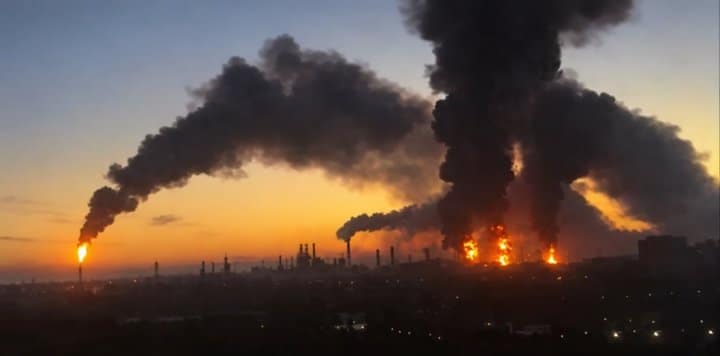
A barrage of drones and missiles launched by the Ukrainian military rained down on the Russian capital early Sunday morning. The attack was as spectacular as it was reactionary. At least two people were killed, and 20 were injured. Civilian buildings were hit, and a refinery south of the city was targeted. At least 11 cities around the capital were also bombed. According to Moscow mayor Sergey Sobyanin, air defenses intercepted 450 drones heading toward the city. Across the country, more than 1,000 were reportedly shot down.
This offensive took place on the final day of Russia’s three-day parliamentary elections. Of course, these elections are nothing more than an exercise in sham democracy. But the timing was likely not random, since attacking the heart of the Russian capital on the very day of a national election carries significant symbolic weight.
The bombing took place in the context of escalating tensions between the two sides. The war has entered a new phase in which bombings on both sides are targeting not only logistical and energy infrastructure, transportation routes, and ports, but also, and with increasing frequency, civilian areas. As the New York Times wrote a few weeks ago,
About 70 percent of Russian gas stations ran out of gasoline or diesel last month, sparking the country’s worst fuel crisis since the collapse of the Soviet Union in the early 1990s. The Russian economy is not in danger of imminent collapse, even as growth has slowed to almost a standstill and the budget deficit has ballooned. But the attacks deep inside Russia have made the war feel closer to Russians than ever before, and Russian civilians are dying in such strikes at the highest rate since the war began. Ukrainian civilian casualties are higher than at any other point since the initial five weeks of the war, and they are much higher than Russian casualties.
Indeed, the war between Ukraine and Russia has become a war of attrition. Whichever side manages to hold out the longest will have a better chance of winning. Economically suffocating the adversary has become one of the war’s objectives, which involves targeting civilian infrastructure. This marks a leap in the reactionary nature of the conflict. In this context, attacks like Sunday’s strike on Moscow inflict greater suffering on civilian populations on both sides, but they are far from capable of delivering a decisive blow. We must therefore expect more attacks of this kind in the coming period.
Meanwhile, western European leaders are growing increasingly hostile toward Russia. Indeed, the days leading up to the Ukrainian attack were marked by alarmist statements in several European capitals regarding an impending Russian attack on EU/NATO territory. Among these leaders was, of course, French president Emmanuel Macron, who last week convened the leaders of the opposition parties to discuss the “Russian threat,” among other topics.
The EU is politically fragmented. In some countries, political polarization — on both the Right and the Left — is only intensifying, putting many governments under pressure. Identifying an external enemy can allow them to buy time or even, as some analysts explain, to discredit certain far-right or neoreformist left-wing political groups considered “close to Russia.”
The manipulation of tensions with Russia is so obvious that some leaders who for years have represented the most Russophobic wing of the EU are now trying to rein in their Western European counterparts. The UK Guardian explains that
Baltic politicians, who for many years criticized western Europe for being soft on Russia, now find themselves in the strange position of telling some Western leaders to calm down in their public messaging, fearing that talk of an imminent invasion could prove damaging to their societies and economies.
Regarding Putin’s stance toward the attitude of the European imperialist powers, the same article explains that
Moscow has frequently said the provision to Ukraine of weaponry, intelligence and military advisers makes Western countries participants in the war and legitimate targets, but has so far avoided action that might provoke a coordinated response from NATO.
It is quite clear that, for the moment, the Kremlin is seeking to subdue Ukraine while avoiding a direct confrontation with NATO members. On the other hand, NATO is clearly at war with Russia, albeit in a partially indirect manner. Everyone can see the ongoing escalation, but faced with the risk of a direct clash on the battlefield between the Russian military and NATO forces, European leaders will likely prefer to “look the other way” in the event of a retaliation.
There is, however, no guarantee that this fragile situation will hold over time. The important question is not whether one side wants to attack the other, but whether one side can attack the other. Hostile statements, repeated “incidents,” the frenzied rearmament of European powers, and the difficulties facing the Kremlin are all factors that are bringing us closer to a very dangerous situation that could plunge Europe and the entire world into catastrophe.
As for the United States and the Trump administration, it is striking how little power they have to impose any discipline on the warring parties. While Trump openly states that he wants an end to attacks on oil facilities on both sides, they nonetheless continue (largely because European leaders are encouraging them). In this regard, the Financial Times explains that
Trump claimed last Monday that Ukraine and Russia had agreed to refrain from striking each other’s energy facilities while attributing the global rise in diesel prices to the war rather than his conflict with Iran. But Ukrainian officials told the FT then that the U.S. president had got ahead of himself and that no ceasefire had been agreed. Diesel has become a political liability for the president ahead of midterm elections, as infrastructure damage caused by his war with Iran and the Russia-Ukraine conflict squeezes supply, pushing prices to unprecedented levels in the U.S.
The international failures of U.S. imperialism, its decline in global hegemony, and the United States’ partial “withdrawal” from direct management of the war in Ukraine are now resulting in a certain weakening of Washington’s authority over its partners and even over countries that are entirely dependent on it, such as Ukraine. All this makes the situation more volatile and increases the likelihood that it will spiral out of control for Western leaders.
For the working class, the youth, and the masses, the central question is not, ultimately, whether Russia will eventually attack Europe or NATO member states. In this unstable situation, no scenario can be ruled out — not even that of a Western attack on Russia. The central challenge for the workers’ movement is to remain clear eyed about its class interests in the face of the reactionary wars into which its class enemies want to drag it. From the very beginning, the war in Ukraine has taken the form of a war pitting two reactionary camps against each other. Neither the Russian camp nor the Ukrainian/Atlanticist camp is defending progressive goals. Furthermore, as we have long argued, the European imperialist powers are using the war in Ukraine and the “Russian threat” as a means to legitimize their accelerated rearmament. Not only are they preparing for wars in the interests of the capitalists, but they are doing so primarily by undermining the living conditions of millions of workers — men and women — and their families.
The working class, in all its diversity and scope, has no interest in aligning itself with the bourgeoisie of their countries and their reactionary patriotism under any pretext, including in the event of a possible external aggression. The capitalists stoke tensions so they can then use workers and their children as cannon fodder, as can be seen in Ukraine itself, where the army is conducting veritable manhunts to force workers and young people to go and die on the front lines. From this perspective, the struggle against militarism and imperialism becomes a central and urgent task of the workers’ movement, particularly in the imperialist states.
Originally published in French on September 21 in Révolution Permanente.
Read the full story at the source
Source: Left Voice