
Politics Left Voice
After the Midterms, Which Way Forward for DSA?
The midterms exposed an important contradiction: millions want a break with the status quo, yet the elections strengthened the grip of the Democratic Party on U.S. politics. AOC 2028 makes DSA's choic
English (original) ·Read in Deutsch ⇄
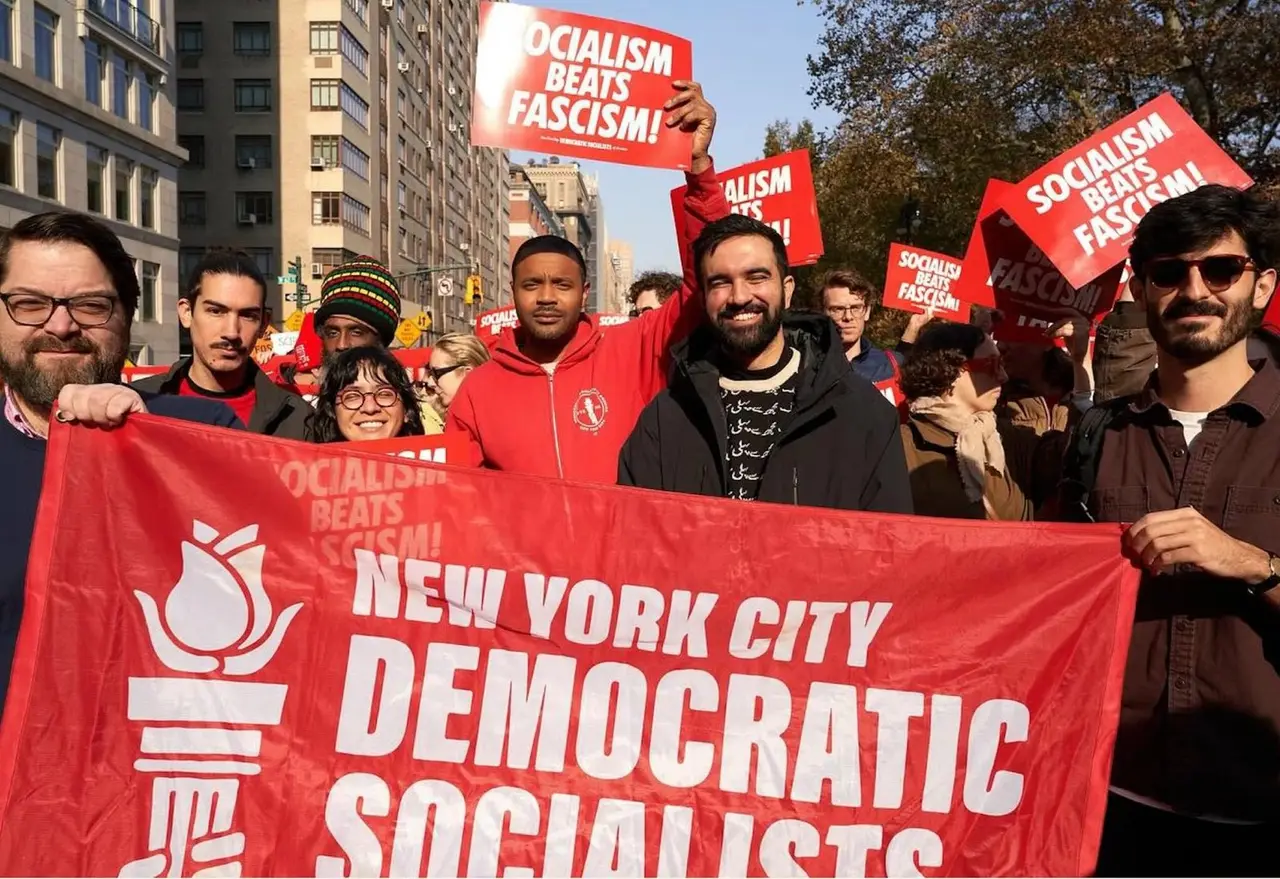
The Democrats’ midterm victory expressed a popular rejection of Trump and everything his administration has done since he was re-elected. From the rising cost of living — a direct result of the war on Iran — to the genocide in Gaza, the violent deployment of ICE in cities across the country, and the onslaught of attacks on democratic rights, millions of people loudly said “no more!”
But the results were not only a rejection of Trump. They also expressed the aspirations of an electorate that is feeling its power and is eager for change.This includes support for such ideas as Medicare for All, taxing the rich, abolishing ICE, and ending U.S. support for Israel. Ironically, these are all policies that the Democrats, the big winners of this month’s midterms, have repeatedly rejected, watered down, avoided, or otherwise undermined every time they have been in office. These are also demands Democratic Socialists of America (DSA) members have organized around for decades, keeping them alive even as Democratic officeholders have repeatedly refused to act on them.This rejection of Trump is obviously a positive development. But there is a catch. The immediate electoral form this opposition has taken has simultaneously strengthened the very party that failed for eight years to check Trump and which has spent a decade proving it will not satisfy the popular aspirations of the masses. The Democratic Party now has a mandate for change, but nothing about its class composition, its leadership, its funding, or its record suggests it intends to deliver. On the contrary, as we saw in California, where the Democratic establishment actually worked with billionaires to defeat legislation to tax billionaires, they are more likely to resist such demands whenever they think they can get away with it.
Many on the Reformist Left, including the writers and editors over at Jacobin, have attempted to grapple with this contradiction between the popular rejection of Trump and the inadequacy of the Democratic Party. For instance, in an article laying out his analysis of the election results, labor historian and Jacobin regular Eric Blanc warns against repeating what he calls the disaster of 2008, when, as he claims, Barack Obama squandered a historic mandate, demobilized his base, and opened the road to reaction. For Blanc, “Everything depends on breaking the destructive doom loop of Democratic victories, dashed hopes, and increasingly reactionary Republican comebacks.” Likewise, Catalyst editor Vivek Chibber emphasizes the need for mass organization, noting that “winning office is not the same as winning power.”
Yet they seem determined to draw all the wrong conclusions. For Blanc and Chibber, both of whom explicitly reject the idea of building an independent working-class party now, “winning power” ultimately means lining up behind the Democrats. In the case of Chibber this means working with them in order to “shift the political culture through the party.” Meanwhile, Blanc argues that the immediate task before us now “is to organize enough independent working-class power to make the anti-MAGA (i.e., Democratic) coalition succeed in meeting workers’ urgent needs, rather than lob critiques from the sidelines about how betrayal and disappointment are inevitable.”Both believe that working-class power can be built in coalition with capitalist parties rather than in opposition to them, but such a strategy — where the workers’ movement supplies the organized force and the Democrats retain political leadership — is exactly the lifeline the Democratic Party needs to draw disenchanted working people back into its political orbit. By subordinating workers to the interests and limitations of a bourgeois party, it strengthens the capitalist state while simultaneously weakening independent organization and working-class power as a whole.
For the generation now joining DSA, especially after the genocide in Gaza under Biden’s administration, there is an enormous distrust and hatred of the Democratic Party. Even Blanc had to concede that the election was “a repudiation of Donald Trump, not a vindication of Chuck Schumer and Hakeem Jeffries” — the same pro-Zionist leaders who mounted no serious fight against Trump’s reactionary offensive and now claim credit for his defeat when it was communities and workers that dared to confront Trump from Los Angeles to Minneapolis. In fact, the movement against Schumer and Jeffries as they mount their leadership campaigns shows that working people remain fed up with the Democrats and are willing to fight for our demands independently of them.
That is why the central question now is not how we can help the Democrats pass this or that piece of legislation. Instead, we have to ask ourselves how best to build the independent working class power we need to force the Republicans and the Democrats, including DSA electeds, to answer to us on our own terms. In this regard, socialists can learn a lot from the popular struggles in France, the Spanish State and Minneapolis.
A recent exchange within DSA highlighted the tensions over what political “independence” means in practice. Sid C.W., a National Political Committee (NPC) member from Marxist Unity Group, argues that organizing “independently” in this moment requires wrestling with the fact that the Democrats will not be able to deliver what working people want them to. In response, Blanc contends that simply denouncing Democrats amounts to “propagandizing”: telling people that the party will not deliver without offering a concrete way to organize and act. But his alternative — focusing on pressuring Democrats — becomes mere opportunism if winning concessions from a capitalist party becomes the organizing goal. Socialist demands and tactics then come to be judged by whether they can move Democratic officials, rather than whether they strengthen the masses’ capacity to organize and act independently.
That exchange reflects a broader argument: for Blanc, as well as many of the leaders of the DSA, the current weakness of the Left is not a strategic problem to overcome, but a justification for making the Democratic Party its indefinite political horizon. Chibber provides a more explicit defense of this logic. For him, the Left is just too small to accomplish anything without using the Democratic Party as a vehicle for its politics. And this is why he argues that those in DSA who are calling for class independence are essentially small-minded sectarian purists, while those who insist on continuing to work within the Democratic Party are doing “actual politics.” However, his own account of what an organization can do once it reaches a certain size complicates that argument:
Once your organization reaches a certain size, like in New York City or in Chicago, it can actually move things. You can move events. You can actually mobilize people in large numbers and, at least to some extent, even think about setting the political agenda. What happens when you’re very, very small is that you’re piggybacking on things that other people are doing.
But DSA is no longer a small organization, not in New York City, where it has almost 17,000 members, and not nationally, where it has over 130,000 and is growing every day. That does not mean DSA can win everything on its own or that DSA is the party the working class needs, but it does mean the question is no longer simply whether it is large enough to act independently. Most important is whether it uses that capacity to build working-class politics and organization or channels it into a program of pressuring the Democrats.
And DSA’s growth is only part of what has changed.The social forces confronting bipartisan imperialism have also grown dramatically in the last period. From the Black Lives Matter uprisings of 2020 and the hot labor summer of 2023, to the campus movement for Palestine and the fightback against ICE in Minneapolis, Chicago, and Los Angeles, not to mention the absolutely massive No Kings protests against Trump, people are clearly fed up with both parties and have shown a capacity to act beyond the electoral timetable of the Democrats.
And in many ways, the election confirmed that shift: Abdul El-Sayed won in Michigan despite the millions that AIPAC spent to defeat him. And of course many people, including those who voted for Claire Valdez and Darializa Avila Chevalier, came out explicitly to register their hatred of ICE — an organization funded every year by every Congress since it was created in 2002. These were Democratic victories, but the aspirations expressed through them clash with the Democrats’ role as an imperialist party of capital. In the streets and in the elections, people were not simply following the Democrats’ lead: they were starting to put forward demands of their own.
The growth of DSA and the recent wave of class struggle, especially in Minneapolis, show the material possibility of acting and organizing independently for more than just elections. An electoral strategy centered on the Democratic Party and not on using independent candidates to further a socialist program squanders this opportunity. Independent candidacies can help build the fight for a working-class party that challenges the political order itself; no change in the law will simply open the way for that party — we have to win the space to build it through struggle. In fact, such a strategy would only draw the DSA further into the trap of working within an institution that has steadfastly refused to take the demands of working people seriously, and which, further, is materially incapable of actually delivering them without abandoning its fealty to the capitalist system it defends.
In fact, the current debate in the organization over whether Alexandria Ocasio-Cortez (AOC) should run for president in 2028 makes this choice even more salient. While the NPC of the DSA has not yet formally endorsed AOC, it has made its intention to do so very clear. In September, the 27-member NPC rejected plans for a special presidential endorsement conference, which would have allowed elected delegates to debate and decide the issue. Instead, it is organizing internal discussions and chapter-level polls under the slogan “It’s time for you to decide.” But it’s obvious that such discussions are purely advisory.
This is no way to decide such an important issue. The NPC must put the strategic choice before the membership before committing DSA’s resources to another presidential campaign that subordinates its program and organizing to the Democratic Party; members must be able to decide the organization’s electoral strategy — including whether to run an independent candidate around the DSA’s own program.
The question facing DSA now is: will it use this moment to funnel our energy and aspirations into supporting a presidential candidate working on behalf of the interests of bipartisan imperialism, or will it finally begin to organize the kind of independent power needed to win all of our demands?
Many of the caucuses lining up behind AOC 2028 have already made it clear that they don’t believe this is the right time for such a fight. Their wager is that supporting AOC will help build a mass Left rooted in labor and organized around popular economic demands, creating the strength they argue is necessary before a break with the Democrats becomes possible. But building a working-class constituency is not the same as building its political independence. If that constituency is organized primarily to elect and pressure Democrats, its growing numbers can strengthen its role within the party without increasing its capacity to act against it. The missing link is a strategy for turning organizational growth into independent political power: preparing workers to pursue their demands even when doing so means confronting the candidate they once supported and breaking with the party that put her in office.
All over the world, independent action from below is driving mass politics, from the fight against declining living standards in France to the general strike a few days ago in the Spanish State against the housing crisis which forced parliament to deliver on some of the movement’s demands. And we saw the same thing happen in Minneapolis, where workers and communities were able to confront and limit the ability of ICE to operate in the city. The fight for popular demands such as Medicare for All will require the same kind of self-organization, not as a base for pressure campaigns that accommodate the insurance industry, as Obamacare did, but in the form of workplace and neighborhood committees of healthcare workers and working-class people who are denied care, empowered to make decisions, take action, and build the capacity to fight the interests standing in their way.The point is not to build an alternative alongside existing society, but to organize the working class to confront the forces that govern it. Struggles over the ongoing ICE raids, the AI-driven attack on jobs and communities, and the imperialist attacks in the Middle East are opportunities to start coordinating action to develop a common program — not by narrowing our politics to economic demands deemed electorally popular, but by connecting the fights over bread-and-butter issues like health care, education, wages, and living standards to the fight against repression and imperialism. In a moment where states like Florida are ramping up their attacks against the DSA and buildings are collapsing in working-class communities like Flatbush, seeds of struggle are likely already developing around questions like housing and the attacks against the Left.For instance, an assembly on housing in a city like New York, where there are around 17,000 DSA members, not to mention many more people who are willing to organize and put their energy behind alternatives to the Democrats, could have profound political effects. Instead of tailing the narrow reforms of the Mamdani administration or settling for what the Democratic Party and the state are willing to allow, it could bring together workers, students, activists, and community members to discuss and decide a way forward, connect the struggle over housing to other questions like policing, and build a movement that can confront the forces blocking our demands locally and nationally.This is where democratic organization from below connects to the struggle for a working-class party. An assembly can decide demands and organize action, but confronting the forces blocking those demands requires more than a single local movement. It requires a common program and an organization capable of coordinating struggles nationally and fighting for political power. DSA could help build that organization through these fights, rather than treating movements as sources of volunteers and pressure for Democratic campaigns.
That work cannot wait until 2028. This weekend’s NYC DSA convention will be a space for delegates to debate campaign proposals, including AOC’s presidential campaign, but the right to elect delegates does not by itself give members the power to collectively develop a different political strategy for the organization. Democracy must mean more than voting on previously drafted proposals and supplying the volunteers to carry them out. DSA is growing because people are looking for an alternative to top-down politics. They will not stay if they are treated as a volunteer pool rather than political subjects with a say in the organization they are building.
Genuine “base building” means organizing inside and outside DSA. Mass branch meetings, housing assemblies, and workplace committees where workers, students, and community members decide demands, organize action, and hold leaders accountable, are mass politics that can organize hundreds of thousands around a shared program for working people and the oppressed.
An organization like DSA has the capacity to connect such bodies through a common socialist program and act on their collective decisions — not treat their participants as simply volunteers for AOC 2028. The task after the midterms is to give the clear desire for a break from both parties of capital an independent political form and ultimately an independent party, capable of fighting for our demands even when Democrats stand in the way.