
World labournet.de
Profitability before safety: Spanish railway unions protest after repeated fatal accidents
Dossier After the train accident in Adamuz (Córdoba) on January 18, 2026 and the Rodalies train accident in Gelida (Barcelona) shortly afterwards, the Spanish railway union Semaf has issued a statement a
Deutsch (original) ·Auto-translated to English
dossier
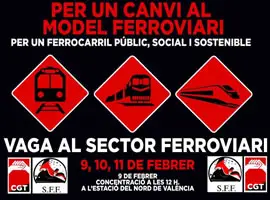
Following the train accident in Adamuz (Córdoba) on January 18, 2026 and the Rodalies train accident in Gelida (Barcelona) shortly afterwards, the Spanish railway union Semaf announced in a statement that it would hold those responsible for the safety of the railway infrastructure criminally responsible and that the start of operations in Catalonia would not take place without sufficient safety guarantees for transport. The union has also called for a general strike in the railway sector on February 9, 10 and 11, 2026, with the CGT's Sector Federal Ferroviario and Intersindical's Sindicato Ferroviario also joining. See these explanations and further information on criticism of the rail privatization program in Spain - as well as another accident:
- An even larger train accident in Spain the day before strikes against the continued decline of the rail network as the cause of the fatal accidents in February 2026 is leading to further calls for strikes

- [“It is the outcry of the workforce of all railway companies”]We will not wait for the next accident - SFF-CGT is calling for strikes on the railways
“After the accidents in Adamuz, Gélida and Urda, railway operations can no longer be continued with emergency solutions. Safety requires sufficient staff, maintenance, training, investment and decent working conditions.
We at the SFF-CGT are taking legal action to call strikes in the railway sector. It's time to demand real solutions and defend the future of railways!
After the accidents in Adamuz and Gélida, we said that the railways cannot continue to wait for a tragedy to occur to talk about safety. Months later, the serious accident in Urda confronts us once again with a reality that we cannot ignore.
THE PROBLEM IS STILL THE MODEL (…)
That's why we don't want another agreement full of good intentions, working groups and partial measures that postpone the problems until tomorrow. We want sufficient staff, adequate training and experience, real investment in maintenance, workload relief, sufficient resources to work under normal conditions and to respond when these no longer exist, and effective regulation of fatigue, working hours and rest breaks.
WE GO ON STRIKE AGAIN (…)
The SFF-CGT has taken legal action to declare rail strikes and demand concrete measures to address the problems we have been highlighting for far too long. We call on the other unions to join this mobilization in defense of the workforce and the railway. This is not just the will of our members: it is the outcry of the workforce of all railway companies.
Because safety doesn't come from having your picture taken with the Minister of Transport, not taking emergency solutions or announcing measures after every accident to smooth things over. Safety comes from personnel, resources, training, experience, maintenance and working conditions that enable those who maintain rail operations to carry out their work in safe conditions.” SpanishPress release from the Sector Federal Ferroviario de la CGT on October 30, 2026 (machine translated)
- Deadly competition. Spain: Train accident means setback for Prime Minister Sánchez in the middle of the election campaign. His party is partly responsible for the liberalization of the railways
“Just a day before a nationwide strike by Spanish train drivers on Thursday, news of another serious train accident shocked the entire country. With the strike, the railway workers wanted to enforce improved safety measures. Now two high-speed trains collided in Urda in Toledo province - after the safety system failed. In the accident, 69 people died, over a hundred were injured, and more than a dozen were in mortal danger on Thursday. It is one of the worst train accidents in Spanish history, and the government in Madrid has ordered three days of national mourning. (…) Since 2021, commercial companies have begun to compete with Renfe. Since then, precarious employment conditions have also become rampant on the railways, and there are constant delays and minor accidents. Renfe, the Italian Iryo and the French Ouigo compete on the Madrid-Seville route. They are making a loss and are engaged in a fierce battle to come out on top when the others go bankrupt. The train disaster hits Spain in the middle of the election campaign and is the second serious accident involving high-speed trains in just one year…”Article by Carmela Negrete in the young world from October 30, 2026 - Spanish railway workers go on strike after a train crash in Toledo that leaves at least 69 dead
“…On October 16, the train drivers' union SEMAF called on Renfe workers to go on strike on October 29 to protest against the failure of the railway companies and the state to improve safety measures following the accident in Adamuz. According to Renfe, around 29 percent of train connections were canceled due to the 24-hour strike, especially on suburban trains in Madrid and Catalonia, but also on long-distance services. (…)
Puente rejected calls for his resignation, stating: "At this moment I am not thinking about resigning. I am not in the emotional state to think about it now."
The public sector union CSIF then released a statement calling on Puente to resign and criticizing his attempt to blame Adif personnel for the disaster. The CSIF said on The CSIF accused Puente of using Adif workers as “scapegoats”; The union also pointed out that it had last warned about “excessively long working hours” at Adif in September.
The Italian railway company Iryo also criticized Puente and disputed his claim that the Iryo train driver received instructions from Adif to move before the collision. (…)
Before Wednesday's accident, the SEMAF union had already called on October 16 for a strike by Renfe train drivers on October 29 to protest the inability of Renfe, Adif and the government to introduce adequate safety measures following the accident in Adamuz.
The SEMAF union said it called for the strike because it "realized" at the recent meeting with the Ministry of Transport, Adif, ASEF and Renfe that "agreements on rail safety, as well as emergency protocols for weather events, the recruitment of new train drivers and the reliability of rolling stock, have been blocked by the administration. After a consultation of the Arbitration Commission on October 5 and today's meeting, we have drawn clear conclusions: everything is still as blocked as it was in May." SEMAF criticized the “bureaucratic slowness” of the government and the railway companies…”Contribution by Santiago Guillen and Alex Lantier from 10/30/26 at wsws - SEMAF expresses its condolences over the accident and maintains the security strike of October 29th
“At SEMAF, the entire organization is deeply shocked by the serious accident that occurred this morning on the Madrid-Seville high-speed line between a Renfe train and an Iryo train. We would like to express our condolences to all the victims, but we are aware that the full extent of the accident is not yet known.
At this point in time we do not have any information about the train drivers who were in the cab of the Renfe train.
As far as the causes of the accident are concerned, we would like to withhold comment until we know exactly what actually happened in order to avoid speculation, as we believe that the main aim is to help the victims and support their families.
We would also like to inform all members that SEMAF maintains the strike called for tomorrow, October 29th, in defense of railway safety and compliance with commitments for structural change in the field of safety.
We would also like to inform all train drivers and all specialists in the industry that - regardless of tomorrow's strike call - we are examining further actions and measures to defend railway safety.
Finally, we urge all driving personnel to exercise extreme caution when carrying out their work.” SpanishPress release from October 28, 2026(machine translated) - Unions and victims demand that Adif employees not be made scapegoats to conceal political responsibilities
“Safety in rail transport requires investment, maintenance and adequate staffing," criticizes the CGT union. The victims' associations of Angrois and Adamuz emphasize that human error "is never the cause in a complex and regulated system like rail transportt“…” span.Article by Javier H. Rodríguez from October 29, 2026 in El Salto(machine translated) - The railway branch of the CCOO union is calling for Puente to be fired for calling him “the weakest link in the chain.”
“…Puente is at the center of attention after appearing before the public for the first time to explain the circumstances of the accident, citing human error as the main cause of the tragedy. Subsequently, several media outlets published audio recordings in which an employee authorized the departure of the AVE under normal conditions, although it was at a standstill due to an error in the computer system.
TheRailway department of the FSC-CCOO union on Thursdaycalled for the “immediate” dismissal of the Minister of Transport, Óscar Puente, because he “blames the workers and denounces the weakest link in the chain”. According to this union, it is “absolutely irresponsible that, in the midst of a tragedy of this magnitude and while investigations are still ongoing, conversations of the professionals involved are published, leading to parallel judgments and pillorying of workers without knowing all the circumstances of what happened, the stressful situations to which they are exposed or the increased workload they have to cope with“…” span.Contribution from the El Salto editorial team from October 29, 2026 (machine translated) - The decline of the railway network and its consequences.
“From the CGT national trade union sections of ADIF and RENFE, we express our condolences to the families and relatives of those who died in the train accident in Toledo province and wish a speedy recovery to those injured; Our sadness is with everyone affected. Our appreciation goes to the emergency responders, medical staff and staff caring for the victims of this tragedy. However, we cannot say the same about the indescribable behavior of the Ministry of Transport and the ADIF management. The publication of the recordings from the Atocha control center (CRC) - taken out of context and fragmented - is a disgrace. (…)
The railway network in Spain is suffering from structural deterioration, which is affecting the quality of public transport and the safety of passengers and employees. Over the last thirty years, the railway model pursued jointly by the PP and PSOE governments has emphasized the construction of new high-speed lines that bring profits to private construction companies and also enable inauguration ceremonies that are of electoral advantage. (…)
In addition, the separation of ADIF and RENFE and the liberalization of passenger transport through the entry of private operators into the market are leading to an increase in train movements on some routes and making coordination between companies more difficult. This general deterioration of the situation is particularly serious in the Atocha CRC, which regulates traffic on the stretch of road where the accident occurred. (…)
We at the CGT will continue to advocate for workers' rights and the importance of a public, social and safe railway, which needs more public service jobs to have sufficient staff, better work organization, more safety, more investment and more maintenance.” SpanishCommunication from the regional associations of the CGT at ADIF and RENFE(machine translated) - The CGT on the Toledo tragedy: We stand by the victims, advocate for safety and refuse to look for culprits among employees
"...The CGT will not allow scapegoating of employees to evade corporate or institutional responsibilities. Rail safety requires investment, maintenance and adequate staffing - something the CGT has been calling for for decades. Only through a thorough investigation into the events, safety systems, working conditions and management decisions can we clarify what exactly happened and put an end to rumours, lies and slander on this matter. Today Our thoughts are more than ever with the victims, their families and our colleagues at the railway.“ SpanishPress release dated 10/28/26(machine translated) - See also thatSector Federal Ferroviario de CGT and theBlog of the railway workers at the SFF-CGT
- [“It is the outcry of the workforce of all railway companies”]We will not wait for the next accident - SFF-CGT is calling for strikes on the railways
- The significant impact of the rail strike on the whole of Spain certainly favored the agreement on (occupational) safety, staff expansion and maintenance
- Spain: Agreement with railway unions to increase investment in maintenance by €1.8 billion and create 3,650 jobs.
“The Ministry of Transport and Sustainable Mobility reached an agreement on February 10, 2025 with the railway sector unions to increase investment in maintenance by EUR 1.8 billion, create 3,650 jobs and improve the safety of public rail transport. The agreements reached led to the lifting of the strike measures. (…)
The agreement reached, which is the result of negotiations held in recent days between the Ministry, Adif and Renfe with representatives of the SEMAF, UGT and CCOO unions, provides for the implementation of specific measures affecting the field of employment, rolling stock, maintenance of the railway network and other organizational and regulatory aspects.
In the normative area, it was agreed to amend Royal Decree 929/2020 of October 27 so that train drivers' breaks of less than 45 minutes are counted as effective travel time. A coordinated system for reporting risks by workers will also be established.
In addition, it was agreed to set up within a month a committee for the harmonization and coordination of common safety management, involving representative trade unions. Working groups will also be set up to monitor temporary speed limits (Limitaciones Temporales de Velocidad, LTVs) and weather warnings.
Finally, it was agreed to strengthen the resources, staff and structure of the State Railway Safety Agency (Agencia Estatal de Seguridad Ferroviaria, AESF) with 50 new positions and to introduce various mechanisms for attracting and retaining talent, particularly aimed at strengthening supervision and the new tasks that the sector requires.
Measures in the area of Adif and Adif AV:In terms of employment, it was agreed to increase Adif's workforce by 2,400 positions over the period 2026-2030, an annual increase of around 480. In this sense, it was agreed to include a replacement rate of at least 115% in the next state budget laws…”Report from February 11, 2026 in lok-report.de - The follow-up to the strikes on February 10 shows the general discontent in the railway sector.
“The strikes in the railway sector announced for February 10th had a significant impact on the entire country: more than 500 local trains were canceled, over 100 medium-distance and regional trains were canceled and dozens of long-distance and high-speed trains were affected. The SFF-CGT union points out that these figures reflect the real dissatisfaction of the workforce with the agreement signed by CCOO, UGT and SEMAF.
The CGT Railway Sector Union (SFF-CGT) assesses positively the high level of participation in today's strike day across the national territory and on all railway services, with a high number of train cancellations and cancellations due to the lack of operational staff, on-board staff and train drivers.
For the organization, the annulment of the decision on minimum services at Renfe has resulted in many workers, regardless of their union affiliation, being able to support the strike, which is interpreted by the union as a clear sign of the workforce's dissatisfaction with the agreement signed by CCOO, UGT and SEMAF.
As of 3:00 p.m. today, more than 500 local trains have been canceled, particularly in the Basque Country, Seville, Asturias, Valencia and Málaga. There were also more than 100 medium-haul and regional trains. As far as long-distance and high-speed transport is concerned, the cancellation of more than 50 connections is estimated to have an impact on more than 3,000 users.
What is particularly striking for the SFF-CGT union is that Renfe in particular is trying to silence and demobilize workers more than some private operators. In this context, the union highlights OUIGO's information work, which has facilitated the exercise of the right to strike in the face of confusion and pressure maneuvers observed in other companies. (…)
The SFF-CGT union recalls that tomorrow, February 11, will be the last day of strikes in the railway sector. The mobilizations will continue with rallies at 12:00 at the country's main train stations to show that the conflict continues and the workforce is demanding real and structural solutions.
"Today's events show that dissatisfaction is deep and widespread. It is a collective reaction to a railway model that does not provide satisfactory answers either in terms of safety or working conditions," the union concluded.” SpanishSFF-CGT press release from February 10, 2026documented at the CGT País Valencià i Murcia (machine translated) - The SFF-CGT union is maintaining the strike in the railway sector because it considers the agreements reached to be inadequate.
“The SFF-CGT union points out that the agreements announced in recent days do not represent a real change in the railway model and once again leave out an important part of the sector and its workforce, which is why the union maintains the call for strikes at Adif, Renfe, Iryo, Ouigo and Serveo. (…)
The SFF-CGT union criticizes that the content of the agreement once again confirms the exclusion of part of the railway sector from the negotiations. According to the union, the text is missing essential elements that directly affect the safety, working conditions and operation of the system.
Among the union's biggest shortcomings is the failure to address the problems of private companies in this sector, where precarious working conditions, overwork and a lack of resources continue to prevail. It also does not set minimum crewing levels for trains, a fundamental safety issue raised in reports from the state railway safety agency.
Likewise, there are no clear obligations regarding the internalization of workloads or the use of resources dedicated to infrastructure maintenance, and no uniform approach is established in the event of evacuations, derailments or reloading, leaving the workforce unprotected and without common protocols…” span.SFF-CGT press release from February 10, 2026documented at the CGT País Valencià i Murcia (machine translated)
- Spain: Agreement with railway unions to increase investment in maintenance by €1.8 billion and create 3,650 jobs.
- The CGT's railway specialist group is calling for a new railway model in Spain that puts the safety of workers and citizens at the forefront
“Manifesto read out at the rally in front of the Ministry of Transport to demand a new railway model:
In view of the terrible events of recent times, the railway specialist group of the CGT trade union (SFF-CGT)Mobilization measureslaunched to call for a new railway model that puts the safety of workers and citizens at the forefront.
We are here because we will not allow the railway to be destroyed. At stake is not just a company or a society, but the entire model of a high-quality and safe railway.
THE SITUATION OF THE RAILWAY
The liberalization policy, the massive outsourcing of tasks and the neglect of maintenance endanger railway safety in an alarming manner.
The process of liberalization of rail transport, far from consolidating a stable and efficient model, has led to uncontrolled competition. The so-called “price war” not only endangers the economic viability of companies, but also the quality and security of services. Private operators' losses cannot be offset by reducing fees, as this will only lead to a reduction in infrastructure maintenance.
The outsourcing and subcontracting of essential services in the railway sector leads to an obvious deterioration in the quality of services provided to citizens. The crème de la crème of Spanish construction companies put their economic profits above safety and the general interest.
CONSEQUENCES
As a direct result of years of massive outsourcing, casualization and planned dismantling of the public sector, there has been a complete deterioration of the infrastructure and rolling stock.
The recent serious accidents in Adamuz (in which 46 people died, including two train drivers and a train conductor) and Gelida (in which another train driver died) cannot be considered isolated cases. Rather, they are another symptom of the chronic illness that plagues the railways.Because security cannot be eliminated in one fell swoop: it is being destroyed piece by piece, through cuts, privatizations, subcontracting and silence.
RESPONSIBLE
None other than politicians of one stripe or another are responsible for this situation. Political decisions that have separated us in numerous companies. Who have turned the railway into a commodity, a market niche, without taking into account that it is an essential service in which collective benefit must take precedence over economic margins.
ANSWER
For the SFF-CGT it is clear: it is time for the railway sector to unite and demand an immediate change to the railway model. We will not allow the lives of the workforce and citizens to continue to be played with. We will not accept that operational collapse becomes the norm. We will not remain silent as service deteriorates and the work that sustains it becomes precarious.
SOLUTIONS
The solution cannot be limited to agreements for certain professional groups or companies. Because the solution requires the participation and shared responsibility of all actors involved: ministries, AESF, infrastructure managers, public and private operators, on-board services and all companies in the sector. Because we are all part of the same system that works together or is destroyed together.
DEMANDS
Our basic demands to save the railway are:- Internalization of workload: There is an urgent need to reverse the massive outsourcing of infrastructure and rolling stock maintenance. This can only be achieved by increasing the number of staff in public companies.
- But not only do we need more staff in public companies, it is also essential to increase the number of employees in all companies in order to provide a safe and high quality service.
- It is essential that there is a minimum number of staff on board the trains to ensure the care and safety of the service. And these personnel must be trained and prepared for emergency management.
- We need a coordinated and effective cross-sector response to major incidents and emergencies that protects both workforce and users. We need a consistent security protocol.
Today we, the CGT, say emphatically: we will fight for a safe railway, for a high quality railway. Now the future of the railway is being decided. Because this fight concerns us all. Because the railway is not for sale. Because the workforce doesn't give up.” SpanishArticle/documentary from February 3rd, 2026 on Tercera Información
with photos (machine translated).https://www.sff-cgt.org/ Not (yet) found - Mobility and its price: Reflections on the train accidents in Spain
“The investigations into the train accident on January 18, 2026 show that it is better not to get on a high-speed train in Spain
"The investigation into the Adamuz accident focuses on a dozen major companies. Adif, Ferrovial, FCC, OHLA, Azvi, Ayesa, Maquisaba and ArcelorMittal were directly involved in the rehabilitation of the section of the line where the accident occurred. Iryo and Renfe were involved in the accident itself. The list of companies expected to testify as part of the investigation into the Madrid-Seville high-speed train accident will be extensive, as 88 Contract awards and subsequent subcontracts were involved in the 780 million euro renovation project (…) Many chefs have obviously spoiled the broth here (…) One should keep an eye on the consequences of the Spanish train accident worldwide: in terms of mobility, freight traffic and the political and economic consequences.”Article by Amelie Lanier from February 2, 2026 in the Underground Blättleon the economic structure of the railway in Spain - Among other things, SEMAF is calling for a general strike in the industry
“This evening we received the tragic news of the death of another colleague. Other colleagues and users were also injured to varying degrees.
The storm caused several accidents, including two derailments: one in Maçanet, where a boulder fell on the tracks and was hit by the train without causing any harm to the passengers; The second, more serious derailment occurred in Gelida, where a retaining wall collapsed onto the tracks and was struck by the passing train, causing casualties and injuries.
All of us at SEMAF are shocked and consider this situation of constant deterioration of the railway to be unacceptable. Various measures must urgently be implemented in our network to ensure the safety of specialists and users.
As soon as this organization became aware of the derailments, it took the necessary steps to stop the movement of all trains in the Rodalies area. Unfortunately, in the course of these measures we learned of the death of our colleague.
As FIRST measures to improve the situation on the state railway network, where two accidents have occurred within 48 hours with numerous fatalities, including three train drivers, SEMAF calls for the following:
– We will call a general strike across the sector to give legitimacy and protection to the mobilizations of workers and users with the aim of demanding the security and reliability of the network.
– We will demand criminal responsibility of those responsible for the safety of the railway infrastructure.
-The start of operations in Catalonia will not take place without sufficient safety guarantees for traffic.
-We will request that the same procedure be applied across the network in situations similar to those in Catalonia due to adverse weather conditions.
-At the start of operations, the train drivers of all railway companies will require the RC to guarantee them safety on the route to be traveled. If these guarantees are not given, train operations will be adapted to the actual operating conditions of the infrastructure…” span.Press release dated January 21, 2026 from SEMAF– Sindicato Español de Maquinistas Ferroviarios (machine translated)
- The SFF-CGT union is calling for strikes across the railway sector on February 9th, 10th and 11th
“Given the terrible events of the last few hours, the SFF-CGT union will carry out mobilizations to demand a new railway model that puts the safety of workers and citizens at the forefront.
The Railway Sector Union of the CGT (SFF-CGT), represented in most companies in the railway sector, announces that it will hold mobilizations on February 9, 10 and 11 to demand an immediate change to the current railway model and to focus on road safety, service quality and the protection of the working conditions of all railway workers.
According to the union, recent events have once again demonstrated what has long been known in the industry: uncontrolled liberalization, massive outsourcing and structural casualization have endangered railway safety and pushed the system towards an increasingly obvious operational collapse. The events in Adamuz and Gélida should not be treated as isolated incidents or isolated errors: they are an expression of a model that has weakened the ability to prevent, maintain and respond to incidents. "Everyone knows that this model endangers security. What happened is no coincidence: it is a direct result of years of covert privatization, the neglect of the conventional network and the reduction of resources and personnel," says the SFF-CGT union.
IT'S NOT A INDIVIDUAL GROUP'S PROBLEM: IT AFFECTS THE ENTIRE SECTOR
The SFF-CGT union emphasizes that this situation affects not just a single group, but all the people who maintain rail transport: train traffic, infrastructure, train crews, employees of suppliers and contracting companies and drivers. For this reason, the union calls for unity across the rail sector to respond decisively. "This is not the time to divide or look for blame among workers. The response must be collective, immediate and directed at those who made political and corporate decisions that destroyed the railway model," they emphasize.
MOBILIZATIONS AND PRIOR WARNING TO THE MINISTRY
The SFF-CGT union points out that it had already highlighted this situation in a letter to the Ministry of Transport and Sustainable Mobility on September 26, warning of the deterioration of the railway model and the direct impact on safety. Despite the severity of the diagnosis, this letter remained unanswered.
Given this situation, the union announces strikes across the railway sector on February 9, 10 and 11 to demand concrete action, sufficient resources and an end to a model that prioritizes profitability over safety.
"The railway system is in a deep operational and reputational crisis. We will not allow the lives of citizens and staff to continue to be played with. It is time to act and hold those responsible to account," concludes the SFF-CGT.“ SpanishCall documented on tercerainformacion.es(machine translated) - [Sindicato Ferroviario] Strike in the railway sector
“Following the accidents in Andalusia and Catalonia, the railway union, part of the Intersindical trade union federation, joins the railway sector strike and calls for a series of measures and a fully public management of the network by Renfe and Adif.
“The current deterioration of rail transport from every perspective not only represents a significant disruption for citizens, but is now also endangering the physical integrity and lives of workers and users,” the union said in a recent statement. The organization places special emphasis on the process of outsourcing the maintenance of infrastructure and vehicles. It calls for “ADIF and Renfe to regain full and unrestricted control of maintenance and for the current outsourced contracts to be terminated.” This is a clear appeal against the privatization process that both the PSOE and PP governments have been promoting for years for the entire rail transport system.
At the same time, they point out other measures that need to be implemented, such as: E.g. compliance with speed limits at all points on the network reported by workers due to their deficiencies. Likewise, the number of people who are allowed to ride in the driver's cab at the same time during training should be limited to "two duly authorized people, one of whom is from the service"..” SpanishReport from January 22nd, 2026 on poderpopular.info(machine translated) - The Semaf train drivers' strike is dividing the unions: the call does not receive the unanimous support of the Renfe and Adif works councils
“…The Semaf union, which represents the majority of train drivers, has called three days of strike on February 9, 10 and 11 in response to recent fatal accidents and what it sees as a lack of structural safety on the railway network. The union calls for immediate action, a review of the state of infrastructure and the suspension of normal rail services until full guarantees are in place for workers and users.
However, not all unions and works councils supported the call. In meetings with the management of Renfe and Adif, part of the union representatives decided to prioritize dialogue and opposed a general strike, both because of the impact on users and the expediency of the chosen time.
The union's split comes against a backdrop of high tensions in the rail system, with local transport hit by service disruptions, extraordinary safety checks and an open debate over the maintenance of the conventional network…” span.Report from January 22, 2026 in El Triangle(machine translated) – unclear how interest-driven this message is
- The SFF-CGT union is calling for strikes across the railway sector on February 9th, 10th and 11th
- Train accidents in Spain: train drivers announce strike. After several serious train accidents, more safety is being called for on the partially privatized railway network
"The disasters in Spain's railway traffic are increasing. Last Sunday, two express trains in southern Andalusia - one from the private railway company Iryo, the other from the state railway Renfe - collided with serious consequences. 45 people were killed and more than 120 were injured, some seriously. The cause of the accident near the village of Adamuz was initially unclear to the authorities - the trains were relatively new, the route was straight and had only recently been serviced. An official investigative commission named According to an initial preliminary assessment, the next serious accident occurred on Tuesday evening. Local transport in Catalonia was practically paralyzed. This time, the passengers of a local train near Barcelona were affected. The train driver was killed and 37 passengers were injured. Many railway workers refused to go to work in just three days Colleagues in the driver's cab died in accidents. As a result, long traffic jams formed on the streets, as the trains transport around 400,000 people every day, as the Catalan government announced on Thursday. After an inspection, another crash on the rails occurred on Thursday - this time a train crashed into a crane, and there were several minor injuries.It is undisputed that the partial privatization of the state railway company Renfe in recent years has led to a deterioration in service offerings, safety and working conditions. Spain originally had the largest and most modern high-speed train network in Europe, and so far its reputation has been good. Passengers appreciate the punctuality, and the career opportunities as civil servants are also promising for employees. (…)
From 2021, Spain's long-distance rail transport has been opened to private providers. (…) One thing is certain: with further privatization, precarious working conditions will become the norm everywhere in the industry. There will be a three-day nationwide train drivers' strike in Spain from February 9th unless an agreement has been reached between the Ministry of Transport and the train drivers' professional association by then. They demand something self-evident: more security for their jobs and their passengers.” Article by Carmela Negrete in the young world of January 24, 2026  Train accident in Adamuz (Spain): After the death of 45 people, calls for a rail strike are loud
“At least 45 people died in the horrific train crash in Spain on Sunday evening, January 18, when two trains collided near the town of Adamuz. Anger is growing among workers who have long warned that the rail privatization program being pursued by Spain's Socialist Party (PSOE)-Sumar government is accompanied by poor maintenance and underfunding of rail safety. Train drivers call for strikes. (…) On Tuesday morning, the Spanish train drivers' union SEMAF was forced to call for a strike. She criticized the “unstoppable decline of train stock” and called for “the safety and reliability of the rail network to be guaranteed”. With her call for strike she wanted to “give the mobilization of the working population a legal basis” and she emphasized the “criminal responsibility of the people who are responsible for the safety of the railway infrastructure”. (…)
The Madrid-Andalusia high-speed line is the oldest in Spain and was put into operation in 1992. The privatization of rail transport has seen an increase in traffic as Ouigo and Iryo (private companies partly owned by the French and Italian national railways respectively) have taken over parts of this lucrative rail corridor from the Spanish national railway operator Renfe. However, they did not carry out the necessary maintenance measures, but instead commissioned the state-owned company Adif, which was spun off from Renfe in 2005, to maintain the tracks. The income from their use did not flow into maintenance, but into the pockets of the shareholders of private companies such as Ouigo and Iryo.
Over the last year, railway officials have alerted Adif board members and state authorities to the dangers in the Adamuz area. Adif was forced to publish eight reports last year about signaling problems, potholes and bumps on the tracks, and imbalances in overhead power lines in the region. These reports continued at least until October, long after Puente claimed the tracks had been repaired.
In August, train drivers' complaints became so serious that the SEMAF union had to write a letter to Adif warning of "severe wear and tear" on the railway infrastructure. The letter said train drivers raised concerns “daily” but no action was taken…”Post by Alex Lantier from January 23, 2026 at wsws
Basic information:
- SEMAF – Sindicato Español de Maquinistas Ferroviarios
- CGT Sector Federal Ferroviario andSector Federal Ferroviario de la CGT on bluesky
- Sindicato Ferroviario
Until October 30, 2026, this dossier was called “Profitability before safety: After 2 (fatal) accidents within 48 hours, the Spanish railway unions are calling for a general strike for February 9-11, 2026” - when there was still hope that these would be the last accidents...
The postProfitability before safety: Spanish railway unions protest after repeated fatal accidentsappeared firstLabourNet Germany.