Politics · labournet.de · 2h
Milei keeps his word: the government in Argentina is making drastic cuts in education and science
Deutsch (original) · Auto-translated to English
dossier
“Funds for school meals were also cut. The budget for universities is only enough for a few months. Students achieve partial success with institute appointments. However, the government is denying the teachers' union the collective bargaining that is customary at the beginning of each school year, so that the income of teachers and school staff is falling even further. It's currently still the summer holidays, but classes are scheduled to start again in the next two weeks. Currently advises  the union about a possible strike. (…) universities and state scientific operations are also affected. The budget for universities was frozen at last year's level. (…) Last Wednesday, one floor of the building Godoy Cruz 2290, central headquarters of the Conicet, was temporarily closedoccupied …”Contribution by Miguel Arndt from February 22, 2024 in Amerika21 , see:
- Education strike against austerity measures in Argentina: Second, nationwide strike by university teachers within just one week

“University employees want to strike again against the lack of funding for universities and low salaries
Against the government's divisive and extortionate policies, for better conditions at universities: With a second, nationwide strike within just a week, university teachers want to bring university operations in Argentina to a nationwide standstill this Tuesday. Their demands are specific: they demand an increase in salaries of 31.2 percent, plus the August inflation rate, and also for the government to guarantee the operating costs of all academic institutions - which it is actually obliged to do by law.
Last Wednesday, university lecture halls in Argentina remained empty for 24 hours. The union alliance of the Federation of University Teachers (FEDUN) and the Federation of National University Employees (FATUN) had launched the first part of their action plan after wage negotiations with the government predictably failed. The union leaders had previously backed away from the original demand for a 51 percent increase and, despite increased mobilization and protests, had agreed on 21 percent. But after three months, the teachers finally burst their collar when the government put a three percent increase in salaries on the table.
For more than 300 days, the government has ignored the university funding law, which requires it to increase lecturers' salaries by 51 percent and a budget increase amounting to 0.36 percent of GDP. The law was only passed last year due to strong public pressure. She continues to refuse to accept the legislative setback for her course, even though she has so far failed with all objections and four legal challenges. Even a three-day deadline to submit a progress report given by Argentina's Supreme Court last week appears to have bypassed President Javier Milei's cabinet…”Article by Santiago Stavale, Buenos Aires, in the Junge Welt from September 8th, 2026(“Education strike against cuts”) - Nationwide 24-hour teachers' strike on August 3rd for increased funding, the social right to education and against the Milei government's anti-education offensive
- Protests against Milei are spreading in Argentina: social organizations are criticizing the right-wing government's austerity policies and labor market reforms
“Buenos Aires. Teachers' unions and dock workers are shaping a new wave of protests against President Javier Milei this week. They blame the government for the loss of purchasing power, the underfunding of public education, the deregulation of the labor market and reforms that, in their view, dismantle social gains of the past decades.
The escalation of social conflicts coincides with a further intensification of the president's rhetoric. In a television interview, Milei stated that there were “terrorists disguised as students, journalists, professors and scientists,” triggering sharp criticism from the opposition, trade unions and university associations.
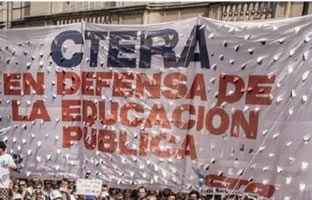
One of the focal points of the conflict is education. The association of education workers CTERA called for a nationwide strike and accused the government of refusing collective bargaining and failing to reintroduce the teachers' fund (FONID). This salary subsidy was discontinued by the Milei government in 2024.
In addition, the unions are calling for a new law on education financing and increased funding for schools and school canteens. They argue that teacher salaries have lost significant purchasing power in the face of inflation and cuts to education will continue. (…) The opposition Multicolor movement within the teachers' union SUTEBA expressed itself even more sharply. “Teachers across the country are striking and mobilizing to repel the Milei government’s anti-education offensive (…), which has reduced public education to a state of absolute distress,” their representatives said…”Article by Sven Hanfstängl Reuss from August 8th, 2026 in Amerika21(For the other protests see the reports in the dossier:Ultra-right Javier Milei will be the new president of Argentina – if Bolsonaro and Trump congratulate...) - Nationwide teachers' strike in Argentina: Teachers demand dialogue and adequate salaries
“The Association of Education Workers has called for a 24-hour strike this Monday after the government refused to negotiate wages and reinstate FONID. The demands include increased funding and rejection of reforms.
On Monday 3, a nationwide teachers' strike will begin in Argentina, called by the Association of Education Employees (CTERA) for preschool, primary and secondary education, following the “continued refusal” of the government of Javier Milei to enter into dialogue and new wage negotiations.
As announced by CTERA and various unions, the industrial action, which is initially expected to last 24 hours, aims at other demands, including the “immediate” reintroduction of the Teachers' Support Fund (FONID) and increased funding for schools and educational programs. “Teachers' salaries continue to lose purchasing power, the repayment of FONID and national education funds continues to be non-existent, and initiatives are being pushed forward that aim to curtail labor and pension rights as well as the social right to education,” the unions argued in a joint statement.
The demand for a wage adjustment and “urgent” financing is a reaction to the “devaluation” of wages below the inflation rate and to the lack of funds for schools and canteens. The teachers also called for the adoption of a new education financing law and rejected the draft law on freedom of education and possible pension reforms in order to “defend the public, solidarity-based and pay-as-you-go pension system.”
The measure coincides with the planned start of school in the city and province of Buenos Aires, Chaco and Santiago del Estero, but will affect the entire country. Although it primarily concerns public institutions, some private schools will also take part, depending on the decision of the institution in question or the requirements of the teaching staff and the unions in the sector, such as the Argentine Union of Private School Teachers (SADOP).
In parallel, the Union of Public Employees (ATE) has also called for a nationwide strike on the same day, as a result of which the normal operations of various public institutions at the provincial and federal levels will be restricted.”SpanishReport from August 2, 2026 on teleSUR(machine translated) - Forceful nationwide teachers strike with extremely high participation and massive CTERA mobilizations across the country
“The Association of Education Workers of the Republic of Argentina (CTERA) reports that the national teachers' strike called for today saw an extremely high turnout throughout the country, with large numbers of education workers taking part in the various actions and demonstrations in each province.
The focus of the day of action was the large-scale rally in front of the Ministry of Economy, which was organized together with CONADU, CONADU Histórica and ATE and which strongly demanded measures that guarantee the social right to education and respect for workers…” span.Reported on August 3, 2026 by CTERAwith photo gallery (machine translated) - See alsoMulticolor (Insta)
- Protests against Milei are spreading in Argentina: social organizations are criticizing the right-wing government's austerity policies and labor market reforms
- More than 2,600 scientists from different countries, including 25 Nobel Prize winners, warn of the dismantling of science in Argentina
“Buenos Aires. More than 2,600 scientists from different countries, including 25 Nobel Prize winnersin an open letter to President Javier Mileiturned. In it they call on him to stop his government's "dismantling" of the science and technology system.
According to the signatories, Argentina's science, technology and innovation system is experiencing a regression in wage policies, budgets and facilities. They demand the protection of the institutions, researchers and knowledge that the country has built up over several decades.
The scientists attribute the deterioration to the reduction in funding for science and technology as well as a lack of long-term prospects for sustaining the sector. They explain that the measures implemented since the beginning of the current government's term in office have resulted in the loss of around eight jobs per day in the science and technology sectors.
In the letter, the signatories say they are “dismayed” by the militarization of scientific institutions. (…)
They specifically condemned the "increasing militarization" of the National Institute of Industrial Technology (INTI) and the "repression" against Conicet, Argentina's main research institution, whose employees peacefully protested against 379 layoffs and the abolition of careers for support staff and researchers.
Such events are “unprecedented incidents worldwide,” the letter says. “It is unthinkable to find examples of governments physically abusing their scientists,” the international scientists wrote. (…)
“We strongly and respectfully request that the skills acquired are retained,” the letter says. Otherwise there is a risk of “the collapse of a system that took many years to build, from which all of humanity benefited and which would take many more years to rebuild.”…”Article by Hans Weber from August 3rd, 2026 in Amerika21(“25 Nobel Prize winners warn of cuts to science in Argentina”) - Researchers from the state research funding organization CONICET in Argentina are protesting against cuts and layoffs of 375 postdoctoral researchers
"Across the country in Argentina, employees of the state research funding organization CONICET (National Council for Scientific and Technological Research) protested against budget cuts and the impending dismissal of 375 scholarship holders. They also demanded the immediate reintroduction of health insurance for all employees. In Buenos Aires there was a march to the CONICET headquarters in the Palermo district, at the same time as a meeting of the CONICET board. Similar actions with a few hundred participants also took place in others Large cities, including many members of the Union of State Employees (ATE). (…) At the end of July, 375 postdocs who qualified for further employment in the “Scientific Researcher Career Track” are to be terminated. In addition to the threat of layoffs, the termination of health insurance has also led to the interruption of treatment for people with illnesses. According to ATE, the CONICET board is acting on the instructions of the Milei government's austerity policies. The recent escalation comes amid a policy of freezing funding programs for projects and laboratory supplies, as well as a decline in scientists' real wages by more than 40 percent. Both have already led to an exodus of scientists abroad. (…) In previous years, hundreds of CONICET employees were put in a precarious position due to the suspension of their previously included health insurance. CONICET offered those affected 90,000 pesos (approx. 52 euros) each to insure themselves. “An insufficient amount that disadvantages people with previous illnesses,” said those affected.The dismantling of CONICET is also reflected in the long delay in filling positions. 585 research positions from the 2022 selection process and 400 positions from the 2023 process have not yet been filled. In addition, there are pending recruitments from the procedures for administrative staff.” Contribution by Stephan Hollensteiner from July 6, 2026 in Amerika21(“Researchers in Argentina protest against cuts and layoffs”) - After 30 months and four federal demonstrations, an agreement was reached between the government and the universities: salaries will increase by 24.3%
“The rectories will not withdraw the lawsuit pending before the Supreme Court regarding the financing law. In addition, increases in financing costs, university hospitals and scholarships were decided.
After more than two and a half years of struggle by the university community and four nationwide demonstrations. After months of ignoring the will of Congress and the rulings of the judiciary, the government of Javier Milei reached an agreement with the rectors and university unions on a 24.3% increase in salaries for teaching and non-teaching staff, as well as increases in operating expenses, university hospitals and scholarships. Although Casa Rosada intended to persuade the National Interuniversity Council (CIN) to withdraw the lawsuit, it failed to enforce this clause. The majority of unions accepted the negotiation but indicated that they would continue to demand full implementation of the financing law.
It was only after 30 months that the university unions and the government signed a collective agreement for the first time. After the meeting between representatives of the Ministry of Education, CIN and representatives of teaching and non-teaching staff, the salary increase of 24.33 percent was confirmed. In June there will be a 21.33 percent increase on May base salaries, and the remaining 3 percent will be given in October on September base salaries…” span.Article by Celeste del Bianco from June 11, 2026 in Página|12(machine translated) - The nationwide active strike of teaching and non-teaching staff has begun at all public universities in Argentina until June 4th against the austerity policy
- Against austerity policies. With public lectures and protests: The strike at universities against the financing law has begun
“The measure is met with resistance from Milei. The left and militant circles denounce the complicity of the authorities in trying to negotiate with the government.
On Tuesday 26, a nationwide strike by teaching and non-teaching staff began in all public universities in Argentina, which will last five days and is one of the most determined protests in recent years. The measure, initiated by teachers' associations such as Conadu and Conadu Histórica, comes just two weeks after the massive Marcha Federal Universitaria on May 12, in which hundreds of thousands gathered in defense of public and free education. Finally, the Fedun Teachers' Union (CGT) called for a strike on June 29 that will see non-teaching staff paralyze universities across the country.
The situation escalated on Tuesday. Students from the “Nacional Buenos Aires” and “Carlos Pellegrini” high schools decided in meetings to support the teachers’ strike by occupying their respective schools. (…)
Budget cuts are not the only attack. The day before the university march, the government officially announced another cut of more than 5.3 billion pesos, affecting not only universities but also academic institutions and important social sectors. Far from vigorously defending the university, the university administration's response was to negotiate behind the backs of the educational community. Peronist and radical rectors, united in the CIN, are trying to secure minimum funds for their coffers, while at the same time the government is pushing forward a new law that will replace the current one, abolish the inflation-related salary adjustment and further restrict resources.
This nationwide strike coincides with awareness campaigns across the country. In addition to the student actions, the first event organized by the teachers' associations will take place on Tuesday in front of the courthouse, where teachers, students and university representatives will hold public lectures to demand that the Supreme Court force the government to comply with the law. Teachers, union representatives, students and political leaders are involved. The mobilizations are also taking place at universities such as UNC, UNLP, UNT, UNGS, UTN, UNR, UNNE, UNAJ, UNCAUS and others. In addition, the non-teaching unions of FATUN announce further strikes on May 29th and June 3rd and 4th.
Milei's government responded with attacks and threats. She published an official document in which she questioned the right to strike and, together with rectors such as Emiliano Yacobitti (UCR), threatened to deduct strike days from their salaries and to classify the education sector as systemically important - a clear attack on the right to protest. But the teachers did not let this deter them and reaffirmed their will to fight for wages that correspond to the shopping basket and to defend the public, free and scientific university…” span.Report from May 26, 2026 in La Izquierda Diario  (machine translated) with photos and videos
 - Indefinitely. Students occupy the “Nacional Buenos Aires” and the “Pellegrini”: They demand compliance with the university financing agreement
“Faced with non-compliance with the funding law and anger over austerity measures and teachers' starvation wages, students from Nacional Buenos Aires and Pellegrini gathered in rallies and voted for indefinite school occupations to intensify the fight. An important step to multiply and radicalize by coordinating a real battle plan to bring Milei to its knees. The conflict in universities is coming back into focus with the strike by teaching and non-teaching staff that has begun in all public universities in the country and will continue for five more days. However, to this measure there is another piece of news: after weeks of mobilizations, symbolic hugs and important meetings of all university members, students of the Colegio Nacional de Buenos Aires and Carlos Pellegrini have decided to continue with indefinite occupations…” span.Submitted by Juan Manuel Astiazarán on May 26, 2026 in La Izquierda Diario(machine translated) with photos
- Against austerity policies. With public lectures and protests: The strike at universities against the financing law has begun
- Argentina on May 12th: Large crowds throughout the country protested at the 4th University March - also against provocative short-term further cuts amounting to millions
- Great Federal March. University March, live: Thousands of people stream into the Plaza de Mayo
“Large rally in the Plaza de Mayo and in numerous cities across the country. The rejection of austerity measures in the education system is massive. But university authorities and union bureaucracies want to use this power for negotiations that lead nowhere. The government is in a serious crisis. She can be defeated. But for this to happen, the fight must be continued by developing a common struggle between teachers, non-teaching staff and students with the support of the population. The left represents this perspective…” span.Report from May 12, 2026 in La Izquierda Diario(machine translated) with photos and videos - The protest every minute: University demonstration in the Plaza de Mayo to confront Milei about the financing
“Large crowds are expected in central Buenos Aires as the government continues to violate the law that provides funding for universities. Repeated demonstrations are taking place across the country…” span.Report from May 12, 2026 in Página|12(machine translated) with photos and videos - Across the country, crowds gathered for the fourth nationwide student march: “It really sucks to ignore the dreams of thousands.”
“The Milei government has not complied with the funding law for more than 200 days and the education community has taken to the streets to denounce the breach of the democratic pact…” span.Article by Celeste del Bianco from May 13, 2026 in Página|12(machine translated) - Millions of euros in cuts in education and science: Another provocation from the government on the day before the student demonstration
“The Libertarian government announced cuts affecting universities and institutions such as Conicet, the National Commission for Space Activities and the National Commission for Atomic Energy.
As universities and academics prepare for the fourth march across the country on Tuesday, the government is taking up the chainsaw and making new cuts in another desperate attempt. A provocation with which the libertarian government is experimenting by cutting the budget of emblematic institutions such as the Conicet (3 billion pesos less) and reducing, among other things, the funds for improving the infrastructure of state universities by 5 billion pesos. The excuse is the same as always: maintaining the zero deficit. The timing is precise: this decision is announced just as millions of people are preparing to demand from the authorities the right to study and receive training in the country. Faced with this situation, the National University of Río Negro (UNRN) decided to internationalize the conflict and filed a complaint with the United Nations to highlight the deterioration of Argentina's higher education system and demand intervention.
Jorge Aliaga, physicist and planning secretary at the National University of Hurlingham, describes the cuts in detail. Speaking to Página 12, he explains: "This measure was taken as a result of falling tax revenues. The aim is that the authorities do not spend and that there is no budget deficit. This will of course have an even greater impact on the functioning of the system." He continues: “What was published in the Official Journal on Monday represents a budget amendment that adds some items in the Anses and in the repayment of external debts, but foresees very significant cuts in most departments, in particular in health, education, science, public works and roads.”
Organizers of the fourth student march expect Tuesday's demonstration against the higher education funding law to attract even more people than previous events. True to form, the government, seeking to recover from the loss of image caused by repeated cases of corruption among its officials, is trying to up the ante and make cuts in education and science, two of the hardest hit areas. As a sign of strength, Milei, Adorni and Co. continue to stir up the conflict…” span.Article by Pablo Esteban from May 12, 2026 in Página|12(machine translated)
- Great Federal March. University March, live: Thousands of people stream into the Plaza de Mayo
- On May 12th, teachers, students and university staff will be called upon to defend public education and university hospitals in various cities in Argentina
- There are more than enough reasons: a historic mobilization to save the universities is expected
“The libertarian government wants to destroy higher education in Argentina. The organizers expect a massive turnout and emphasize: “We hope that May 12th will be the beginning of the end of Milei’s presidency.”
There are more than enough reasons for the fourth University March, which will take place across the country this Tuesday. With nearly 60 universities taking part, it is only natural that the protest will be replicated in every corner of the country. The call in Buenos Aires will be centered in Plaza de Mayo, and the main rally will take place at 5 p.m., when unions, principals, teachers and students will take the floor. Public universities and the 2 million people who live there face their darkest hours in May 2026. The judiciary's move to delegate the final decision on the higher education funding law to the Supreme Court could further delay the implementation of the law, which has not been applied for more than 200 days. The most recent conflict: the dispute between the government authorities and those of the UBA over cutting funding for university hospitals. When the libertarian smoke has cleared, only one reality remains: the situation of teaching and non-teaching staff is catastrophic, as they have lost around 34 percent of their purchasing power since Javier Milei took office. (…)
University hospitals whose days are numbered
The last few days have been very tense for state universities, as if the May 12 demonstration had further inflamed tensions between the government authorities and the university authorities. While the UBA complained that the government had not transferred funds for consumables, maintenance and equipment for its hospitals, Capital Humano said it was keeping up with the transfers and accused the UBA of wanting to withhold all the funds that are actually due to the entire university hospitals in the country.
The truth is: the total budget for these health facilities is 114 billion for 2026, but only 10 percent of this has been spent so far this year (just over 10 billion has been allocated). As a result, the situation of 700,000 patients using these facilities is in an uncertain situation.
The situation in hospitals is a clear example of what is currently going on in general. The latest report from the Ibero-American Center for Research in Science, Technology and Innovation (Ciicti) and the Association of University Teachers indicates that wages for university employees have fallen by 33.7 percent in real terms over the last 29 months, falling for the seventeenth consecutive month. In order to return to the November 2023 level and compensate for the losses incurred during this period, they would have to be increased by 50 percent…” span.Article by Pablo Esteban from May 11, 2026 in Página|12(machine translated) - On the way to the fourth federal march. Impoverished: The university in a state of emergency
“…It's not just about the cuts as a purely economic issue. It's not about the fact that we lost 42 percent of our salary in two years. The point is that the faculties constantly have to live with the despair of having to close their doors, and that this situation gets worse the further you get from the city of Buenos Aires. (The universities in the greater Buenos Aires area have made higher education accessible to the first generations who never had this opportunity before.) It's not just about the economics, it's not about university financing, nor is it about the gaps in social security that result from underfunding. It is about something much broader: the “poverty” of a country that cannot generate, produce and pass on its knowledge in a reflective, critical, secular and committed way.
Just like the concept of slave, the concept of poverty is a false, erroneous concept adopted by those who try to see a dialectic where there is none. Slaves do not exist and never have existed, just as there are no poor people. There are the enslaved and the impoverished. Nobody enjoys being a slave. It's a process. One is born free - perhaps with too much freedom, which is later regulated for the greater good - but one becomes enslaved.
We should talk about the impoverished. And one of the main factors of this impoverishment is the attack on the public university, which has become a spoil of war. The precariousness of the conditions in which we do our work - caused by the current government and its attempt to present this as normal - attacks and destroys the history of a country in which the public university has been a unifying factor and engine of social advancement.
How far will we go? As we have done so often, we university teachers will continue to teach in and out of the classroom and stand up for our rights - rights that are also the right of all Argentines to education. We will think together with our students about the conditions under which they will later work, learn, live and love. We will hold our lessons where they belong: in the lecture halls, on the streets, at the demonstrations.(…)
Teachers, researchers and universities – central places of thought – are currently going through a critical time. Our options to continue practicing this profession are limited. Beyond study plans and organizational charts, it's about something as simple as it is complex: helping to think about the world in which we live. On the 12th we will march and set an example for the public university with every step.“ SpanishArticle by Martín Smud from May 11, 2026 in Página|12(machine translated) - Nationwide student march on May 12th: The UBA is calling for people to fill the Plaza de Mayo to demonstrate for more resources and higher wages
"The Milei government is downplaying the protests and promising to submit a new university funding law to Congress. At the same time, university hospitals warned of possible supply shortages due to a lack of funds.Faced with the call from the university authorities for a new mobilization protest rally that will take place on Tuesday, May 12, to demand an adjustment in salaries for teaching and non-teaching staff and a higher budget for financing higher education, the University of Buenos Aires (UBA) called on the entire community to march to Plaza de Mayo from 5 p.m. “We must take to the streets again in thousands to defend our future,” they emphasized. The government downplays the mobilization and maintains its stance of not complying with the law passed by Congress. The mobilization is again linked to the demand for compliance with Articles 5 and 6 of Law No. 27,795 on the Financing of Higher Education, given the urgent wage and budgetary problems of state universities…”Report from May 6, 2026 in Página|12(Spanish, machine translated) - 200 days after the higher education funding law came into force, a ruling allows the government to go to court
“A huge mobilization of teachers, students, non-teaching staff and various social groups is being prepared for Tuesday, May 12, to defend the public and free university and demand the implementation of the law on higher education financing. The government is turning to the judiciary to continue funding cuts. She owes university employees a full year's worth of salaries. More than ever there is a call to take to the streets.
The government has managed to obtain a positive resolution according to which the injunction that obliged it to implement Law 27,795 on higher education funding will now be decided by the Supreme Court, where it is betting on winning the favor of the judicial caste. This is a significant provocation after almost 200 days of non-compliance with the law, which means that the funds for the adjustment of salaries and scholarships in universities are not provided.
In addition, this decision provides the impetus for the large mobilization that is being prepared for next May 12th. The final decision about college funding will not be made in court, but on the street. (…)
The day of protest on May 12th will include rallies in various cities, including a central demonstration in Buenos Aires that will start at 3 p.m. towards Plaza de Mayo and will bring together hundreds of thousands of teachers, students and higher education workers.”Report from May 7, 2026 in La Izquierda Diario(Spanish, machine translated) - National University March: What we have won is not up for negotiation!
“It is time for universities to take to the streets again on a massive scale across the country. The demand is clear: the law on university financing, which Milei refuses to implement, must be adhered to. The university authorities are preparing a pact with the government behind closed doors. We must not allow their interests and model to be imposed, as was the case in 2024, when operating resources were increased at the expense of the salaries of teaching and non-teaching staff, thereby maintaining precarious working conditions and curtailing the rights of students. It depends on our fight from below!...” span.Article Matías Busi from May 6, 2026 in La Izquierda Diario(machine translated)
- There are more than enough reasons: a historic mobilization to save the universities is expected
- Nationwide strikes by lecturers at state universities in Argentina for higher salaries are expected to last until the end of March, with small interruptions
"Since the beginning of the week, large sections of lecturers at state universities have been on strike to emphasize their demand for salary increases. The strike was initiated by the two largest national lecturers' unions Conadu Histórica and Conadu. They have called for a strike with small interruptions until the end of March. The unions complain about a large backlog of promised salary increases and are demanding the implementation of the University Financing Act. This was passed in August Passed by the National Congress in 2025, it provides for a larger budget for the operation of all universities and bi-monthly salary increases linked to inflation for all lecturers. The government of President Javier Milei is challenging the law legally and has suspended its implementation by decree (…) The teaching staff of the largest university in the country, the Universidad de Buenos Aires, has called for an indefinite strike until the salary increase provided for in the university financing law (So far) 55.4 percent have been implemented. In addition, they presented a report on salary developments, according to which real wages are currently 35.6 percent below the level of November 2023 and are therefore “at a historic low”. According to Laura Carboni, general secretary of the UBA lecturers’ union, since November 2023 “for every three months worked, only two have been paid”. "Things cannot continue like this. We need coordinated action to end the government's attack on universities," said Carboni. Student organizations also support the strike.Law student Victoria Liascovich, spokesperson for the Falta Envido student movement, emphasizes: “The university funding problem is a strategy brought about by the central government, because a passed law is ignored by the executive.” Their accusation is: “Instead of closing the state universities, they are trying to deprive them of their resources and gradually reduce their offerings.”…” Contribution by Stephan Hollensteiner from March 20, 2026 at Amerika21(“Argentina: Nationwide strikes at universities”) and:
- A hit in the budget. Salaries that are not enough, debts that grow: the reality of teachers in the province of Buenos Aires
SpanishArticle by Natalia Hernández from 3/19/26 in La Izquierda Diario - Catamarca: A massive and protracted struggle of teachers in the province of “Jalilandia”
SpanishDossier from March 19, 2026 in La Izquierda Diariowith photos
- A hit in the budget. Salaries that are not enough, debts that grow: the reality of teachers in the province of Buenos Aires
- “Law on Freedom of Education” (Milei, not Orwell): Alarm in the education system because of the draft education reform in Argentina
- “Alarm in the education system because of the draft education reform”
"(A draft for educational reform has been circulating in some media these days.)
CTERA strongly opposes and rejects the document circulating under the name of the “Law on Freedom of Education” because it represents a real attack on the democratic system as a whole and, in its entirety, acts against the state guarantee of the right to education, against public schools, against trade unions and against the social and labor gains achieved in years of popular struggle.
The authors of this initiative seek to repeal the current Education Law (LEN 26.206), which was the result of extensive and in-depth debates with all representative sectors of society and the different political areas. They disregard and ignore the respectful and pluralistic participatory process that, in 2006, managed to define education as a social right and knowledge as a public good, in order to undemocratically replace it with another design that clearly corresponds to the dictates and interests of the most economically concentrated companies in the private sector, defining education as a service and focusing on the principles of individual freedom over social interests…” span.Report from CTERA dated 11/20/25(machine translated) and more - Upcoming reforms in the education system. Analysis of the document “Law on Freedom of Education”
“Last week the document “Law on Freedom of Education” was published in various media. Below is an analysis of the text, its aims and its class character…” span.Article by M. Betania Oreja Cerruti from 11/25/25 in La Izquierda Diario
- “Alarm in the education system because of the draft education reform”
- Buenos Aires Province. On October 8th there will be a teachers' strike for salaries and against adjustments in the education system.
“It was passed through school mandates in a plenary session sponsored by the Multicolor opposition with the vote of more than 4,200 teachers. It was also decided to stop on the 14th as part of the national measure declared by Ctera. Milei attacks education with cuts and a shrinking budget. In the province, Kicillof adapts with poverty wages and schools without conditions. A battle plan with continuity is necessary.
Given the inaction of Baradel and Sutebas Celeste to declare the wage adjustment valid, discontent is growing in the schools. Teachers are forced to work a nine- or ten-hour day (with the fifth hour added by Kicillof). Teachers' salaries are poverty wages; a teacher earns $700,000 for one position and a teacher earns $599,402. (…)
To make ends meet, teachers take on two or even three jobs. In addition to the overload of work, there is also the poor condition of the buildings and the lack of resources to deal with the effects of a social crisis that is being felt strongly in schools. For this reason, they are calling for an increase in the education budget for construction work, canteens, positions, scholarships and materials. The fight over salaries and budgets is a fight to defend public schools. This fight takes place in a national context in which the Milei government, which once boasted of the chainsaw, is in free fall. The connection between Espert and the drug trade, which the left denounced in 2019, was the straw that broke the camel's back. Last week, Milei's vetoes of the University Funding Act and the Pediatric Emergency Act were finally defeated in the Senate.
In the meantime, the union leaderships, under the leadership of Peronism, plan actions only sporadically. The Ctera announced a delayed strike for October 14 and allowed entire months to pass without action, leaving key provincial conflicts such as Misiones, Santa Cruz and Jujuy isolated. (…)
While the crisis-ridden government presents a budget that calls for "projected" inflation of 10% by December 2026 - an unrealistic figure that hides deep cuts - it is also preparing to abolish the Education Financing Act. (…)
Let us support the provincial strike on October 8th and take charge of the Ctera national strike on October 14th to enforce continuity!“ SpanishReport from October 6, 2025 in La Izquierda Diario(machine translated)(see alsohttps://www.pagina12.com.ar/857780-estudiantes-de-la-uba-convocan-a-la-marcha-universitaria-fed ) - Students, teachers and administrators took part in the renewed national day of struggle against budget cuts in Argentina's education system on May 22nd
- University staff in Argentina are on strike again
“Thousands of students, teachers and administrative staff at the University of Buenos Aires protested on Thursday against loss of purchasing power and delayed wage payments. Various unions, the student umbrella organization Fuba and the student councils of the faculties as well as the management of the largest and most research-intensive university in the country called for the protest. The Universidad de Buenos Aires (UBA) has around 300,000 students and provides around 30 percent of the research output in Argentina. The focus of the protest was the budget cuts imposed by the Milei government since December 2023, from which all national universities and especially the UBA are suffering.
The street protest was followed by a general strike that took place on Friday and paralyzed various UBA faculties. It was the end of a week of action with which the unions tried to unite protests and place the “university conflict” more firmly on the political agenda again. Despite the massive protests last year, which culminated in the nationwide mobilization of around 800,000 people on April 23, the Milei government is sticking to its course. Milei deprives public universities of resources and adjusts salaries only slowly and inadequately. "With the salary cuts, Milei is draining the public universities. There is an exodus of lecturers who have to look for other jobs in order to secure their livelihood," said Laura Carboni, general secretary of the UBA lecturers' union. According to the union, the loss of purchasing power among university professors during Milei's 17-month tenure is estimated at an average of 34 percent. “There is a lot of anger against this government,” said Carboni, “several salary groups are now below the poverty line” (…) Jorge Anró, deputy secretary of the Argentine Union of University Employees, explained: “The situation is really disastrous, we are doing even worse than in 2024.Inflation exceeds salary adjustments month after month, student scholarships are frozen, science and research programs are not renewed, and the operating budget has been frozen since May last year.” He continued: "It is our duty to take to the streets in Buenos Aires and throughout the country to make it clear to the government that a strong and developed country is impossible without a university of equal standards. We tell the people that the university belongs to them, that it is their future and represents the hope of a child moving forward in life. To deprive a people of this hope is to deprive them of everything.”…”Post by Stephan Hollensteiner from May 27th, 2025 in Amerika21 - Universities in Struggle: Adaptation, Precarity, and a Plan to Defend Education Funding.
“Argentina's public universities are facing an unprecedented crisis characterized by budget cuts, loss of purchasing power and increasing precariousness of employment. Since last week, the education community has intensified its fight with strikes, occupations and mobilizations in defense of public education…” span.Article by Laura Antonini from May 26, 2025 in La Izquierda Diario(machine translated) - MAY 22: CTERA NATIONAL FIGHT DAY
“CTERA calls for a national day of struggle across the country on May 22, which will include activities, mobilizations and strikes determined by the different provinces to make the demands visible and the actions effective. During this day there will be a mobilization in the Autonomous City of Buenos Aires, in unity with the state unions of the CTA-T and CTA-A, against the austerity measures of the national government…” span. Call from CTERA from May 14, 2025(machine translated) - CONADU sets protest week and university march in May
“After an extensive exchange, the plenary session of the General Secretaries of the National Federation of University Teachers (CONADU) today unanimously agreed on the continuity of the battle plan, which envisages the implementation of a week of protest and visibility of the conflict starting Monday, May 19, with a call for a demonstration at the end of the month, on the occasion of the presentation in Congress of the bill on financing higher education, which is being drafted with all the institutional and trade union representations of higher education. (…)
– From May 19th to 23rd: National Day of Visualization of the University Conflict, with various actions established in each union with the aim of discussing university issues not only in the different houses of study, but also with the different forms of expression that make up the catchment area of each university.
– Last week of May: University march as part of the presentation of the project to finance higher education…” span.CONADU report from May 15, 2025(machine translated)
- University staff in Argentina are on strike again
- Public universities in Argentina are threatened – not only by underfunding, but also by political control
- Public universities in Argentina threatened
“The situation at Argentine universities is getting worse after President Javir Milei's attacks and massive budget cuts. In response, several faculties went on strike for days and protests were mobilized across the country. Meanwhile, President Milei continues his campaign to discredit public universities and ratified the budget adjustment. The budget cuts have resulted in massive waves of layoffs and a migration of teachers to private institutions and are endangering the continuity of the country's previously comparatively good and free academic offerings.
Last week, the prosecutor of the Ministry of Finance, Rodolfo Barra, signed an order for the “Sindicatura General de la Nación” audit body to resume control of national universities. This is a massive violation of the autonomy of universities. Poor economic performance at universities is the president's main argument to justify budget cuts. Since 2022, audits have been left to the National Audit Office, a control body that is not dependent on the executive branch.
Sol Alconada, president of the union of the University of La Plata, capital of Buenos Aires province, said: "We know that this is an attack, it is not an economic problem of university funding, but a political problem, since they do not want the university to continue to exist as an institution for social advancement, for personal development, for national development." The week-long strike and nationwide protests are just the beginning of a growing student movement, said Sol Alconada.
According to estimates, up to 40,000 students and supporters gathered in La Plata last week to demonstrate against the Milei government's plans. They demand that the 3.4 billion pesos [approx. three million euros] that the government canceled for next year. The funds are intended primarily for salaries of teachers and administrative staff, which should be adjusted for inflation. This is not yet provided for in the executive branch's project. According to Luca Bonfante, general secretary of the student center of the Faculty of Philosophy and Literature, more than a hundred public universities nationwide are involved in the protests and strikes…”Post by Julia Liebermann from October 28th, 2024 in Amerika21(“Public universities in Argentina threatened”) - University. UBA Economics: Radicals prepare curriculum reform behind closed doors in the service of Milei
“In the middle of the university dispute over the budget, next Tuesday, October 29th, the board of the UBA Faculty of Economics will vote on reforming the curricula of the degree programs, without the knowledge of professors, lecturers and students and without official information about the content of the changes. Cutting subjects and hours shifted to paid postgraduate courses, devaluing content and eliminating critical training are among the key points…” span.Post from October 28th in La Izquierda Diario - Argentina: How the student movement can become a subject of the fight against the law and for a liberated university
"The triumph of the government in Congress, which obtained the necessary minority to maintain the veto of the law on the university budget, was the starting signal for a student movement that opposes this law. (…) In the province of Buenos Aires alone, 26 faculties were occupied and 12 in the city itself. But the movement extends throughout the country, from Córdoba, Santa Fe, Tucumán, Catamarca, Chubut, Jujuy, La Pampa, Neuquén, Río Negro, Salta, San Juan, San Luis to Santa Cruz and Tierra del Fuego There is no corner of the country where this rebellion has not shaken the educational community. The University of Buenos Aires (UBA) was one of the epicenters of the conflict, as were several faculties of the National University of La Plata, as well as various other universities in Córdoba, Tucumán, Greater Buenos Aires and the interior of the Buenos Aires Province, such as Mar del Plata, Tandil and Bahía Blanca.
The actions continued throughout the week, showing that this phenomenon has few precedents. Among the highlights of the week was a massive mobilization of more than 30,000 people in La Plata on Wednesday October 16 in defense of higher education and against Milei's austerity measures. After a week of meetings and sit-ins in 14 of the 17 faculties of UNLP (University of La Plata), this was a protest march with historic characteristics. Meanwhile, in Tucumán, a large university mobilization took place, organized across faculties through the streets of the city based on mandates from grassroots assemblies. It was a forceful response to the arrogant attitude of Governor Jaldo's police, who had tried to evacuate a public lecture in front of the Faculty of Philosophy and Arts the previous day. (…) This criticism means fighting for a university at the service of workers and the large majorities, in which studying at university is neither a privilege nor a path to social differentiation. We question the fact that our education is designed according to the needs of the “market” to maximize capitalist profits, and that there are agreements between universities and large companies and employers (from Monsanto to Shell, from Bayer to Chevron). This is the elitist policy that the government wants to deepen for universities…” Article from La Izquierda Diarioon October 28th, 2024 in German. Translation by Kilian Gremminger at Klasse gegen Klasse
- Public universities in Argentina threatened
- 48-hour strikes for higher salaries and funding for national universities continue across Argentina, including public lectures
- Strong reaction from teachers on the first day of the 48-hour strike
“DThe demand for salary increases and against cuts at national universities continues.
The Conadu Histórica has extended the strike throughout the week and will be felt strongly in some provinces such as Jujuy, Neuquén and Río Negro with public lectures, demonstrations and demands to the provincial deputies who helped shield Milei's veto of the higher education funding law. The protests continue across the country. This Tuesday there will be a hundred public lectures in the Plaza de Mayo and tomorrow in front of Congress to demand a higher university budget.
University teachers' unions celebrated the high turnout on the first day of the 48-hour strike planned for this week to demand better salaries and funding for national universities, which will continue with various measures and be extended across the country together with non-teachers and students. Today, the second day of the strike, public lectures are planned in the Plaza de Mayo, while the members of the National Association of University Teachers, Researchers and Cultural Workers (CONADU Histórica) will extend the strike throughout the week, which will be felt, among others, at the national universities in various provinces such as Neuquén, Río Negro and Jujuy. The education community also plans to hold a public rally in front of Congress this Wednesday to call on MPs not to accept the brutal cuts to universities proposed by the ultra-right President Javier Milei in the 2025 budget. Meanwhile, students will once again hold meetings to define the continuity of a battle plan while dozens of faculty continue to be consumed by the same demands.The Federation of University Teachers (FEDUN) celebrated yesterday the strike, which continues today, to demand a salary increase for the sector and to reject Milei's veto of the university funding law, which he was able to shield in Congress with the support of the PRO, the purple radicals and the "dialogue-ready" governors of various political orientations. The union described this week as a week of “visibility of the university conflict” and stressed that the strike “is being carried out in all public universities with almost complete consensus,” the union said in a press release, which also added that the sector’s employees “are suffering the largest loss of purchasing power in history“…” span.Post from October 22nd, 2024 in Página|12(machine translated) - Argentina's long road to misery: President Milei's reckless austerity measures are driving millions of people into poverty and despair. Students rebel
"In recent days, students have occupied state universities almost across Argentina's entire country. They are protesting against the ultra-liberal President Javier Milei's intention to force the university sector to make savings next year by making radical cuts to the budget. Other sectors such as the trade unions, the hard-hit pensioners and tenants are joining this mass mobilization in droves. The state of 46 million inhabitants has been in decline since Milei took office ten months ago The worst recession in its history. Housing rents have risen many times over, as have the tariffs for public services. Depending on the survey, the unemployment rate has skyrocketed. According to an official source (Indec), 53 percent of Argentina's population now lives below the poverty line (...) In the monumental center of Buenos Aires you meet people who have lost everything The homeless people are lying next to each other on torn pieces of foam rubber, covered with pieces of cardboard to protect them from the nighttime cold 1000 francs a month should teach.According to information that is now all over the media, the university budget for 2025 amounts to an incredibly low 0.14 percent of the gross domestic product - that is also an indictment. At the same time, the Milei government has decided on massive tax relief for large investors in certain economic sectors with the so-called RIGI funding program. The government is counting on RIGI's investment incentives to bring fresh capital into the country from home and abroad. This is intended to stimulate economic growth and create new jobs. (…) Javier Milei continues with his confrontational style. He dismisses the politicians en bloc as parasites, but fails to build his own sustainable base in parliament. As a speaker at the UN General Assembly, he offends around a hundred diplomatic delegations from all over the world with infantile generalizations and obviously does not realize that he is only accentuating Argentina's solo effort in the alliance of nations. Milei's goal is the so-called minimal state - but the advances made so far in this direction lack real persuasive power, sophisticated planning, coordination and solid political support. Already in the starting phase, Milei's confusing ideas plunged the Argentine economy into a dilemma from which there is hardly a constructive way out. With the first official acts, foreign exchange trading was forced into a pattern that Milei equated with the Spanish term cepo (ankle bracelet). But the shot backfired: Argentina is clinging to exchange controls, which are spiraling ever deeper into an overvaluation of the peso...” Article by Romeo Rey from October 20, 2024 at Infosperber - In the fight against Milei: Uprising of the Argentine students
“After Javier Milei's veto of the higher education financing law, the student movement has gained strength. More than 100 meetings were held and 72 faculties occupied, expanding the fight to 30 universities across the country. This process goes beyond the academic sphere and involves different sectors and the entire working class in the struggle. (…)
It is not yet clear where this great university rebellion will lead, but we know that it is already showing signs of historic significance. It spreads in the province of Buenos Aires with 26 staffed faculties and 12 in Buenos Aires and extends throughout the country, from Córdoba, Santa Fe, Tucumán, Catamarca, Chubut, Jujuy, La Pampa, Neuquén, Río Negro, Salta, San Juan, San Luis to Santa Cruz. There is no corner of the country where this rebellion has not rocked the educational community. The University of Buenos Aires (UBA) was one of the epicenters of the conflict, with the historic seizure of faculties such as law, medicine, psychology, architecture and design, natural sciences, social sciences, philosophy and literature, with more to be added throughout the week. (…) The extent of this conflict is the result of a structural phenomenon that has occurred in Argentina over the last 20 years: the growth of the number of universities and university members. This is what makes the phenomenon we are experiencing so federal: the university, with its various faculties, is spreading to every corner of the country. As a result, the number of students has doubled, from 28 state universities with 600,000 students in 1990 to 61 universities with 2 million students in state universities alone (there are over 500,000 more students in private universities).
- Strong reaction from teachers on the first day of the 48-hour strike
Read the full story at the source →
Source: labournet.de