
World · labournet.de · · 2h
The low wage crisis in the USA
Deutsch (original) · Auto-translated to English
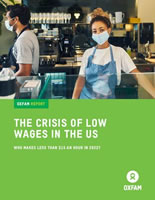
“New research shows that nearly a third of all U.S. workers earn less than $15 an hour. However, women and people of color hold a far greater share of low-wage jobs, and as wages decline in value, this is becoming a civil rights crisis in this country. Almost a third of workers (31.9 percent) earn less than $15 an hour: About 52 million workers and their families have to make do with wages that are losing value. The impact on historically marginalized workers is significant. Gender: While 25 percent of men earn less than $15, the same is true for 40 percent of women (31 million people). Race: While 26 percent of white workers earn less than $15, this is the case for 46 percent of Hispanic/Latino workers and 47 percent of Black workers. Race and gender, age, parents…” Announcement from Oxfam on the (English)Study by Kaitlyn Henderson from March 21, 2022  withInteractive map of low wages by state and also years later:
- A new low for American workers with a historically low share of the gross domestic product they generate is exacerbating the affordability dispute

- A new low for American workers with a historically low share of the gross domestic product they generate
“Workers in the United States are receiving a historically low share of the value they generate, according to new data from the Bureau of Labor Statistics (BLS). The BLS estimates that labor's share of gross domestic product (GDP) "was 52.8 percent in the second quarter of 2026." This is the lowest level the BLS has recorded since it began tracking labor shares in 1947.
The proportion of work has been declining for months. In the first quarter of 2026, the labor share was 53.7%, reaching a historic low at that time. Over the last 25 years, the share of work in income has fallen dramatically. In the first quarter of 2000, the labor share was 63.9%.
But while labor's share of GDP is plummeting, corporate profits in the US are rising rapidly. In the second quarter of 2026, corporate profits rose 9% compared to the first quarter of the year, according to data released in August by the Bureau of Economic Analysis (BEA). Corporate profits “increased $400.9 billion in the second quarter, compared to an increase of $74.4 billion in the first quarter,” the BEA said. (…) In February, the Trump administration proposed a new rule that would make it easier for employers to classify workers as self-employed. Classifying employees as self-employed is usually more cost-effective for companies and disadvantageous for employees. According to Reuters, “employees can cost companies up to 30% more” than self-employed workers…” EnglishArticle by Rebecca Crosby from September 10, 2026 at Popular Information(machine translated) - The Affordability Controversy: We live in a time where companies have excessive pricing power - not workers.
““Affordability” is now the most important word in American politics as households grapple with rising prices for food, housing and energy. The rising cost of living is not a new phenomenon, but it has been exacerbated by years of inflation that began in the wake of the pandemic and hit low-income households the hardest, with costs rising faster than wages for many. While most politicians say they want to help Americans make a living, what matters is how this is done. “Affordability” is a flexible term: its use encompasses many competing agendas, even within political parties, including regressive ones that threaten working people. (…)
Certain policymakers in the Trump administration and commentators close to the so-called “abundance” movement are once again calling for lowering the cost of living at the expense of workers. But instead of further cutting wages and making working conditions even more precarious and unsafe, we must take action against the oligarchs in the US economy: the executives and financiers who control corporations and drive up prices for profit. Our cost of living crisis is not due to spoiled workers, but to corporate power. Understood this way, a genuine cost-of-living agenda combines stricter antitrust and other forms of business regulation, direct public provision of basic goods, and measures to raise wages. (…)
Senior members of the Trump administration and commentators close to the Abundance movement are once again arguing that we should increase affordability by making working conditions worse for a segment of the American workforce. This is despite decades of stagnation in real wages: prices for health care, child care, food and housing have risen by over 60 percent since 2000, while wage growth has not kept pace with productivity increases since 1980. The share of workers in economic output is at its lowest level since the Bureau of Labor Statistics began tracking. Union density, meanwhile, has fallen from 25 percent in 1975 to just 10 percent in 2025, less than 6 percent of which is in the private sector. (…)
In the name of lowering food prices, the Trump administration has also targeted some of the country's most vulnerable and lowest-paid workers: farmworkers and meatpacking workers. The Trump administration says its immigration raids are endangering farm workers, food production and food prices. But their solution is to allow farmers to pay lower wages to guest workers on H-2A visas: Last October, the administration dramatically changed the way the Labor Department calculates minimum wages for H-2A workers, which could result in wage cuts of up to 26 to 32 percent. Last week, a federal judge found that this interim rule was unlawful and ordered the Labor Department to restate it without repealing the rule. The Trump administration is expected to appeal this decision. The Trump administration also wants to reduce production costs in meat processing by increasing the already dangerous processing speeds on the assembly line. Agriculture Minister Brooke Rollins claimed that removing these limits will help “keep food more affordable for every household.” But USDA-sponsored studies found that increasing the number of animals a worker has to process per minute – their “piece rate” – further increases the already high risk of injury.
Finally, the public sector – an area where unions are relatively strong – is also facing attacks from commentators close to the Abundance movement, such as law professor Nicholas Bagley and former Obama and Biden administration official Robert Gordon. Unions representing public sector workers have been accused of prioritizing the narrow interests of their members over quality, affordable public services. (…)
Crucially, the interests of public sector unions and the public are often aligned: public sector unions seek fully funded public services with fair wages and benefits, which can contribute to high quality services by creating a loyal, committed workforce. A low-wage, high-turnover workforce, such as in trucking, incurs significant recruitment and training costs and can undermine the provision of education, transport and other services. Under the Bargaining for the Common Good approach, public sector unions have advocated for smaller classes and increased investment in public transit, which promotes employment for their members and benefits the public. They were also a bulwark for existing state capacities. As the Trump administration seeks to destroy certain parts of federal capacity, the National Treasury Employees Union and the American Federation of Government Employees have also led the defense of agencies such as the Consumer Financial Protection Bureau. (…)
Attacks on workers undermine the purchasing power of some families and miss the root cause of rising prices and stagnant wages. The reality is that we live in a time where companies have excessive pricing power - not workers. For many essential goods, corporate relentless pursuit of short-term profits conflicts with the public interest and makes life unaffordable. (…)
This widespread lack of purchasing power highlights a structural problem in the United States – low and volatile incomes. Tens of millions don't earn enough at work and can't make ends meet without direct government support or, worse, exploitative loans like payday loans and car pawn loans. A real agenda to improve affordability must focus on the world of work and include raising the minimum wage and reducing barriers to unionization. It is true that simulating demand can contribute to inflation in sectors such as housing where supply may be limited. This risk shows that measures to support the demand side are not sufficient and must be accompanied by stricter government regulation of companies and public security of basic needs…”
EnglishArticle by Claire Kelloway and Sandeep Vaheesan from September 1, 2026 in Dissent Magazine(“The Fight Over Affordability,” machine translated) – Claire Kelloway is director of the nutrition program at the Open Markets Institute. Sandeep Vaheesan is legal director at the Open Markets Institute and author of Democracy in Power: A History of Electrification in the United States.
- A new low for American workers with a historically low share of the gross domestic product they generate
- Increase in the US: The number of Amazon employees and gig economy platforms receiving government support almost tripled between 2020 and 2025
“Study Shows Amazon and Gig Companies Are Seeing a Skyrocket in the Number of Workers Using SNAP and Medicaid
The number of Amazon workers receiving government assistance nearly tripled between 2020 and 2025, while the number of drivers for ride-hailing and food delivery apps skyrocketed on lists compiled by the U.S. Government Accountability Office.
While the number of working adults relying on food stamps and Medicaid has increased slightly since the start of the pandemic, the number of beneficiaries working at Amazon and on gig economy platforms has increased slightly, according to a newU.S. Court of Auditors report  (Government Accountability Office) has exploded.
The number of Amazon employees relying on government assistance programs for those in need nearly tripled between February 2020 and September 2025, according to the report released Wednesday. And for the first time, ride-hailing and app-based food delivery services — Uber, Lyft, DoorDash, Grubhub and Instacart — were collectively among the top three employers whose employees received assistance. (…)
“American taxpayers should not be forced to subsidize the starvation wages of large corporations like Walmart and Amazon,” Sen. Bernie Sanders (I-Vermont) said in a written statement. “It is beyond unacceptable that these corporations, owned by some of the richest people in the world, receive government subsidies from the federal government.”
The GAO conducted the study at Sanders' request, drawing on an investigation it first conducted in 2020. The new report is based on September 2025 data from agencies in 11 states that administer Medicaid and the Supplemental Nutrition Assistance Program (SNAP) — more commonly known as food stamps…” EnglishArticle by Lauren Kaori Gurley and Rachel Lerman from July 22, 2026 in the Washington Post online(machine translated)
See on the topic:
- Dossier:An upswing only for the wealthy, America, which has been left behind, continues to suffer: In the Corona crisis, the precarization of work has progressed further
- See also the entire sectionFight for minimum wage in the USA
The postThe low wage crisis in the USAappeared firstLabourNet Germany.
Read the full story at the source
Source: labournet.de