
World · Labor Notes · · 2h
Amazon Package Drivers Rev Up Organizing to Become Direct Employees
English (original) · Read in Deutsch ⇄
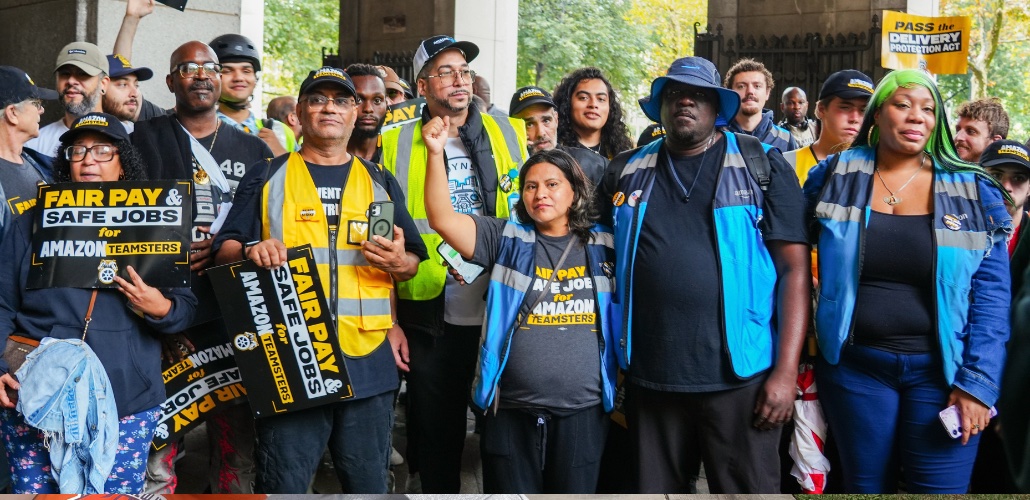
The workers who wear Amazon vests and drive vans with the company’s logo aren’t legally employed by Amazon. But that could change in New York City, under legislation that Teamsters and Amazon workers alongside the Democratic Socialists of America (DSA) are organizing to pass.
The Delivery Protection Act would require Amazon, alongside FedEx and other companies, to directly employ drivers rather than rely on third-party subcontractors. It would also establish safety, training, and labor standards for delivery drivers.
As of October 3, workers and allies had knocked on 11,446 doors across the Bronx, Manhattan, Brooklyn, and Staten Island, according to the Teamsters.
Across the country, 4,500 tiny companies act as Amazon’s delivery service partners (DSPs)—meaning these contractors are the nominal employers, even while the logistics giant retains control.
“For years, Amazon has relied on a convoluted subcontracting system that denies last-mile drivers the protections other workers get, while maintaining extraordinary control over their schedules, workloads, and uniforms,” said Julie Su, New York City’s deputy mayor for economic justice, in a statement.
Treating DSP delivery drivers as Amazon’s direct employees would make the company responsible for wage and safety protections and other legal liabilities. A similar bill is under consideration in Chicago.
LEGISLATIVE BATTLEGROUND
Tiffany Cabán, a DSA member and a city councilor representing Queens, sponsoredthe Delivery Protection Act. It has majority support in the 51-member chamber.
Mayor Zohran Mamdani and other elected officials have thrown their support behind the legislation, saying it would help boost wages, improve working conditions, and raise standards and safety across the logistics sector.
But multimillionaire Council Speaker Julie Menin isn’t on board. And Jessica Schumer, the daughter of Senate Minority Leader Chuck Schumer, is leading the lobbying fight to defeat the bill.
Amazon and other subcontractors are fighting tooth and nail. Amazon has threatened that if the bill passes, it will pull out of New York, forcing customers to pick up orders at hubs in New Jersey.
New Yorkers have been exposed to voluminous mailers and videos claiming that delivery will get slower and more expensive. Amazon has spared no expense, shelling out more than $5 million on lobbying, television and social media ads to defeat the bill. By proposing to make DSP operators extinct, Amazon says, the bill is "threatening the small businesses that deliver to customers.”
The Teamsters represent 330,000 warehouse and package car drivers at UPS. Amazon deliveries constitute a parallel nonunion system that not only undermines wages and working conditions across the logistics industry, but also threatens the volume that union workers deliver.
Amazon workers with support from the Teamsters and other unions have been organizing for years, but as they have hit roadblocks, they have taken the war into municipal government.
Amazon’s army of union-busters and lawyers cost the company $26 million in 2026 alone to intimidate workers and file endless court appeals in a war of attrition. The company’s signature move is to abruptly sever ties with a DSP after workers organize—as it did with a DSP that voluntarily recognized a union of drivers and dispatchers who joined the Teamsters in 2023 in Palmdale, California.
So workers are trying a different angle to constrain the behemoth through legislative fights, educating voters on regulations to level the playing field.
NO MORE ROUTES, NO JOB
“I’d just say that the threat [to workers] is bigger without the bill, because Amazon is getting away with so much,” said Latrice Johnson, a former delivery driver who worked out of a Maspeth, Queens, warehouse called DBK4.
Last year she and 149 co-workers were laid off with less than a day’s notice when Amazon suddenly shut down her DSP. She recalled hearing when she came in to work, “There's no more routes, so you no longer have a job.”
A month earlier, she had received a top award for her work performance. “It was a slap in the face,” she said. The job was a lifeline for her to provide for her daughter.
The Teamsters charge that Amazon violated labor law, retaliating against the DSP drivers for organizing. In all, by cancelling DSP contracts, Amazon has terminated the jobs of nearly 500 delivery workers working out of the DBK4 delivery station, where drivers for multiple DSPs had participated in a strike.
Johnson has been knocking on doors to educate voters and encourage them to contact their city council person to support the bill. She finds that customers are surprised to hear stories like hers. They’re even more surprised and confused when she shares that DSP drivers like her technically don’t work for Amazon.
“I was confused, too, when I first started working, and they told me I don't work for Amazon,” she said. “We wear the vests. We drive the vans. We deliver the packages.
“I’m at the door talking to someone who probably orders from Amazon, and they’re like, ‘Wow, that's not right,’” she said.
ORGANIZING AMAZON DRIVERS
By making the drivers direct employees of Amazon, the bill would remove the company’s ability to so easily cancel their jobs—giving a boost to union organizing. It would also mean the buck would stop with Amazon to fulfill the other obligations of an employer, like providing a safe workplace and legally mandated benefits and breaks.
Amazon notched a major victory when the National Labor Relations Board this June found that the company was not a joint employer with DSPs, releasing it from responsibility for union-busting at subcontractors.
In these circumstances, workers might find organizing scary, but Johnson draws on her own experiences to stay motivated and bolster others' courage.
“I come from a struggle, so there's no standing down,” she said. “I'm always gonna speak up, but there’s still people out there who are in fear of losing their job, and I just want them to know—you could still lose your job without organizing.”
The Delivery Protection Act would also create safety and training standards.
Last year, NYC’s Office of the Comptroller found that crashes increased 78 percent in nearby areas after a last-mile facility opened up. Delivery drivers rush to meet Amazon’s punishing delivery quotas, putting themselves and the public in danger.
Amazon uses driver-facing cameras produced by the A.I. company Netradyne in its last-mile delivery network. The company says these cameras increase safety, but union organizer and Amazon DSP driver Jonathan Rosenblum has written that Netradyne feeds data points to an A.I. system to monitor, track, and evaluate drivers’ behavior. Now Amazon is piloting smart glasses to track workers' delivery in real time.
DRONES OVERHYPED
As Amazon delivery drivers advance on the ground, the company is fleeing to the skies.
The logistics giant announced plans in late August to expand drone deliveries to 500 U.S. cities and towns this year, offering an option for delivery within 30 minutes after an order is placed when the package is less than five pounds.
People aren’t pleased in a suburb outside Dallas where drones
already dot the skies, “zipping over nearby houses, looking like a cross between a mechanical dragonfly and an X-wing fighter, and buzzing like a battalion of bees,” according tothe New York Times.
Besides the noise, Texans are worried that the drones are invading their privacy. “If it’s your backyard and you want to sunbathe naked, that’s your property and you do you,” Stephanie Puri, a researcher in the video game industry, told the New York Times. “But, oh, Amazon can see you.”
Workers and organizers said the drone news is part distraction, part labor discipline, part fearmongering.
“Amazon is always trying to put fear in the hearts of workers by either talking about moving the work out of New York, or drones, or robots,” said Amazon Teamster organizer Antonio Rosario. “But I think these companies don't think far enough. I hear them say things like ‘Robots don't get sick,’ or ‘Robots don't need to be paid.’ But they forget that they also don't pay taxes and they also don't buy the shit that they're selling.”
In fact, the drone program, which is slated to deliver 1 million packages in 2026, is a pinprick when compared to the 6 billion packages delivered in the U.S. last year by an army of drivers—around 18 million packages a day.
The logistics scholar Benjamin Fong is skeptical Amazon will scale up drone deliveries because of technical difficulties. “Robots work well at scale in highly controlled environments,” wrote Fong in Jacobin.
He said the company is aware of the limitations outside the warehouse, given the variability of obstacles a robot or drone may encounter in the outside world. Online videos show Amazon drones https://www.youtube.com/shorts/cjMC696W-Ek>dropping a package into a pool and smashing into an apartment building.
Amazon began drone testing in 2015. Its promises of expansion turned into shutdowns in 2024 and pauses in 2025.
“For suburban areas of the right density, it could become a regular feature, i.e., a huge annoyance that city councilors will hear a great deal about,” wrote Fong. “But even Amazon’s own stated goals for the program are less than 6 percent of deliveries by 2030—a goal that they are most certainly not going to meet.”
Post a CommentHundreds of Amazon delivery drivers and allies rally outside City Hall in NYC in August. Photo: Teamsters
 Luis Feliz Leon is a staff writer and organizer with Labor Notes.luis@labornotes.org
Related
Luis Feliz Leon is a staff writer and organizer with Labor Notes.luis@labornotes.org
Related

Amazon Package Drivers Rev Up Organizing to Become Direct Employees »
October 07, 2026
Film Review: A Portrait of How Workers Build a Strike »
October 06, 2026
How Unions Can Reverse Privatization of Medicaid and Why It Matters »
October 01, 2026
German Amazon Workers Organize to Get Paid for Every Minute »
September 28, 2026
Trabajadores de VW en México podrían declararse en huelga en Octubre. »
September 28, 2026Read the full story at the source
Source: Labor Notes