
Politics · Labour Hub · · 2h
The Case Against a Third Runway: Why Labour Should Say No to Heathrow Expansion
English (original) · Read in Deutsch ⇄
Labour came to office in 2024 promising the most ambitious climate agenda of any government in a generation, and a health service protected from further strain. A third runway at Heathrow puts both promises on the line and the evidence against it has never been stronger.
Even judged purely on growth, the numbers no longer add up. The projected GDP impact has been revised downward by a factor of ten, to somewhere between 0.03% and 0.05% by 2056 — and even that marginal gain is concentrated almost entirely in London and the south-east. The Treasury’s own Green Book cost-benefit analysis puts the scheme’s net present value at somewhere between minus £23.4 billion and minus £62.5 billion over sixty years. This is not a rounding error; it is one of the most comprehensively negative cost-benefit assessments the Treasury’s own methodology has produced for a major infrastructure scheme. It is HS2 on steroids.
Even the jobs argument collapses under scrutiny: the Department for Transport’s own analysis expects the local jobs created to be largely displaced from elsewhere in the country, with 21,400 jobs shifting to Heathrow and 15,200 lost across the wider regions of the UK by 2050. This is a policy that redistributes jobs from the regions to London while asking the whole country to underwrite the health and environmental costs.
This is where the politics gets genuinely awkward for ministers. There is a harder political truth here too. After Labour’s by-election defeat in Gorton and Denton, and with Rosebank and Jackdaw offshore oil and gas developments awaiting decisions, approval for Heathrow would hand the Green Party exactly the opportunity they need to sharpen their appeal to urban, younger, climate-conscious voters.
Supporting expansion would also mean government moving against its own climate advisers and its own legal advice, a gift-wrapped broken promise narrative that opponents won’t need to embellish. Green support in Westminster has plateaued at around 11% after last year’s surge, but roughly a third of voters say they would consider voting Green. A visible pro-Heathrow decision is exactly the kind of trigger that could reactivate that surge.
Undoing London’s clean-air progress
London hit its legal air-pollution limits years ahead of the predictions, thanks in part to measures like the ULEZ – London’s Ultra-Low Emissions Zone. . That progress was hard-won, through difficult decisions and sustained political will. Heathrow expansion threatens to spend it all as headroom for more pollution.
The government’s own air quality test for the scheme is too weak to protect local communities from the roughly 10,000 additional tonnes of nitrogen dioxide the third runway is expected to produce annually. This will lead to potentially hundreds of additional premature deaths every year. And on ultrafine particulates, the pollutant increasingly linked to serious health harms, there are currently no protections in place at all.
If the third runway goes ahead, London will be overflown by a new web of arrival and departure paths, adding 276,000 flight movements a year — around 756 more aircraft overhead every single day. For the communities who already live under Heathrow’s flight paths, this means a genuine intensification of noise and the erosion of the respite periods. Airspace changes under consideration could see night flights double for many London communities, precisely the kind of disruption that erodes health and quality of life, and precisely the kind of policy a government elected on a promise of national renewal should be wary of imposing.
The latest academic research — commissioned by the government itself — shows that aircraft noise causes health problems at far lower exposure levels than previously assumed. Even before applying that new evidence, a third runway would expose an additional 900,000 people to harmful levels of aircraft noise compared with no expansion at all. Monetise the health costs of noise at these revised, lower thresholds and the bill for expansion rises by 4.5 times.
None of this is an argument against investment. It is a case against a specific scheme whose own government-commissioned evidence shows it will cost billions in health damage, breach the air quality protections Londoners have fought for, deliver a vanishingly small economic return while displacing jobs from the regions, and hand political ammunition to a party actively targeting Labour’s own voters. A government serious about its climate commitments, the NHS, and holding together the coalition that elected it in 2024 does not need a third runway at Heathrow. It needs the courage to say no.
Paul Beckford is Policy Director, No 3rd Runway Coalition.
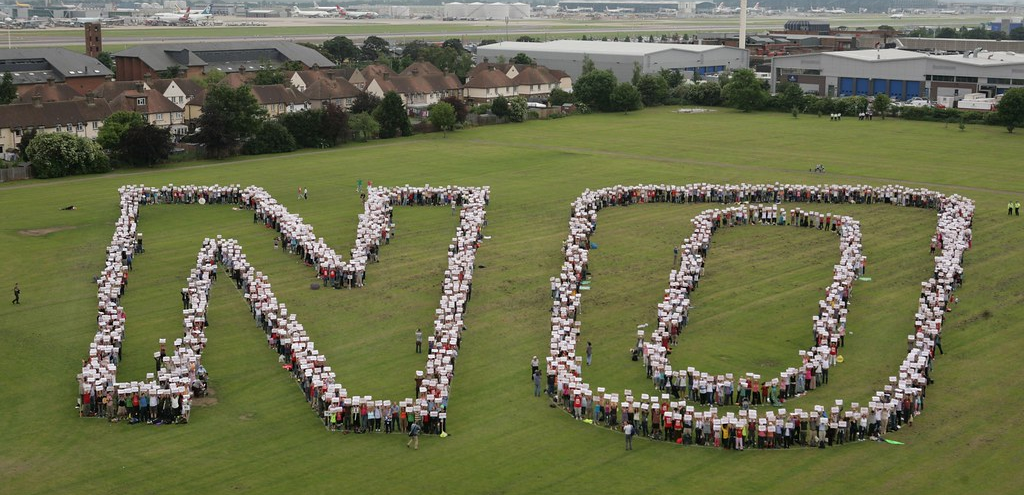
Image: Thousands say ‘No’ to Heathrow expansion. https://www.flickr.com/photos/hacan/3666970579 Attribution: HACAN/hacan.org.uk Licence: Attribution-NoDerivs 2.0 Generic CC BY-ND 2.0 Deed
Read the full story at the source
Source: Labour Hub