
World Labour Hub
On the streets that made history
Mike Phipps reviews Rebel Footprints: A Guide to Uncovering London s Radical History (Third Edition), by David Rosenberg, published by Pluto. Our need to know our history has generated a new expanded
English (original) ·Read in Deutsch ⇄
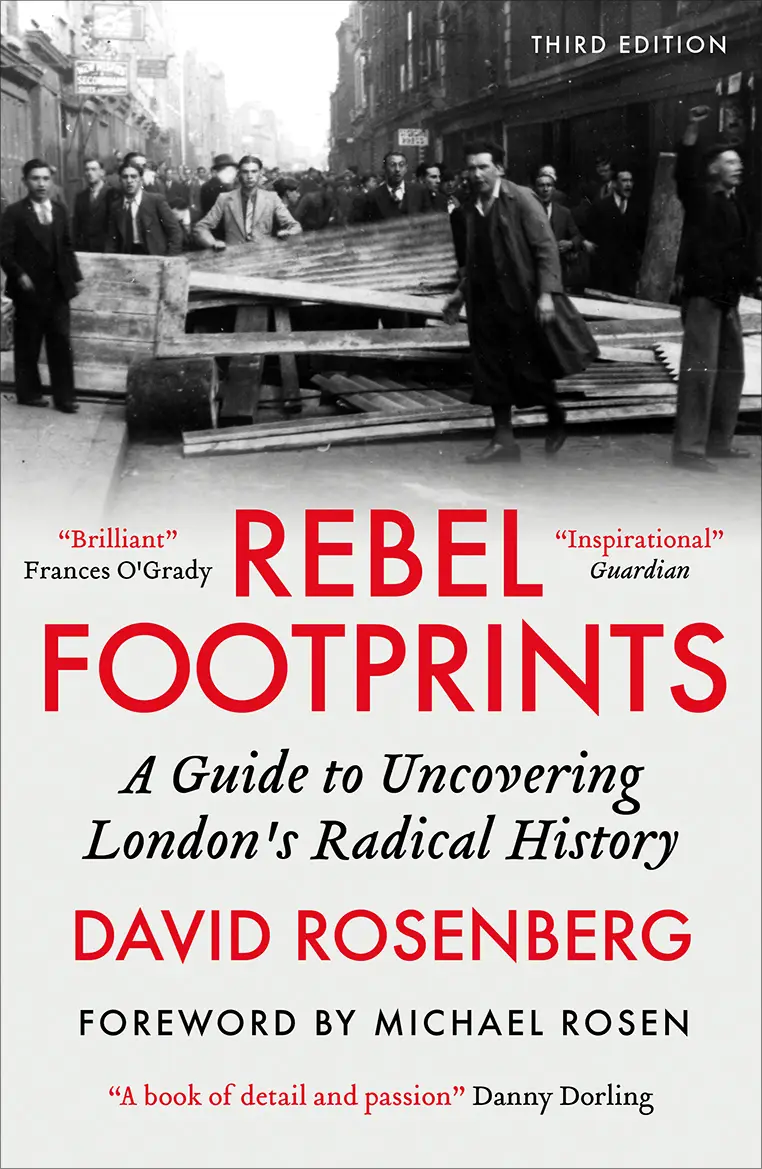
Mike Phipps reviews Rebel Footprints: A Guide to Uncovering London’s Radical History (Third Edition), by David Rosenberg, published by Pluto.
Our need to know our history has generated a new expanded third edition of David Rosenberg’s guide to London’s radical traditions, which takes us for the first time into the 1970s.
The book covers a huge amount, from the Peasants’ Revolt to the struggle to extend the franchise, Chartism and the impact of Irish and Jewish immigration on trade union struggles in the East End. It embraces the fight against slum housing – in 1890, one ten-roomed building in the East End housed ninety people – and the Poplar Council rate rebels.
The author delves into the battles of the suffragettes, going beyond the maindtream presentation of the movement to explore in detail the developing divisions between their West and East End wings and the extreme police violence meted out against the latter’s protests.
Part of the book’s enduring popularity is its understanding of a range of political currents active in the times covered, and its internationalist outlook, exploring how events in Europe impacted parts of the capital.
“Britain maintained a very liberal asylum policy compared with other European nations,” Rosenberg tells us. Many political refuges came to London, including Jews escaping pogroms and discrimination in the Russian Empire, but also some famous individuals, such as Louise Michel, a heroic figure of the Paris Commune, who lived there in the 1890s.
In 1907, 336 delegates of Russia’s revolutionary movement attended a three-week long party Congress, including Lenin, Trotsky, Stalin and Rosa Luxemburg. Sessions were held at an independent congregational chapel on the Hackney/ Islington border. Lenin himself spoke in the East End several times during his earlier stay in 1902–3.
One enduring highlight of the book is the narration of the story of the Battle of Cable Street, which has received considerable coverage recently, coinciding with its ninetieth anniversary. Less well known is the anti-fascist mobilisation in Bermondsey a year later, grippingly recounted here, which marked the end of Mosley’s and his blackshirts’ attempts to march in London’s working class strongholds.
Also covered here is work of the mostly Jewish ’43 group’, set up in 1946 in Hackney, with the aim of breaking up fascist meetings, educating people about the ongoing fascist danger and pushing for legislation to make fascist and antisemitic organisations illegal. In their first two years, the 43 Group shut down up to fifteen meetings a week – and this highly physical activity was by no means an exclusively male preserve.
This third edition of Rebel Footprints includes four new chapters, complete with maps and annotated walks. In particular, it updates the anti-fascist struggle: by the 1970s, the extreme right had turned its attention to East London’s Asian community, with racist skinheads carrying out a series of vicious street attacks, sometimes fatal, in Tower Hamlets and neighbouring Newham.
In April 1970, fifty white skinhead youths rampaged through Brick Lane, home to a growing Bengali-speaking community, injuring several. Councillor Solly Kaye, who had cut s his political teeth fighting poverty and fascism in the 1930s, declared: “The purveyors of racialism can be defeated by united action… it would be the greatest error… if the struggle were left to the immigrant organisations to bear the brunt of the fight… the fight against racial discrimination and violence is part of the fight for a new and better society.”
In Southall too, a more militant spirit developed among young Asians in the 1970s in response to racist attacks. Rosenberg charts the rise of Rock Against Racism and the Anti-Nazi League and their importance in turning the tide against the far right. Even so, one feels that there remain a lot of untold stories still to be unearthed about this scary time that helped shape a whole generation of the new left.
The capital’s radical traditions live on today, Rosenberg reminds us. In May 2020, Black Lives Matter marched in solidarity with George Floyd, murdered by police in Minneapolis. Sisters Uncut and Reclaim These Streets protested against the kidnapping, handcuffing, rape and murder of Sarah Everard by an off-duty police officer. Above all, since autumn 2023, “the largest, multigenerational and multi-cultural marches have occurred in London in support of justice for Palestine.” And there will be more.
Mike Phipps’ book Don’t Stop Thinking About Tomorrow: The Labour Party after Jeremy Corbyn (OR Books, 2022) can be ordered here.