
Labour · Labour Hub · · 3h
10,000 public servants strike in New Zealand
English (original) · Read in Deutsch ⇄
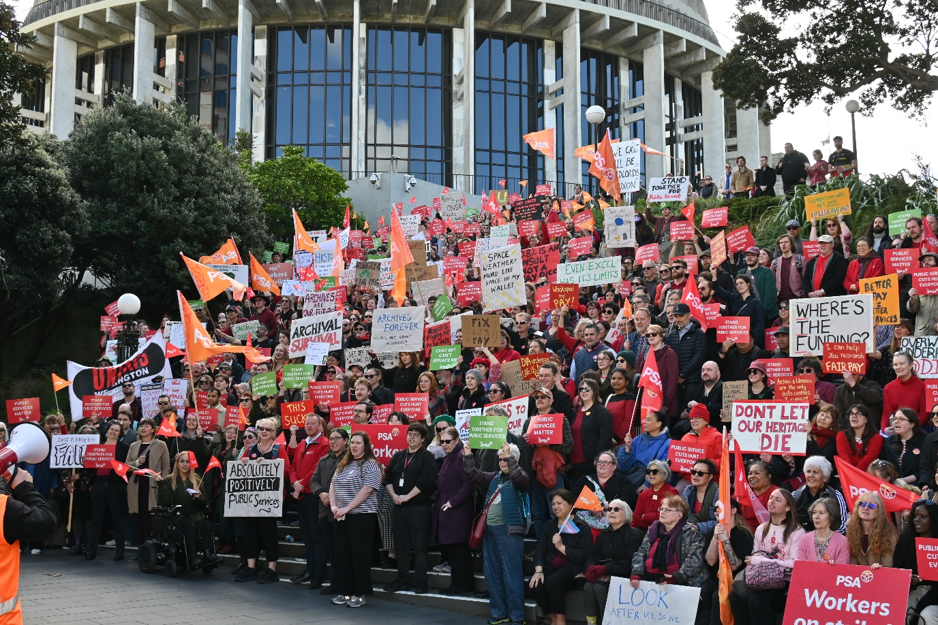
That was the call and response ringing out near Aotearoa New Zealand’s Parliament in Wellington on 9th September, as striking public servants sent a clear message to their employers and the Government that they won’t back down.
They were among the 10,000 public servants across the country who went on strike that day in support of their respective collective agreements. Among those striking were the people who run New Zealand’s welfare and pension systems, operate its borders, prevent child exploitation and digital extremism, run our national library and archives, and much more.
All these public servants were striking to oppose pay offers that would keep them well below the rate of inflation, while they have been working amid the devastating consequences of cuts by a government that’s actively hostile to the public service and workers’ rights.
CAPTION: Public service workers on strike in Wellington on 9th September
All these public servants are members of the Public Service Association Te Pūkenga Here Tikanga Mahi (PSA). They embarked on strike action after months of bargaining with their employers at the Department of Internal Affairs (DIA), the National Emergency Management Agency (NEMA), and the Ministry for Ethnic Communities (MEC); the Ministry of Business, Innovation and Employment (MBIE); and the Ministry of Social Development (MSD).
The rejected offers vary from a 0.8 percent increase from DIA, NEMA and MEC, to a lump sum and 1.5 percent increase from MSD. With inflation sitting around 4.1 percent in New Zealand, these offers would be pay cuts in real terms. Meanwhile, MBIE proposed removing cost of living increases entirely.
Like many people in New Zealand and around the world, these public servants are being squeezed by rising food, petrol and power bills. And they are not on huge salaries – immigration officers, for example, are earning between NZ$60,000 and NZ$70,000 a year, while the median salary in New Zealand is NZ$63,000–NZ$72,000. All these public servants want are fair deals for themselves and their families.
CAPTION: Public service workers on strike in Manukau, Auckland on 9th September
These strikes come after three years of attacks on public services and workers’ rights from a hostile government. The right-wing coalition of the National, ACT, and NZ First parties was elected in November 2023 and immediately set about dismantling the public service in the name of cost savings to fund tax cuts for landlords and big tobacco.
Government directives sent public service bosses scrambling to cut costs, leading to thousands of redundancies and reduced services.
A PSA survey in March found that three out of four public service workers say the Government is not providing sufficient funding to enable public and community services to do a good job, and a similar number say years of restructuring has not helped them deliver better services to New Zealanders.
In October 2025, PSA members working in public health went on strike, along with 100,000 workers in public health and education. Their action over inadequate pay, unsafe staffing levels, resource shortages, and poor working conditions was New Zealand’s largest industrial action in decades.
But the Government’s attacks on public services have continued at pace. As part of this year’s annual budget, it announced plans to cut almost 9,000 further public service workers and replace them with AI.
That’s on top of relentless attacks on workers’ rights, including axing pay equity legislation, weakening health and safety regulations, and cutting leave entitlements.
CAPTION: Public service workers on strike in Dunedin on 9th September
The Government’s response to the announcement of strike action on 9th September was to attack public servants and their fundamental right to strike. Prime Minister Christopher Luxon said they “should be at work”, and that negotiations should continue without industrial action.
It showed the Government attempting to twist public perception of the strike away from what they’re really about – a pay increase that allows public servants to deal with the cost-of-living crisis the Government promised to fix.
CAPTION: Public service workers on strike in Christchurch on 9th September
There was no sign of the Government’s disdain on the picket lines on 9th September – thousands turned out to picket lines across the country with signs, flags, chants, and speeches.
The strike generated significant news media coverage, appearing on newspaper front pages, and TV and radio broadcasts. Striking workers received messages of solidarity from unions around the country and around the world.
The strike was a success in the amount of attention it brought to the public servants’ cause, making employers sit up and take notice.
CAPTION: The front page of Wellington’s daily newspaper on 9th September
In the wake of the strike, we have taken the unusual step of writing to Public Service Commissioner Sir Brian Roche, who is the head of the public service in New Zealand. We have asked him to play an active role to support resolution of this industrial dispute, and asking him to meet with the bargaining teams representing PSA members involved.
Every bargaining team signed the letter to Sir Brian in a show of clear strength and solidarity.
We took the proactive approach to reach out to Sir Brian to show our commitment to reaching a fair resolution, and to put more pressure on employers to come to the table with fair offers. In the letter, we tell Sir Brian that more strike action will follow if we do not see a stronger commitment resolving these disputes.
Fleur Fitzsimons is PSA National Secretary.
Read the full story at the source
Source: Labour Hub