
Germany · Lower Class Magazine · 1970-01-01
The kids are all talking? – Interview with Red Youth Germany
Deutsch (original) · Auto-translated to English
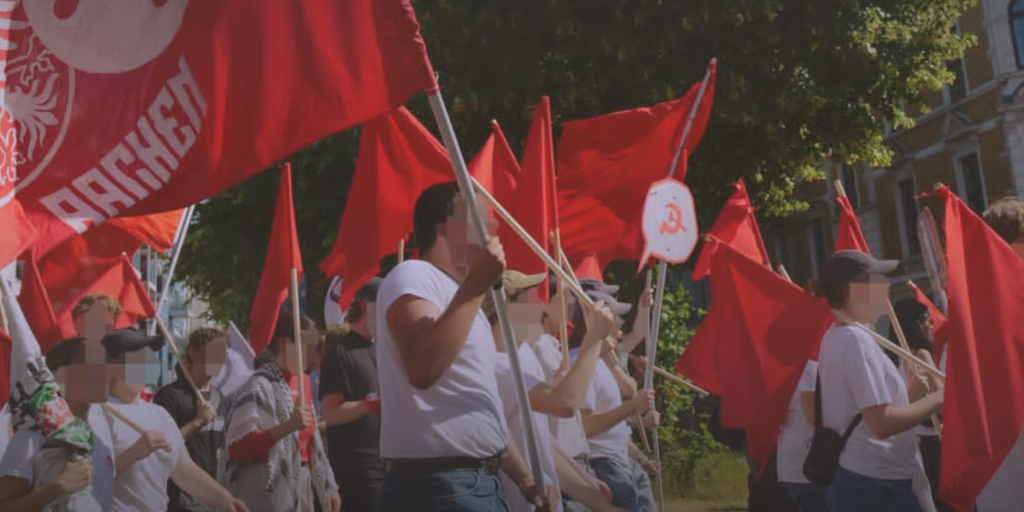
Red youth is now known to everyone on the radical left.
To outsiders, the Red Youth has practically sprung up and grown rapidly, and is more than just an internet phenomenon, but is also present on the streets, at conferences, events, campaigns and camps as a young, communist-oriented movement.
The external image polarizes with communist aesthetics, martial arts, Instagram reels with graffiti and Bengalos and Marxist-Leninist theory.
The organization Red Youth Germany (RJD) was officially founded during the roll of the new red wave in January 2026 and is currently probably one of the most popular movements on the German left.
We wanted to get to know RJD better and asked one of its activists about its content, activities, plans and criticisms.
The interview is the first of its kind for RJD.
How did Red Youth Germany come about?
When did you form and why did you set up the structure?
That's a good question, but not so easy to answer because we didn't decide at one point that a Red Youth Movement was needed in Germany and then build it up.
We use the term “Red Youth”, “Red Youth Movement” or “Red Youth Germany” in three different ways.
First of all, we use the term Red Youth to represent a certain political sequence, i.e. an objective movement within the political forces on the radical left.
Looking back, we see that around 2008, with the G8 summit, Marxism-Leninism found its way back into the radical left.
For example, writes about this
J.
Moufawad-Paul in “The Communist Necessity” that roughly at this point a form of primitive understanding of Marxism had once again found its way into the radical left in the imperialist centers.
In retrospect, we therefore date the emergence of what we call the Red Youth Movement to approximately this point in time.
At that time, the first collectives emerged unplanned and unconsciously that we would consider as part of our movement, as part of our history, as Red Youth.
Of course there are organizations and groups that were older.
But from this point onwards, a corrective movement began to reconnect elements of Marxism with proletarian and popular youth culture and a new revolutionary awakening took place.
We therefore say retrospectively that this is where the Red Youth Movement came into being.
Nobody knew that back then.
But we noticed that you always meet comrades from other collectives, from other cities, with whom you share the same political DNA, even if there were of course differences.
But these are children of the same anger, it's similar, it's more than just a coincidental phenomenon, there was this phenomenon: collectives of young comrades form, combine Marxism with revolutionary youth culture, have content in common and form circles and collectives, which at that time were often still local and only had regional cooperation.
This Red Youth Movement, which has existed in the Federal Republic of Germany since the 2010s, is a movement that is actually taking place.
This isn't something we thought up, it happened.
One doesn't want to say natural, but such collectives arise organically in the class struggle in the society of the Federal Republic of Germany.
But they also break down just as quickly.
They are then supported by 1 or 2 bosses and if these disappear, the collective more or less collapses.
After we had felt and observed for a long time how different comrades in different projects, different youth groups, including, for example, the former youth resistance, had similar practices and similar ideas, we said that this movement must become more than the sum of its parts.
And we theorized that in some cities at the end of 2020.
There are good historical examples of how more advanced political formations can emerge from youth organizations/movements.
On this basis, we set out to unite this red youth movement.
The first step was to make it clear: There is a red youth in Germany and you are part of it.
We started a process of unifying the Red Youth with various other youth collectives that already existed and with which we had contact.
Then we tried to establish contacts when we noticed that our content was similar to other collectives: Don't we want to agree on a program, on common principles and then unite organizationally?
This then resulted in the Red Youth Germany being founded as an organization.
It was publicly founded at the LL event last year, but had already existed as an organization under uniform leadership, under uniform organizational and political principles, with a uniform programmatic basis.
That means: There is the Red Youth as a political sequence, there is the Red Youth Germany as an organization, and we continue to say that there is the Red Youth as a movement.
This urge of young proletarians, of the youth of the people, of the radical left, to do this form of politics and to develop this practice is not linked to our organization.
When the Red Youth is founded in Buxtehude, then we say: Of course you are also the Red Youth, you are also from us, you are part of our movement.
Then of course we try to capture them and see how we can provide support.
That's why I think we are a bit of a special case politically, because the potential of this objectively existing Red youth movement was not recognized by any other cadre organization.
And we said that a cadre organization is needed, the Communist Party is needed in this country, that was clear to everyone from the beginning and the unification of this Red Youth Movement can be a contribution to this.
We also took historical examples.
For example, the Communist Party of Vietnam emerged from a youth movement, the Communist Party of the Philippines emerged from youth work and the Dev-Genç Federation (Devrimci Gençlik, German: Revolutionary Youth or
Federation of Revolutionary Youth of Türkiye, ed.
Red.) in a sense midwife for various revolutionary communist parties.
That is why we believe that by uniting the most progressive parts of the workers' youth, we are making a contribution to party building.
What does your work look like?
What are your activities?
I'll start with the big phrases: By uniting and expanding the Red Youth Movement, we are trying to spread Marxism among the working class youth and thus make a contribution to party building.
That's a big word, you can't really imagine much of it.
Our USP (Unique Selling Point, German: unique selling point, note d.
Red) is, so to speak, this spreading and enlargement of a proletarian youth culture or a revolutionary youth culture.
We try to convey a sense of solidarity and community through various cultural activities at a time when youth are becoming increasingly isolated or many areas of employment are relatively reactionary - drug use, misogynistic shit, some gangster filth and so on.
It's no secret: We do a lot of sport together and value it, do education together and of course we are also active in various fields of the political resistance movement, i.e. in the anti-fascist struggle and, due to the current circumstances, also in the area of anti-militarism.
In all cities where the red youth groups are part of the organization, we have open red meetings where everyone can come.
There we discuss current questions of Marxism and otherwise simply do a lot of political activism, as we know it from the radical communist left.
In addition, the Rote Jugend organization also tries to give something back to our movement.
We try to support other political collectives that are emerging, to see what they need, where can we give tips and tricks, how can we help other youth groups to stand on their own two feet so that it no longer depends on individual people.
How can this movement become more than the sum of its parts?
We also place a lot of emphasis on anti-imperialism and internationalism.
What we decidedly did not do at the beginning was the classic “mass work”, i.e. going to companies or districts.
We initially decided very clearly against it, conscious of our own weakness.
Based on our experiences in other projects, but also because of our own obvious limitations, we were of the opinion that it would be a bit crazy if we immediately threw ourselves into the people as the great revolutionaries.
Either that would lead to us waving the red flag and hoping that someone gets lost, or that we would have to subordinate ourselves to the trade unions in company struggles to a relatively large extent, i.e. a more or less tendency to right-wing opportunism would develop because we are simply not and have not been strong enough as a political formation to accompany or lead the trade union struggles in a revolutionary way.
Or we would do crazy left-wing radicalism along the lines of: Now the real revolutionaries come here and now you can see.
That's why we decided that for these areas of work, which are very important and where other comrades also do it very well, we as a movement, as an organization, still have to develop and grow.
We are now at the point where we have developed relative strength in many places and we must slowly open up and consider such battlefields.
We call this discussion “Red Youth Next Level” because of course it is clear to us that youth groups that make cool graffiti, are stable and have aura are not sufficient prerequisites for a revolution in Germany.
Otherwise we do education, song evenings, solidarity actions with prisoners, are active in anti-fascism... How do you assess the current state of the communist movement in Germany?
That is of course the question of scale.
Of course, it's bad compared to what's needed.
We do not have a strong anchoring of Marxism in the masses, we do not have a communist party worthy of its name.
The strategic considerations as to how the class struggle in Germany should be waged are also underdeveloped within the communist movement.
It is clear to everyone that things could be much better for the revolutionary left, the communist left, given the danger of world war, fascist tendencies in the state and all the mess that one sees.
Nevertheless, we have observed significant forward development in recent years.
When I started politics in the Red Youth, I had to hide my hammer and sickle if I wanted to move in the left-wing scene.
We now see that the autonomous or post-autonomous left and all that liberal bullshit has pretty much played its part and that the communist movement has become relatively much stronger.
In the same way, we see within the communist movement that many inconveniences have been broken.
We experience an encounter at eye level with many other organizations.
Genuine interest in learning from each other and also thinking about standardization.
We have - it's no secret - a very good relationship with various other communist organizations, which we value very much and which we also have criticism of.
For example, there are the comrades from Perspective Communism, the comrades from BDK (Association of Communists, Berlin, note d.
Red. ), the Communist Reconstruction or the comrades from Reconstruction Frankfurt, with whom we have a very solidarity-based relationship and with whom we can also have discussions on an equal footing.
We experience honest rapprochement and honest collaboration within a certain revolutionary spectrum.
That's why, despite all the difficulties, I'm optimistic about the future of communists in Germany.
In which political tradition do you locate yourself?
What organizational, political reference points in the past do you have as the RJD?
Of course we are proud authoritarian leftists (laughs).
We're honest about that.
Some people can accuse us of dogmatism - if you're a liberal it might seem that way.
Our ideological foundation is Marxism-Leninism, but we are explicitly anti-sectarian.
This means that we do not view the dispute over the correct line and the correct application of Marxism in Germany as a book dispute, but rather find out it together in practice.
Our organization is Marxist-Leninist, but it is no secret that many Maoist comrades are also organized with us.
That is, we are not saying that this one interpretation of Marxism-Leninism or Maoism is our fixed point of reference.
Nevertheless, organizationally we see ourselves very clearly in the tradition of the revolutionary communist movement.
For example, a big reference point was always the Communist Party of the Philippines.
Also other parties from the Maoist spectrum.
But we are not saying: “We are in the tradition of the Eighth International so-and-so or the KPD-XY”, but rather we are a relatively organic association that started from scratch.
Of course - our historical ancestors are and remain the KPD, with all its mistakes.
But we don't have a direct line of tradition.
How has the material reality of global capitalism and therefore the reality of our class changed compared to the heyday of the labor movement at the beginning of the 20th century?
Century changed?
What does this mean for the communist movement today in terms of organizational form and strategy?
What are points that can be adopted, what are points that need to be changed in relation to today's reality?
We do not have an analysis on this exact question.
The changes and further contributions to the revolutionary science of Marxism since the 1920s are so enormous and so many that I cannot fully explore them.
Proletarian science, i.e. Marxism, did not stand still in 1917, but also the contributions, especially of the Chinese sequence under Mao Zedong, but also of the urban guerrillas in the metropolises, the various people's wars and national liberation movements in the world, as well as contributions of the K-groups and the autonomists and their findings, whether they are good or bad, must be included and evaluated in the canon of revolutionary science.
But we can say that we reject the reading of revolution and the October Revolution as a shortened insurrection strategy.
Regardless of whether that was the case at the time - which I don't see as simply being an uprising as a singular event - we see with relative unity revolution as a long-term antagonistic process with the state.
That means we don't say you have to gather, gather, gather strength and then do the big Rambazamba.
The word counterpower is one I would use.
It's all the rage in the communist movement, but there's no good analysis or good explanation of it that I'm aware of.
But we would rather work with a term like this.
From the experiences of the Chinese revolution and the subsequent national liberation movements, and I argue also from the October Revolution, one can see that the revolution is more than a singular act, but an interaction where construction and destruction must be there before the uprising and even after it.
There is the idea, especially among orthodox Marxist-Leninists, from what I think is a relatively stupid school, that you have to have a strike, a union and a general strike and then at some point you storm the police barracks.
But that has never been the case historically, and will also lead to our failure if we do not understand revolution as a process that must begin now in various forms.
That is why we welcome initiatives such as district committees, district unions, attempts to build a countervailing power of the working class.
That's what we would say, for example, is what you can definitely take away from understanding the 1920s.
The experience of the Chinese Revolution with real socialism and the emerging revisionism should also be a lesson.
In our country, the understanding of Mao's mass line is relatively well established.
The whole Red Youth was an experiment in the mass line.
You have to take all of that into account.
But I'm not well prepared enough to answer all of this right now.
We can be accused of a lot, but our theory production is anything but overwhelming (laughs).
What kind of politics does it take in Germany today to mobilize and organize the working class against war, crisis and capitalism?
If I knew for sure, I would be happy.
But I claim that we can, from the experiences of the proletariat internationally, identify a few dimensions that are definitely needed.
It is very important for us that the most essential deficiency continues to be the absence of the new type of communist party.
That is, a cadre organization of revolutionaries that is able to act as the strategic backbone and brain of the revolutionary movement and also of the working class, which actually manages to develop a strategy in the first place.
You said: “Organizing and mobilizing the working class” – that can mean anything and nothing.
That is the question: with what strategy and with what purpose do you organize and mobilize?
There are always communists who come up with the idea of saying: We have to organize the working class, we have to go into the factories.
Yes, thank you, but unfortunately there is still little to be gained from this abbreviation.
What is needed is an actual analysis of the economic conditions and also of the various segments of the working class and a strategy linked to this.
I would make the claim that proletarian organization must always be – not in the main, but in its essence – antagonistic and self-empowering for the class.
This means that on the one hand it must be antagonistic and at least very careful with the question of how easily it can be integrated into the bourgeois state and on the other hand it must also be able to achieve success using revolutionary methods.
It may not have to do it every time, but it must be able to escalate strikes or lead other struggles in workplaces that are not covered by unions.
I know this from many of my jobs: If your foreman is a bum - you actually need a communist formation to take care of it.
You don't have to set his car on fire like in Italy - in Germany it would be enough to just shout at him.
You have to do a form of neighborhood work that actually gives the people and the working class a form of counter-power that doesn't get lost in saying: We demand the revolution otherwise we'll break the windows here, but that enables a germinal form of self-empowerment.
However, unfortunately the whole thing also has very clear limitations in the imperialist center, where the bourgeoisie has a lot of hegemony.
But it needs the communist party; it must be able to develop strategies, that is, it must be able to practice Marxism scientifically - not in the sense of just reading, studying and doing analyses, but also carrying out and evaluating a practice in a comprehensive and organized manner.
We would like to contribute to this, but we are still a bunch of 20-year-olds (laughs).
What do you say about the criticism of red identity politics?
Do you think this is mass-connectable?
How do you want to move from a red-identitarian youth structure to socially relevant, broadly effective politics?
The criticism is nothing new for us.
On the one hand it is true, on the other hand I would disagree with it.
Let's start at the back.
The masses as a monolithic subject do not exist.
There must be different forms of cultural response to different segments of the masses and people.
Approaches that try to address all parts in their aesthetics, in their appearance, in their propaganda quickly look like material from the Federal Agency for Civic Education and then no one really likes them anymore.
With our approach we have very clearly chosen a small but clear segment of the masses as our center.
These are the revolutionary sections of the youth of the people and the working youth and we do our mass work in this segment of the masses with the cultural expression that works there.
And we can say: We are able to connect with this segment of the masses.
Precisely because we do a lot of cultural work, all this graffiti, red flags, martial arts - that's a lot of culture - we naturally reproduce a form of subculture.
A proletarian counterculture, as long as the proletariat has no state, is always a subculture because there is a dominant ruling culture of the bourgeoisie.
And we are strategically very aware of this danger.
This is an area of tension in which we operate.
But we would say that you can't get rid of it by simply saying: It stops now.
Wanting does not replace becoming.
Instead, we say: In this segment of the masses, we can use this form to gather forces relatively successfully in order to strengthen a political formation that can also have an impact outside of it.
And it's not just a subculture - we are a political movement.
People are already raising a red flag on purpose.
One or two of them have even read a book.
And we are also expanding this relatively limited propagandistic, aesthetic approach.
We are becoming more diverse as a movement.
In the past it was often just young German trainees, but now we have become a bit more diverse in some places and we are trying to diversify our culture.
However, we believe that with this cultural work we can make a contribution to inspiring comrades and young people for Marxism and thereby strengthening ourselves to open up other fields.
This also arose from the idea: Before we can organize the working class, we must first learn to organize ourselves.
That means we start with people who are similar to us - very aware that this is not the end of the story.
But we start with ourselves, with what is close to us, with what we see as the most advanced parts of the masses, in order to strengthen ourselves, consolidate and expand from them.
Nevertheless, a lot of subcultural politics comes out again and again and this is an area of tension that also harbors dangers.
There are also concrete projects in this direction in many cities and groups of the movement: considerations about getting more involved in labor and union struggles or in district work and setting up your own projects and shops.
These are considerations that we have.
In order for you to be able to do this sensibly, you also need a certain foundation.
You can't do that if you start with 6 teenagers, you need a certain network, you need a certain political experience.
We are also aware that things work differently in other parts of the proletariat than we do, but you have to start somewhere.
In parts of the left-wing scene, one repeatedly encounters criticism of the broader red youth movement for having an authoritarian type of organization and a particularly patriarchal, “crappy” demeanor.
What do you say to this criticism?
So the point about authoritarian: We are authoritarian leftists.
José Carlos Mariátegui, a Peruvian communist from the 1920s, once said: “If the revolution requires violence, authority and discipline, then I am for violence, discipline and authority.” And there are the corresponding texts by Engels - so we won't join in with the accusation.
So, if anyone asks us, we are authoritarian leftists.
We're still pretty nice people, I maintain, and we don't eat anarchist comrades either.
On the contrary, we are for cross-spectrum cooperation from everyone who is on our side of the barricade.
Regarding the accusation of being a jerk: I find the term “tacky” to be a very bad political category.
I already said before that different cultural expressions of the same content are always needed.
We claim that many parts of the working youth and the people cannot identify with many expressions of the radical left.
I call it this potato sack left or jingle left or gauntlet or something like that.
This isn't hate towards people - if anyone likes it, they should do it!
When you get to know us, we don't all look the same, that's a cliché.
But we are simply for comrades to do sport, for comrades to live healthy lives and that can be seen.
And we believe that this is a form of external influence that can also show a different image of the communist left.
Of course, this converges very strongly with patriarchal role models and ideas, but you can't get rid of patriarchal chauvinism by fighting the external manifestations of it; you have to talk to your comrades to find out whether they have patriarchal views and see whether they show patriarchal behavior.
We sometimes also hear that we look like Nazis.
Well, we claim completely different things than Nazis. By the way, they stole “German Youth Forward” from us (laughs).
That's why I find the criticism understandable and in some cases it hits a point.
But we are proletarian feminists and would not take part in many of the things that are in the discourse.
It can be natural and is completely okay if people don't feel attracted to it.
Then they should make the policies that appeal to them.
We encourage comrades to do sport, to be strong, to be healthy, but that is not linked to a boxer cut or anything like that.
How do you feel about community work?
There is also criticism that says that you should concentrate on the companies... Before I completed my training, I worked as a temporary worker for 3 or 4 years in various companies, in sectors and industries that were not unionized and were also difficult to unionize due to the fluidity of the labor market.
You were there for a month, there for another month, sometimes just a few days.
The proles stay in the district longer.
That's why district work is an absolutely necessary complement to company work.
I wouldn't say she's more important, but actually put her on the same level.
Of course the work in the workplace and in the unions is important, but the district is essential because of the current composition and inventory of the working class and especially the parts of the working class that have the most reasons to struggle.
People are no longer concentrated in huge companies, many sectors of the proletariat don't even have proper employment contracts, all the illegal work on construction sites, home offices, the flexibility through temporary and temporary work.
There are many sectors of the working class that are less concentrated in individual factories.
That's why I believe district work is essential.
For example, I am a big fan of the comrades from the BDK.
Do you do union work?
Not everywhere.
As a structure, some of us sit at union meetings, at union youth meetings.
This is something we experimented with a bit with several comrades who are union members in their industries.
But not yet across the board, not yet with such a high priority.
In a moment of weakness you run the risk of the associated economism and reformism, that you degenerate in terms of content and become a stooge of the unions.
Trade unions are needed, I am a member myself.
If you're not, you're stupid - become a union member, get involved.
That's important, but it's not the end all be all.
We are aiming for a debate in the immediate future in order to think more about what work in companies and unions can look like.
Many of us sit at meetings of trade union youth, of the DGB youth, of the IG Metall-Youth, of the IG Bau.
We maintain contacts in many places and are just getting started.
But we wouldn't take it upon ourselves to claim that we are the big trade unionists or company fighters.
We're not there yet, but we're also cautious.
What do you think about the exploitation of parliament, keyword: communists in the Left Party?
If you ask me what communists should think of parliament, I would say: distance.
It will become apparent in the revolutionary process, but there are many historical experiences that it always backfires.
I think that's because parliamentarism also does something to you.
There are certainly many good comrades in the Left Party.
Good luck on the way!
I think it's made of wood.
I can imagine that with a more developed proletarian counterpower, some form of other engagement with the parliamentary forces will be necessary.
But this has to happen from a moment of strength.
We're not voting, we have better things to do.
This is our organizational opinion.
I voted for the Left Party last time and it really annoyed me.
So far, there has always been a boycott of elections since I was allowed to vote, and last election, fascism got me to the point where I voted.
Less than 3 months later, the war loans came with the approval of the Bremen Left Party.
No thanks.
So we would say that this is mostly a bad idea.
Where would you like to be in 3 years?
Preferably in communism.
But realistically and as a structure: If the class struggles do not continue to develop at the same pace and we continue to have the relative calm that we have now in the next three years, then I would hope that, from the perspective of the Red Youth, we manage to find a sensible way of dealing with the areas of tension in which we operate - subculture and Marxism, youth mass organization and the need for a cadre organization - and to get rid of the political-ideological illnesses that are currently accompanying us.
As a movement, I hope that we continue to grow at the pace we are currently doing and that we continue to reach and politically involve as many good young people and achieve even more success.
Sometimes we still fail to reach out and organize collectives.
I hope we can do that.
For the communist movement, I hope that the revolutionary parts of the communist movement will manage to unite, fight each other's weaknesses in solidarity and self-criticism and, through a merger, make a contribution, a leap forward, in the question of building the Communist Party.
That's not entirely unrealistic, I argue.
The last words are yours.
Thanks for the interview to Lower Class Magazine!
It was our first time in this form and I think it shows.
There are always myths about us and we have not been good at communicating our theoretical and strategic thoughts to the outside world.
That should definitely change within the next 3 years.
There will soon be publications on the Red Youth Movement.
And to all young readers: you too belong to the Red Youth, comrade.
Get active, get organized.
Youth forward to unity, youth forward to struggle.
The article The kids are all red? – Interview with Rote Jugend Deutschland first appeared on Lower Class Magazine.
Read the full story at the source →
Source: Lower Class Magazine