Germany · Lower Class Magazine · 1970-01-01
Cross, cut, goal! – Germany’s summer nightmare
Deutsch (original) · Auto-translated to English
While gray clouds hang over the country, World Cup fever continues to cover the nation like a veil. 7 to 1 against the small island state – the blood is boiling.
With a Bitburger Pils, the everyday worries in front of the screens can quickly be forgotten, at least for the 1.5 months of the tournament.
The nation stands behind the team like a firewall: Merkel is cheering on our right, Kaiser Friedrich is in Rudi Völler's arms, while a few kids on the street in Undav jerseys are chasing a ball from Tedi.
Unfortunately there wasn't enough for Decathlon's World Cup ball this year because parents' money has become tighter... See the champions, take the field now, you define us, make us feel proud (Wavin' Flag:K'naan - World Cup Song 2010) One thing is clear: the nation will have to fight its way out of the misery of the past few years.
The glory of days gone by seems to have been almost forgotten today in the face of changing times.
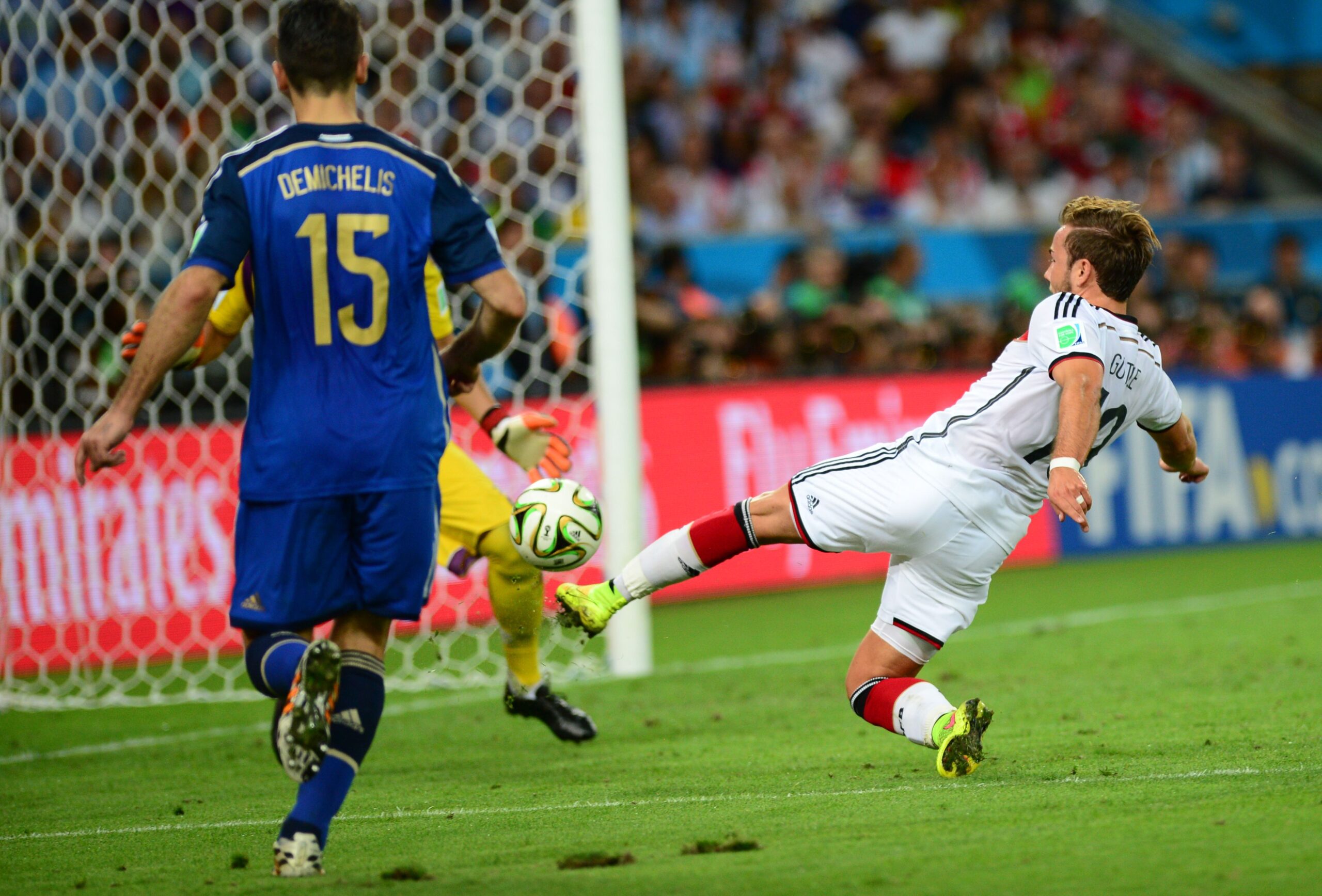
Yes, we were world export champions. 54, 74, 90 and 2014 in Rio de Janeiro: “Do him, he does himnnnn, Mario Götze”, “Götze!” – the voice of commentator Tom Bartels still echoes in the collective memory!
What did we dance in the streets: This is how the Germans walk, this is how the Germans walk and this is how the gauchos walk... Years later, only the dregs of the joy remain and Olaf Scholz croones to us like a Schweinsteiger from the off: “A turning point, a turning point”.
They'll call me freedom Just like a wavin' flag (Ibid.) Friedrich Merz's speech about a month before the opening game, in which he celebrated the 23rd birthday, also seems to have been forgotten.
At the DGB Federal Congress, the trade unionists present swore to the necessary solidarity.
The state of the nation is “challenging and demanding”.
This did not mean the group opponents Ivory Coast, Ecuador and Curacao.
On the one hand, according to Merz, there is the missed opportunity to keep up with digitalization and on the other hand there is the demographic development.
The people are getting old and Nagelsmann also seems to be missing the graying all-stars Ballack, Schweinsteiger and Thomas Müller in his squad on the way to success.
With the current birth rate averaging 1.35 children, the lowest level since the first post-war year of 1946, Germany's economic ambitions are on a knife's edge.
It is no coincidence that the social reforms that are to be presented in July come from this.
Merz was sure to get boos from the trade unionists when he announced the “package of measures” a month ago, but with a bit of luck the reforms will pass the general public by if the boys make it to the final on June 19th.
July in New York and the parliamentary summer break begins the following.
You′re a good soldier, choosing your battles.
Pick yourself up and dust yourself off, get back in the saddle (Shakira: WakaWaka, 2010) And then there is also the war: “We all feel it in these weeks and months: the world around us is rearranging itself.
She doesn't do this slowly, leisurely and manageably.
She does it eruptively.” What Chancellor Friedrich said in his speech at the 23rd
DGB Federal Congress said it was of course not Australia's surprising 2-0 victory against Turkey, but was expressed in the rockets that rushed through the night of the Middle East that same night, fired by the USA at Iran, like dark birds of prey.
What follows from more than 4 years of war in Ukraine, the genocide in Palestine, the destruction of Lebanon and the attack on Iran is nothing more than a moral criticism, which is only intended to create justification for embarking on a war course and getting the national ship into the appropriate channel.
The so-called reform package, which is to be launched next July, will involve fundamental changes to the pension system, working time regulations and the financing of the healthcare system.
These “reform packages”, which may not sound so wild at first, mean the merciless implementation of a German location policy for the company bosses.
This should be accompanied by the abolition of the 8-hour day and the pension at 67.
The all-round care package will also include a reduction in the benefits of statutory health insurance companies.
The planned pension reform has been the ongoing topic for several months.
It was not for nothing that Friedrich Merz described it as “the hardest plank” in the de facto dismantling of the welfare state.
Specifically, this is about a further privatization of the so-called old-age provision, in which only a minimal statutory pension insurance should remain in place as “basic insurance” (Friedrich Merz).
However, from 2032 onwards, the vast majority would be left to the capital market via company and Riester pensions.
According to Merz, for a flourishing German economy, the savings of pensioners should, in the best case, be used, since as a speculative object it could generate higher profits and thus financing options: “You just mentioned the three trillion that are in savings accounts and sight deposits in Germany.
They don't belong there!
They belong in the cycle of our national economy, they must be invested and, above all, they must ensure that people in Germany take greater control of their wealth creation and that they are therefore better protected in old age. So pay attention to your cash boxes in the bedside cabinet and, if in doubt, to the gold teeth of your relatives.
Of course, the government would like it best if the money flowed directly into the booming arms industry.
At least in the short to medium term, this could enjoy billions in returns with the promise of job security, while in the long term this “dead capital” is scrapped or, more cost-effectively, receives the final anointing from a cheap copter drone in a war zone.
The call for greater wealth creation is of course accompanied by a model of life and a material necessity, which results in the absolute affirmation of the bourgeois model of life: trading app on the cell phone, some gold here, some government bonds there and the family in the semi-detached house is still happy even in old age.
But everyone who has nothing to save or who doesn't fit this model will be caught up in Merz's threats in 30-40 years at the latest, when Merz will already have seen the flowers from below.
A careful look in the cities is enough to see that with increasing privatization of pension provision, even more pensioners will have to rummage through trash cans in search of deposit bottles in the future.
Today, over 19% of people over 65 are at risk of poverty, with the number of women significantly exceeding that of men.
You're on the frontline, everyone's watching You know it's serious, we're getting closer, this isn't over (Ibid.) A few weeks ago, a report from Bild made news that reported on the pension commission's preliminary agreement.
This included the reform proposal to aim for a retirement age of 70.
The argument goes that increasing life expectancy must be accompanied by longer periods of employment.
For the workers, whose life expectancy is already reduced by a few years due to physically difficult work or shift work, this means that they can fall exhausted into their grave immediately after completing their duty.
According to the report, all people born after 1990 would be affected by a pension from the age of 70, with the pension level after 2031 falling below the current 48% of the current gross monthly average earnings.
In a Forsa survey at the end of 2025, 81% of those surveyed said that they viewed increasing the retirement age to 70 as a wrong development.
Desperation is particularly widespread among those families who, for financial reasons, have to take care of relatives in need of care.
This work is predominantly carried out by female relatives who, as a result, are no longer able to work.
In such cases, pension insurance has until now paid for old-age provision.
If Health Minister Nina Warken has her way, only 70% of pension insurance contributions should be covered by the nursing care fund in the future.
In such a case, those affected can decide between starving in old age poverty or swallowing the pill of long-term dependence on their partners.
Last but not least, a reform package for statutory health insurance companies is planned for the near future, which should take effect as early as 2027. The proposed legislation announced by Health Minister Nina Warken (CDU) is expected to save 16.3 billion euros next year.
The draft law provides for the abolition of the payment of additional costs that arise, for example, from increases in hospital staff's tariffs.
Until now, this difference has been covered by the health insurance companies.
On top of that, a reduction in the care budget is also planned.
The inevitable consequence would be job cuts, an increasing overload of the already exhausted medical staff and, last but not least, the closure of unprofitable hospitals.
“Priorities need to be set,” said Chancellor Merz, and thus further milestones need to be taken on the path to a totally privatized and commercialized healthcare system.
When the German national team plays against the Ivory Coast next Saturday, millions will once again be sitting in front of their screens and immersed in the national frenzy.
“Bread and circuses” have always played a special role in maintaining a consensus among the subaltern classes towards the ruling system - especially in times of growing contradictions when calls from above are made to tighten one's belt.
With all the joy over the World Cup, one should not ignore the unprecedented attack on the welfare state that is being carried out at the same time as this year's World Cup.
To this end, the federal government is in the process of getting the union leadership on board, as the meeting with business associations and the union leaders in the Federal Chancellery at the beginning of June shows. “The motto for our long journey out of the crisis and the depression is – let’s get up on the football throne.” (Sportsfreunde Stiller) What will remain in today's world, football throne or not, will be depression and disillusionment if the social achievements of generations are wiped away in the shortest possible time.
It's not that far yet.
There is not yet much to suggest that there will be widespread resistance to this storming attack of the new era.
Photo: https://upload.wikimedia.org/wikipedia/commons The article Cross, cut, goal! – Germany's Summer Nightmare appeared first on Lower Class Magazine.
Read the full story at the source →
Source: Lower Class Magazine