Germany · Lower Class Magazine · 1970-01-01
The revolution writes the most beautiful stories - about the life of the revolutionary Yakov Mikhailovich Sverdlov
Deutsch (original) · Auto-translated to English
They say life writes the most beautiful stories.
But how can this beauty be measured?
Isn't it precisely an expression of the diversity of experiences, the penetration of individual moments and the flood of feelings that bubble up from them?
At least that is probably how a certain Yakov Mikhailovich would have answered the question.
By Georg Ackermann A few years ago I had no idea even the name “Sverdlow”.
I was very interested in the events surrounding the October Revolution of 1917 in Russia.
However, it seemed much more important to me to escape from the ideological confusion of our day by reading theoretical classics and thereby first organize my political coordinate system.
It was only when I came to terms with the question of how this historical leap could have come about that the name Swerdlow came to my attention.
From then on I set out to find the story of one of the greatest revolutionaries that the last centuries and the mill wheels of world historical development had produced.
But it so happened that a few years ago you had to search for a long time to come across German-language records from and about Sverdlow.
Only a few books, leftovers from East German bookcases, circulated from hand to hand.
Anyone who was not willing to telephone a large number of antiquarian bookstores in the former GDR would have been condemned to wait a long time if Ceylan Verlag had not republished the book in which Yakov's partner, Klavdija Swerdlowa, wrote down her memories in 2024.
Memories of one of Lenin's comrades-in-arms If we consider the life of Yakov Mikhailovich Sverdlov, as it is described in the book, then we see the life's work of a revolutionary who, although he was not allowed to grow particularly old, carried away every second of all the people who surrounded him and awakened the best in them.
It is not for nothing that the book is subtitled “Memoirs of a Comrade of Lenin.”
He himself said of Sverdlov: “Through illegal circles, through illegal revolutionary work, through the illegal party, which no one embodied and represented as completely as J.M.
Sverdlov - only through this practical school, only in this way could he become the highest representative of the first Soviet socialist republic, the best organizer of the broad proletarian masses. And so, in the course of the revolutionary upheavals, Yakov became the youngest member of the Central Committee of the Russian Social Democratic Workers' Party at just 26 years old and chairman of the All-Russian Central Executive Committee at 32.
But it was a long road to get there, which forged Jakov's character into toughness but also gave him flexibility where it was needed.
While a considerable number of Bolsheviks were condemned to go into exile in the wake of the 1905 revolution, Yakov Mikhailovich remained in Russia until the October Revolution was realized.
He was arrested dozens of times by the Okhrana, the tsarist secret police, put in prison, taken to the most remote corners, surrounded by endless taiga and tundra, and yet under these conditions he managed to become one of the most important figures of the Bolsheviks. Born in 1885 in the city of Nizhny-Novgorod, where the Oka meets the Volga, Yakov's path led at a young age into the ranks of the social democrats, whose organization had to struggle with the harsh conditions of illegality in tsarist Russia.
None other than Maxim Gorky came and went with the Sverdlov family.
Gorky took the material from stories like that of the young Yakov, which he later condensed into a story in the person of the young Pavel in his famous work “The Mother”.
Like Pavel, Yakov made his own way into the currents of the revolutionary movement: the older comrades of the party circle in Nizhny Novgorod quickly became aware of the boy, who not only involved the young people around him in the revolutionary work, but also began to develop a comprehensive understanding of the philosophical and political problems of his time.
His work took him to the vastness of the Urals when he was not even 20 years old.
In the areas of Yekaterinburg and Perm he played a decisive role in building up the Bolshevik faction, which at that time had to mean in particular the ideological clarification of the line in the confrontation with the Mensheviks, Socialist-Revolutionaries and anarchists.
As a propagandist, he went from factory to factory, gave fiery speeches on the shoulders of his fellow campaigners, as the book vividly describes, discussed all the burning questions of the workers and sometimes slipped through the cracks of the Okhrana, which wanted to maintain tsarist autocracy through terror, especially during and after the revolutionary days of 1905.
Later, as a father of two children, as the revolutionary Klavdija Swerdlova reports, it was Jakov who was always concerned with the question of how the young family could raise their two children to be real people, whom Jakov always affectionately referred to as “little animals”.
He wasn't afraid of any household chores, in the few moments the family was able to spend together.
Here too, Yakov was clear that the revolutionary upheaval should not stop at the family.
Swerdlow shows that although objective conditions are important, these are not worth a damn given the lack of subjective forces.
Even in prison, it was Yakov Mikhailovich who united the political prisoners, building a daily life based on sadness, hunger and humiliation.
The cell, says Klawdija, who herself was incarcerated countless times, became a commune and her fellow prisoners became communards, who from then on shared everything, organized the daily routine together and promoted political education.
Even in exile in Siberia, thousands of kilometers away from the places of his youth, he gave his fellow exiles the optimism without which survival under these conditions would hardly have been possible and even became a doctor and teacher to the locals, in whose hearts from then on he had a secure place as “the professor”.
The life story of Sverdlov was written by the revolution.
But not as an automatism, as fate, but as a constant decision to move forward wherever you are and work, to chart the path and always affirm life despite all its difficulty.
Yakov Mikhailovich inevitably became a benchmark for entire generations after him, the apostle of a new age that is still pushing to break through the rigidity of the dictatorship of profit, of war and the exploitation of man by man.
He died on the 16th at the age of just 33.
March 1919 from the Spanish flu.
In the book, Klavdija Sverdlova succeeds in painting Yakov's interweaving with the history of the revolution in the most vivid colors.
Even if Klawdija's retrospective description re-evaluates political forces, which sometimes leaves little room for the complexity of the historical processes and sometimes reads as if a lot of things were predetermined, this is only a small downer in a drawn life story that is still unparalleled today and urges people to act today despite the difficult fighting conditions.
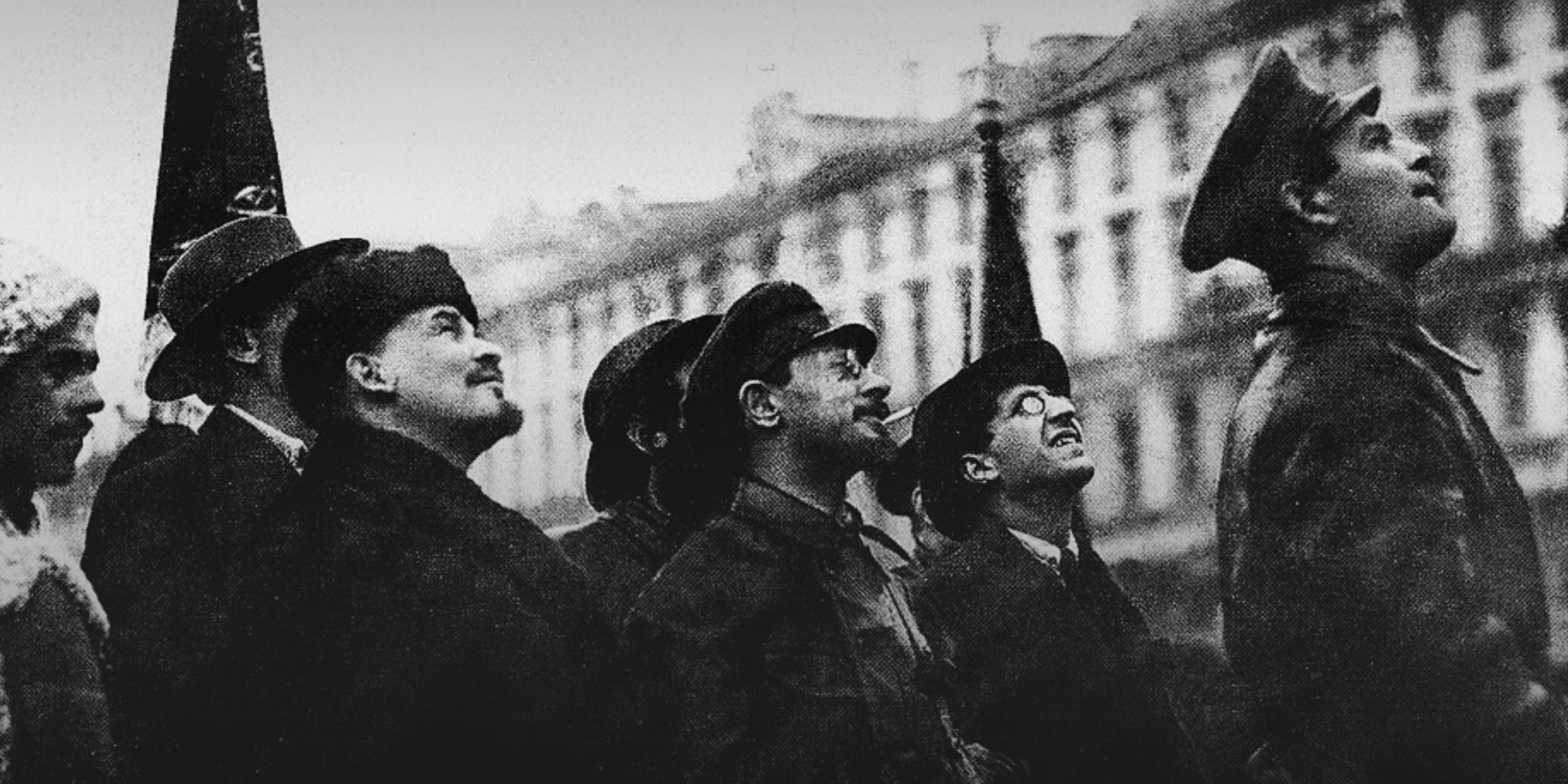
Photo: https://commons.wikimedia.org The article The revolution writes the most beautiful stories - About the life of the revolutionary Yakov Mikhailovich Sverdlov appeared first on Lower Class Magazine.
Read the full story at the source →
Source: Lower Class Magazine