
Germany Lower Class Magazine
The Art of Revolution - Interview with Carlos Manangan, a revolutionary of the National Democratic Front of the Philippines
Below we publish the second part of the interview conducted by Radio Résistance with Carlos Manangan, a revolutionary of the National [ ] The article The Art of Revolution – Interview with
Deutsch (original) ·Auto-translated to English
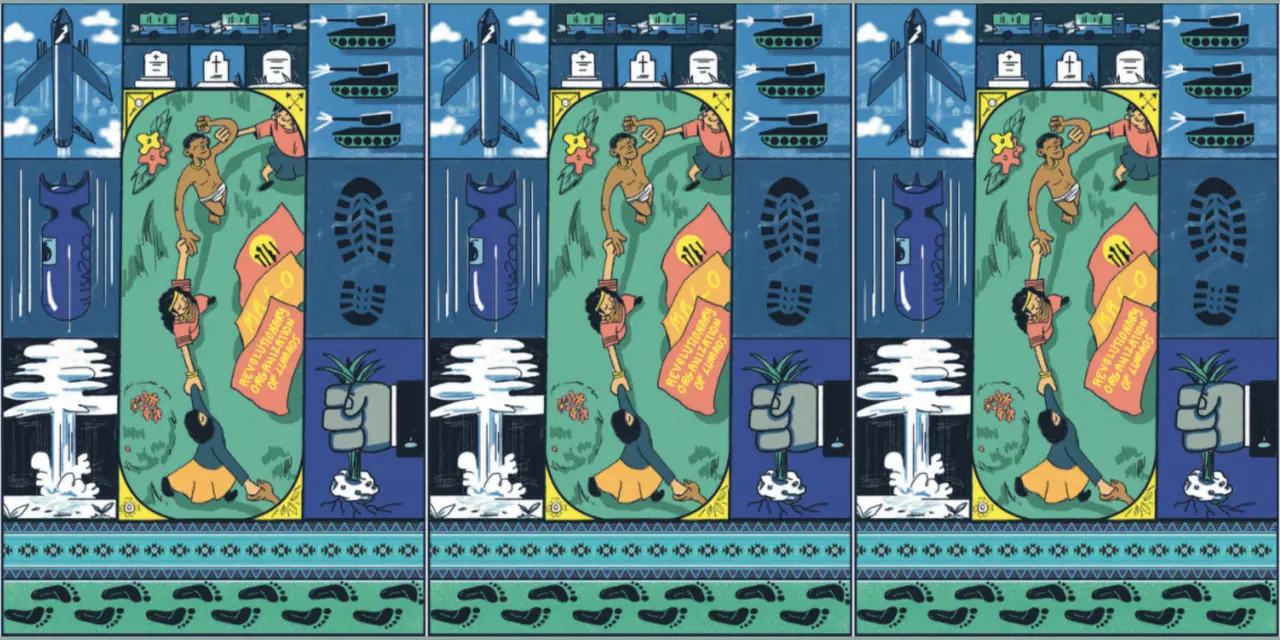
Below we publish the second part of the interview fromRadio Resistancewith Carlos Manangan, a revolutionary from the National Democratic Front of the Philippines (NDF) and the Filipino diaspora organization “Compatriots-NDF”. An artist himself, Manangan creates revolutionary art in various formats including video, music, theater and puppetry. You can find the first part of the interviewhere.
Can you tell us about the historical or theoretical influences of the revolutionary movement in the Philippines?
The Philippines' revolutionary history dates back to the Spanish colonial period. Our first revolution was declared in 1896. It was influenced by the French Revolution. There were some young people – we call them “Illustrados” – who went to Europe, to Spain, to study. There they were able to absorb revolutionary ideas contained in books, poems and songs about the French Revolution. At that time they had not yet come into contact with Marxism. It was still too early.
So our first national democratic revolution was more of a bourgeois-led revolution. It was about brotherhood, about freedom and about independence. There was no class consciousness back then. And that was almost the only moment when we became a nation, developed a consciousness, as a people with the desire to free ourselves from Spanish colonial rule. We weren’t Filipinos back then. We almost won the national democratic revolution against Spain.
But then the Americans came. And they made an agreement with the Spanish and various political interests - political and colonial interests - to hand over the Philippines to the United States rather than surrender to the revolutionaries. So they staged a battle and the Americans came as our new colonial masters. And for nearly half a century we were an American colony.
American colonial rule began in 1898 and ended in 1941 when Japan invaded and occupied the Philippines. During this period of rule we also came into contact with revolutionary ideas from Europe as well as the United States. And in 1930, almost more than 30 years after the Americans came to colonize us, the first Communist Party was founded in the Philippines. A few years earlier, there were already other progressive parties, socialist organizations and parties, and patriotic parties. But for us, the Communist Party of the Philippines was a revolutionary breakthrough.
When the Japanese came in 1941 and invaded the Philippines during World War II, it was this Communist Party that raised the People's Army against the Japanese. So they became legendary because they were armed. They had weapons. In addition to the People's Army against the Japanese, the Americans also began armed resistance. But these were led by Americans. So in terms of native origins, it was the communists who built a purely native army.
But after the war, the communists celebrated the return of the Americans. They subscribed to the idea that Americans were saviors. And that was the first mistake. They entered into collaboration with the ruling elite. They also tried to break into Congress. So there was this idea: “Oh, we can change the system through elections and parliamentary struggle.” But of course the younger communists began to recognize its limitations. And they wanted to evaluate the revolutionary experiences. In their conclusions, they noted that the old party had made opportunistic errors on both the left and the right, had engaged in collaboration, and had promoted ultra-left ideas. When the old party began to work in parliament, it had the slogan: “See you in the presidential palace in two years.”. So it was really a very, very idealistic party.
In 1968, when the younger communists realized that it would be very, very difficult or impossible to change the old party, they refounded the Communist Party. When they refounded it, it was Marxist, Leninist and Maoist. This didn't come out of the blue. They had spent years studying various revolutions. They were also influenced by the Russian Revolution and the Chinese Revolution. They were also influenced by the Indonesian communists at the time. They did good work in the social study and class analysis of Philippine society. So they re-founded the Communist Party of the Philippines in 1968.
It has been said that the Philippines is semi-feudal because it still has features of the feudal society from the Spanish colonial era that were inherited by the Americans. But we are also semi-colonial, because in 1946 the Americans granted us - "granted us", that's really in capital letters - independence, which in reality was only a sham. Because it was linked to numerous conditions. The US military bases should remain in place. There should be military and political advisors. The education system should be built under the guidance of Americans. A new religion was also introduced that was supposed to counter Catholicism, but other, even more fundamentalist religious organizations were introduced instead. So we realized that we were semi-colonial and semi-feudal. And therefore the only solution is to continue the old national democratic revolution. But this time it will not be led and controlled by the bourgeoisie. It will have a socialist perspective.
That was 57 years ago now. And it is not just an armed struggle. It's a cultural battle. It's a cultural revolution. It is an economic revolution.
This may be a small digression, but could you briefly tell us how you yourself became a revolutionary?
I used to be very reactionary. I didn't believe in the revolution. Really not. My father was a revolutionary, but I hated it. I hated it because he was never with us and there were always four people in our house. He never had time for us. It was only when I came into contact with the struggle in the Philippines and the comrades that I realized: Oh, they are not doing this for themselves. They are thinking about us, the younger generation. That was the moment I turned to revolution. Of course, it was also a long battle against petty-bourgeois ideas, such as the idea:"Okay, I'm going to be an artist. I'm going to create revolutionary art."I thought that would be enough. Later I realized: No, people, revolutionaries dedicate their lives to the revolution and can get killed in the process. You can die. They can sacrifice themselves, sometimes even their families, in the course of the revolution. And we have to be prepared for that.
So part of the confrontation with the revolution is also how we can change each other. What do we feel and think about suffering, sacrifice and death – yes, even death? We talk about it. Are we prepared for this? The comrades say that only when you accept the possibility that you could be killed, murdered, tortured or imprisoned - only when you accept this possibility does fear fade into the background. She is always there. But she fades into the background. You realize, “Ah, I can overcome these fears.” But it must be a constant struggle to overcome this fear. That's why we have this rallying cry. We can be heard shouting:“Makibaka, huwag matakot.”This means daring to fight together. Not just daring to fight, but it must be about fighting together. And “huwag matakot” means not to be afraid. It means overcoming fear. Because it is human nature to be afraid. When you are together, when you are in a collective and discuss it and talk about your fears and weaknesses, then you have a good support system to overcome them. Most of the time it works. But precisely because we are human, it can happen that an entire collective has the same weakness and reinforces each other in it. Therefore, people in other collectives should be able to recognize and diagnose these weaknesses and be prepared to criticize comrades and revolutionary organizations regarding their practices in a revolutionary way.
Not in the way we deal with our enemies, but rather in the spirit of debate and with the aim of helping people correct their mistakes.
You find yourself in a very special situation, as on the one hand you are part of the Filipino movement, but on the other hand you are also active in “Compatriots-NDF” within the diaspora. The communist movement here in Europe is not nearly as well organized or as advanced as that in the Philippines. What do you think about it?
I think the basis would be a really in-depth social investigation and class analysis of European societies at the country level. An investigation into how they developed, why revolutionary parties disappeared, went under. But in the Philippines there is a saying that revolutionary parties do not die, even in a vacuum. As long as there is class struggle, class leadership will somehow develop.
What did I observe in Europe? Well, of course there is a lot of individualism. You work alone. There are collectives, but they do not function as revolutionary collectives. People talk about their own comfort zones, living situation and sharing food. But I hardly hear anything about the common struggle.
Yes, there are platforms to fight for housing, for refugee rights and the rights of migrants. But no revolutionary movement develops from this. I mean, sometimes protests don't even have an impact on society. Because demonstrations are actually supposed to show the power of the people to bring economic production to a standstill and to paralyze industry. And here we follow the rules. There are only certain places where you can demonstrate. You shouldn't mess with the police. Yes, I think it's wise not to mess with the police because when it comes to guns and weapons, they have them. And we don't. But we should also think about: How do we overthrow this government? How do we overcome this fascist military and police infrastructure?
We must also take decisive action in organizing workers, especially young people. We must provide them with revolutionary ideas and culture. We have to teach them history. The very idea that the oppressed people can seize political power should be enough. I mean, for us, the inspiration from the revolutionary movements of human history is not to copy them, but to draw inspiration and lessons from them.
Take China for example: China is both semi-feudal and semi-colonial. So we need to investigate that. Although the Chinese revolution ultimately failed, today it is reformist and revisionist and claims to be communist or socialist. We are not following this direction. We criticize them because they are allying themselves with the other imperialist powers and turning themselves into social-imperialists. This is not the spirit of revolution we strive for. Therefore, we accept the good, but we are also aware of the mistakes, because we don't want to make the same mistakes.
We examined Latin America. We studied liberation theology because we shared a colonial history with Latin America. And our revolutionary Christian comrades are concerned with liberation theology and are trying to influence the church as an institution and the believers towards revolution. If not revolutionary, perhaps there are supporting elements.
But all of these contexts cannot simply be copied and pasted. We deal with them and then critically adapt them to the revolutionary conditions in the Philippines. We are concerned with the Palestinian struggle. We establish contacts with Palestinian leaders. We record conversations with them, analyze these conversations and look for commonalities. And then we connect with these struggles and create friendship associations where we can build bridges and exchange culture and ideas.
So these expressions of solidarity are also important. This is not a chauvinistic revolution that is all about the Philippine Revolution. Now we're really reaching out and trying to influence and share our experiences with other revolutionary organizations to see what else we can learn from you. And here are things we experience that might interest you.
You just touched on liberalism and how it impacts revolutionary organizing. Can you go into a little more detail about this topic?
There are many forms of liberalism that we have gone through. There is of course liberalism, which ultimately refers to the individual comrades. These are little things like your own comfort zone and trying to limit yourself to things like your job, your own home and securing your salary in order to have extra money for amenities. And of course the revolution demands that we be prepared to make sacrifices. So that’s… one thing.
Collectively, we have good friends and people with whom we disagree.
Within collectives there is a fear of criticizing people you like. You then try to approach criticism carefully. And you are more brutal, more direct and sometimes more subjective when you criticize other comrades you don't really like. Correcting weaknesses in this way is not characterized by helpfulness. This is aimed at really tearing someone down and destroying their ego so that they are fired from their position.
These are some examples. Or sometimes it's about sugarcoating the truth to make it easier to digest and accept. And sometimes about poisoning criticism to really emotionally and psychologically hurt people in the community you don't like.
It is important that we view liberalism from the perspective of the people we want to liberate. And for us these are the proletariat, the working class, the workers and the small farmers. We try to take their point of view and their point of view and look at everything from that perspective. So in the early stages of being an activist, this is part of the learning process that you have to go through. One must understand the meaning of suffering, sacrifice and martyrdom. And then you have to look at different forms of liberalism and recognize where your own weaknesses lie. And you have to commit to fixing those weaknesses. You have to identify your weaknesses - essentially, practice self-criticism.
One also has to deal with internationalism, especially proletarian internationalism. Not just solidarity in songs or in messages, but a real understanding and sharing our solidarity with other peoples and communities in struggle.
For this reason, as early as the 1970s, ten years after the founding of the Party, we sent teams to carry out real proto-diplomatic work and establish contacts with struggles, peoples, revolutionary movements, parties and even states in order to establish our revolutionary movement as a belligerent movement and a state. We achieved that early on. This means we have placed ourselves on an equal footing with the Philippine state. Our revolution is therefore a national revolution whose aim is to seize power over the government of the Republic of the Philippines in order to be able to establish a new revolutionary government of the Philippines with a socialist perspective. This socialist perspective is therefore very, very important to us.
Part of the fight against liberalism—both at the individual and organizational levels—is constant study. We study our history and the history of the revolutionary movement of the Philippines. We have basic courses on Marx, Lenin and Mao. We have advanced courses that go deeper and reinforce these fundamentals. And we have courses that are far more advanced and deal with the world revolution and in depth with revolutionary struggles abroad, their strengths and weaknesses. And you don't learn alone. It is usually a collective process. So we learn together, so you have the advantage of hearing questions. You have the advantage of benefiting from the experiences of older and wiser comrades.
After that, we make every effort that once we have identified someone as an activist who is willing to learn, we bring those individuals together in a group to learn together. So there are always new activists. And the graduates of these courses are also trained to become teachers and educators. This is how an educational movement is born.
The revolution is not just an armed struggle. It is an educational movement to raise the level of understanding. There is a propaganda movement that ensures that all propaganda is consistent with the revolutionary goal. So we do not simply express ourselves spontaneously without consulting other comrades or without ensuring that our political line and tone are always correct. But above all, I think that the most important thing in the fight against liberalism is the close connection with the working masses. To be constantly with workers - in their workplaces, in the communities in which they live, with their families, in production work, in demonstrations and protests, and in learning.
That's why we try our best to create a balance between theory and practice through our involvement in the various areas. So we have a holistic process. Six years! When I first became an activist, I thought it was enough to be aware of the suffering and struggles. I didn't know there was a communist party. I didn't know that there were different levels of courses that I had to complete. I didn't understand that until 15 years later when they said, "Oh, have you taken this course?" And I said, "What course? I didn't take any course." But everyone thought I was an advanced communist. I unconsciously did a lot of revolutionary work. And they said, “You have to sit down for three months to learn, and then another three months to teach, so you really understand the concepts.” So I spent almost a year deepening my theoretical foundations. And for a year I just lived with indigenous peoples, with farmers, with workers. And only then did they say, “Okay, you’re good enough to call yourself a revolutionary.” And that wasn’t a self-awarded title. You have to earn it.
What we have observed here in Europe is that when a revolutionary upsurge develops– especially among young people –, very often develops its own counterculture. And we've found that after a while, capitalism somehow finds ways to commercialize these kinds of cultural products. We were wondering if you have experienced this kind of development in the Philippines?
Yes, that happens. But you have to take advantage of it. Previously, wearing a T-shirt with a hammer and sickle symbol could get you into trouble. You can be arrested. I know someone who was arrested and tortured, and he wasn't even an activist. The t-shirt came from his vacation in Vietnam. He had seen the T-shirt. He liked it. Just like the Mao hat from China. Yes, that happens. It's like the masses see it as a badge of honor even if they're not revolutionaries, and they're pretty proud to wear that. It is part of the revolutionary culture that is breaking into the mainstream. And I think that's a good sign.
But what really matters, in my opinion, is that revolutionaries should not brand it as their own or as something exclusive.
The labor movement has different layers. There are reactionary layers. There are progressive ones. There are liberal classes. And there are also revolutionary layers. And we have to be transparent enough to go back and forth between these layers and find people who are more open to the more radical, to the truly revolutionary.
We live in a capitalist society and liberalism really prevails. And this is the age of imperialism. We cannot limit ourselves to individual activists and small collectives. We should try to make the revolution a mass movement. And only then, I believe, when socialism and communism are so widespread that everyone is a member of a socialist or communist organization that is really serious about the revolution and acts revolutionary, will we be able to seize political power. However, as long as the movement is limited to a few hundred revolutionaries who instigate uprisings and demonstrations, it will not achieve this when it comes to gaining political power. There will be a regime change. Other reactionaries will seize political power and we will have to start from scratch. It takes painstaking work to bring this fermentation process called revolution to completion.
Do you have any final words?
I think in our respective lives and in our societies we must find the courage to fight and overcome fear - not just the fear of the fascist state, but also the fear of stepping out of our comfort zone and truly reaching out to those who are involved in life and death struggles. And we must extend our revolutionary spirit and our help to those who are truly in the midst of this struggle.
Thanks for the conversation!
The postThe Art of Revolution - Interview with Carlos Manangan, a revolutionary of the National Democratic Front of the Philippinesappeared firstLower Class Magazines.