
Germany taz
20 years of the Ohel Jakob Synagogue in Munich: celebrations under police protection
Charlotte Knobloch received distinguished visitors at a ceremony in Munich's main synagogue. Which suddenly became a little higher. more...
Deutsch (original) ·Auto-translated to English
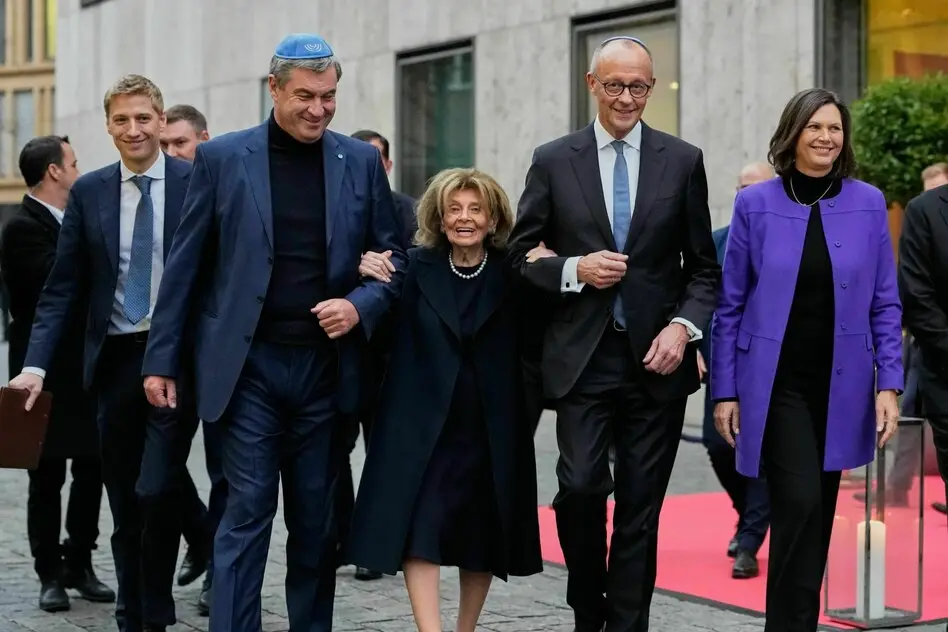
Of course, almost none of the speakers could resist a small allusion to the news of the day when welcoming the guests. “Dear Madam President of the State Parliament,” says Munich Mayor Dominik Krause when it is Ilse Aigner’s turn, placing particular emphasis on the “state parliament” part of the word. Or Federal Chancellor Friedrich Merz: “Dear President,” he says, takes a meaningful pause and then adds “the Bavarian state parliament.” The guests at the ceremony applaud it with laughter.
Even when Charlotte Knobloch, the President of the Israeli Community of Munich and Upper Bavaria, speaks first, and addresses Aigner as “highly esteemed, dear Ms. Aigner, Madam President,” the amusement is great. No wonder, after all, it is Aigner's first official appearance as future Federal President. Of course, this is not a real office, and of course it is also a coincidence, but the future head of state could hardly have wished for a more fitting, dignified occasion than the ceremony marking the 20th anniversary of the inauguration of Munich's new main synagogue, the event at which Munich's Jews, as it has been said ever since and Aigner also put it in her speech, arrived "in the heart of the city."
It was barely three hours ago that Ilse Aigner appeared in front of the press in Berlin with Chancellor Merz and he introduced her as the next Federal President. And so the attention in the synagogue is primarily focused on the woman who enters the room behind Knobloch, who is holding hands with Merz and Prime Minister Markus Söder.
And it is Knobloch, the landlady herself, who is the only one to directly discuss the personality: The news from Berlin was a great joy for everyone, she says. Aigner is “a woman who represents the best in our country”. And Knobloch goes one better: “I say it: There is no one better than her.” When Knobloch CDU leader congratulates Merz and Söder on their election, Merz nods his head slowly.
Eventually things get even more serious. Because of course the occasion, the synagogue's 20th anniversary, is a joyful one, and all speakers - especially Holocaust survivor Knobloch - try to exude confidence. And at the same time, they know that such a ceremony can only take place if the area has been closed off beforehand, a large contingent of police and security forces protect the guests and the explosives dog has done its duty.
You also know that the Munich Public Prosecutor's Office has just reported findings that a man in Munich is said to have planned an attack on the Jewish museum right next to the synagogue. But the man was shot dead in an attack on police in front of the Israeli embassy in Belgrade at the end of October.
You know that the public prosecutor's office is investigating a death threat against 93-year-old Knobloch that someone made on a park bench in the English Garden after Knobloch expressed concern about the AfD's election victory in Saxony-Anhalt. And they will remember the attack that neo-Nazis wanted to carry out when the foundation stone was laid for this very synagogue. They wanted to set off bombs at the ceremony in 2003. The plan was discovered shortly beforehand.
But you also know that anti-Semitism is not something that “still” exists in Germany, but that hatred of Jews is actually increasing, especially after the massacre on October 7, 2023.
The new main synagogue Ohel Jakob - the name means “Tent of Jacob” - was opened on November 9, 2006, exactly 68 years after the pogrom night in which the Nazis burned down, among other things, a synagogue of the same name in Munich. The magnificent former main synagogue on Herzog-Max-Straße had already been demolished three months earlier.
After the war, the Jews who remained or were stranded in Munich initially used a small synagogue on Reichenbachstrasse. This synagogue, originally built in the Bauhaus style, was also devastated by the Nazis, but was not completely destroyed. It was poorly restored and served as the main synagogue until 20 years ago. It was only last year that the building was restored – in its original style.
Ohel Jakob, which was built with a community center and Jewish museum on St.-Jakobs-Platz right in the center, is now a landmark of the city. The 28 meter high church consists of a base made of light natural stone, reminiscent of the Wailing Wall in Jerusalem, and a glass cube sitting on top.
Of course, all speakers recall the history of the building of the synagogue, the Shoah and the threats that Jews face today. Mayor Krause, for example, warns against hatred of Jews that comes under the guise of supposed solidarity with Palestine. And Merz quotes Knobloch, who said at the opening of the synagogue: “We have built, we are staying, because we belong here.” She said that despite the arson attack on a Jewish old people's home in 1970. Despite the Olympic attack in 1972. "We belong here. These are words of hope. A creative hope that says 'Nevertheless'. We still belong here. I am infinitely grateful to you for this despite this, dear Dr. Knobloch."
Söder points to the power of social media and algorithms that spread hate and anti-Semitism in a completely different way than was previously possible. "If we want to remain a well-fortified democracy in the long term, we don't just have to think about how we can protect young people. Poison is spread throughout all generations."
And finally, Aigner remembers a speech she recently gave in the state parliament. “The ‘Never again!’ is dead,” she said. That scared some people and caused questions, she says. “But I ask you: What other judgment should one come to – when Jewish people are no longer safe, no longer secure, no longer free, when they can no longer live their Jewish identity without fear.” And: “This climate of fear is a disgrace for our country!”