
Germany · Lower Class Magazine · 1970-01-01
The communists are finally back, but headless
Deutsch (original) · Auto-translated to English
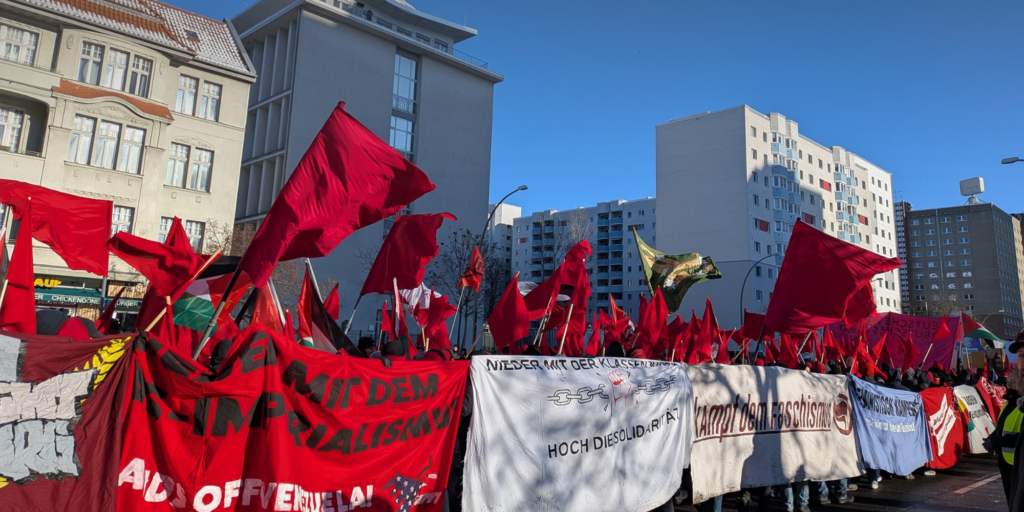
A few weeks ago, two articles appeared in Lower Class Magazine that could actually have been the opening blow of a larger debate within the communist movement in Germany, but which ended up fading away within the wide walls of the social media titans.
Such a debate is important because in Germany we have been experiencing a blossoming of the communist movement that is unique in the imperialist countries, albeit a delicate one in historical terms.
Despite its slow development, this flower is by no means untouched in its growth.
Rather, their drive is threatened from within.
The question that the polemics of David Meyn and Max K. explore is the nature of this internal threat.
In a situation in which German capital is once again stepping into its marching boots, the urgency of effective revolutionary resistance, which is ultimately what is at stake here, is self-explanatory.
In what follows, I will attempt to restart this potential debate.
In the following, I will undertake a somewhat more in-depth examination of the problems of this movement of ours, deal with the concrete historical conditions of the class struggle in Germany - conditions that are often not taken into account with fatal consequences - and finally also give some suggestions as to how we can better fight our way forward and better combat some of the dangers that are already having an impact today.
This will be controversial and perhaps painful for some, but I think as communists we have to get used to strict self-criticism, because that of the class enemy will in any case be a lot harsher.
Let's go!
A discussion contribution by Malik L.
We move forward wavering. What unites the articles by Meyn and K. is the centrality of the concept of anti-revisionism.
Are the problems of the German communist movement rooted in its anti-revisionism, as Meyn argues?
What K. convincingly demonstrates is the shortening of the concept of anti-revisionism that Meyn uses.
Well, the term is not properly defined and it turns out that anti-revisionism was historically meritorious.
Does this mean that the question of whether anti-revisionism is our central problem is off the table?
I think in order to answer this with some certainty, we need to take a step back and note what we are actually talking about when we talk about the problems of our movement.
The original article by Meyn gives us three symptoms of the problems of our movement: 1.) While its quantity continues to increase, the quality, i.e. the social influence, stagnates. 2.) There is a strong revolving door mechanism, which means that the length of time the militants stay in the organizations is short and the organizations do not succeed in retaining their members in the long term; 3.) There are increased divisions within organizations.
Well, that's all true if you take the relevant restrictions into account: 1) as the organizations grow, their social influence necessarily grows, simply because they are part of German, capitalist society, which does not mean that one is already knee-deep in class struggles; 2) Obviously, the individual organizations also retain people in the long term, probably also a growing core of people, although small relative to the growth of the movement as a whole, who determine the nature of the organizations decisively but not exclusively; 3) When there are more organizations, there are of course more divisions, the more so the more ineffective each organization is at achieving its goals.
None of these problems are new.
We know them from the last big wave of revolutionary construction projects from the late 1960s to the early 1980s.
In this respect, the recurrence of these problems points us to something that K.
His reply addresses: the importance of historical experience and at the same time what seems special about our situation: namely, that we suffer from the consequences of a break with tradition.
After the collapse of the K-group movement, the revolutionary movement - at least the part that did not indulge in illusions of the "long march through the institutions" into bourgeoisization, or simply threw in the towel and joined the liberal or even fascist bourgeois camp - was able to stay alive through the autonomous movement.
It has its historical merits in that it has kept the revolutionary spirit on the back burner in its own way, but at the same time it is comparable to a dead end, which is clearly evident today in its helplessness in the face of the onslaught of bourgeois reaction.
It also only took up the teachings of the K-group movement in a negative form: we don't want this and that.
Considering the quite clear weaknesses and disgusting qualities of the K groups (pronounced dogmatism, sectarianism, free play of patriarchal dynamics, nerdism, the most absurd ideological deviations, abuse of their own mass base, etc.), this is understandable, but it was and is a failure due to historical necessities.
And we continue to suffer from this failure to this day.
Without a scientific examination of the K-group movement, and for us that can only be a consistently revolutionary Marxist one, we will continue to reproduce its mistakes without historical necessity and thereby also run the risk of its failure.
Further.
I said that this break in tradition is an apparent peculiarity of our situation.
Apparently because the K-group movement also suffered from it.
During their rule, the Nazis had succeeded in reducing organized communist resistance within Germany to a very limited extent through dehumanizing violence.
As a social force, they were able to eliminate the German communists.
With the re-establishment of imperialist Germany in the form of the Federal Republic of Germany, not only were the vast majority of Nazis rehabilitated and put to work in the state apparatus.
What's more, the core of Nazi fascism, its fanatical anti-communism, was also reflected in the Federal Republic of Germany's raison d'etre (later appropriately enriched with unwavering loyalty to the genocidal settler-colonial state of Israel).
It was therefore not long before the KPD, which was already in the process of becoming middle-class, was outright banned in 1956.
This sealed the historic break in the tradition of the revolutionary communist movement in Germany, even though its actual beginning dates back to the advent of the Nazi dictatorship.
Accordingly, we repeatedly find attempts in the K groups to build on the heyday of communist organization in Germany before the Third Reich.
And even at this time, especially the 1970s, the consequences of this very own break in tradition became apparent.
In a mostly extremely dogmatic manner, methods, structures, working methods and theoretical elements were simply transferred from the past into our own time.
All too often, the transformation of the real social conditions that separates the two historical moments from one another was ignored.
And it remained so, not least because the conditions for a critical examination of and concretization of historical practice were missing, namely a scientific investigation of Germany's social development, which culminated in the present and, moreover, indicated the future in its tendencies.
Without such research work - research understood as a unity of practical and theoretical work - a fruitful approach to our own history could not and cannot take place, let alone with German history as a whole.
We are then condemned to reproduce the same mistakes over and over again – condemned because of our own incompetence.
In short, there are definitely deeper roots to our problems than anti-revisionism.
Roots that we will not reach with the current theoretical status of the movement.
This addresses another problem: our generally low and very slow level of scientific development.
This is also touched upon by Meyn and his own contribution bears witness to the verdict.
If we keep in mind that our movement has been around for over a decade now, its age alone cannot explain its misery.
The break with tradition and its pending reappraisal certainly contribute to this, but are themselves also caused by our lack of scientific knowledge.
There is still an understanding of theory in which the methodological level is not taken into account (dogmatic teaching courses in DiaMat or HistoMat do not help, but only emphasize the problem).
Most of the time, the Soviet canon is processed like a series of textbooks, the contents of which are drilled into people's heads, as if they were eternal truths.
The original contributions read accordingly.
Marginalized revolutionaries or other revolutionary traditions outside of Marxism receive little attention and are often only labeled as revisionism.
There is almost no debate with bourgeois thinkers, and when it does, it is under the same circumstances.
The capitalists have to grapple with the same social problems as us, although they of course reach different results.
A mature, confident approach to theory, which a sophisticated understanding of the Marxist method opens up to us precisely because we should and can always understand theory in its concrete social context, is rare.
The devil is in the details With this I want to move away from the level of abstraction of the general and move on to some concrete manifestations of our problems.
Let's pick up where we left off and tie it together with a few other aspects.
Why is it that attempts at debate like those by Meyn and K. fade away in the digital ether?
There is a brief flash in the pan in the comment sections, which necessarily follows the medium's rules of discourse, i.e. it is superficial, emotional, and overly polemical.
The movement's low scientific level is another aspect: most militants are not yet qualified to undertake more detailed, in-depth research.
There is also a problem that is already familiar from the K-group movement: the overwork of those organized.
There is often a mindless busyness, in which the most committed ones struggle to the best of their ability and use up their energies in a multitude of small, mostly politically meaningless tasks.
There is no time to pause and reflect, let alone for in-depth methodological, historical and theoretical studies.
Of course, you can then specifically assign cadres to specialize in theoretical work.
However, this often leads to an alienation from the practical work, which contributes to reinforcing the dogmatic character of the theoretical work.
The exhaustion of individual cadres who are particularly committed is a danger inherent in any serious revolutionary attempt.
Particularly in the area of mass organization, there is a pronounced differentiation of political levels and the willingness to sacrifice oneself for the cause.
A core of leading forces emerges naturally from this situation, whether we want it or not.
It is important to use the strength and commitment of the most committed people in order to motivate and enable as many other active people as possible to become more committed and conscious.
This is a frustrating process.
And it is precisely the build-up of frustration that often leads to a bureaucratic attitude developing within the cadres according to the motto: “Then I’ll just take the matter into my own hands, the main thing is that it gets done!” But that is by no means the main thing.
The main thing is that we, as the masses, empower ourselves to determine our own destiny.
The bureaucracy here consists precisely in the fact that the masses are deprived of this opportunity and that an undemocratic mentality develops and ultimately establishes itself.
The cadres themselves suffer from this attitude, which results in constant overwork and exhaustion.
And the revolutionary process threatens to change its character early on.
There is a tendency to place the organization and its tactical goals above our strategic goal.
This addresses another widespread problem: party fetishism.
To make this clear, we cannot claim that this is a problem that is prevalent everywhere, but it is a phenomenon that is particularly widespread in organizations that see themselves as building projects for the German Communist Party.
So what does that mean?
It is the reversal of the relationship between strategic goal and mediation.
The communist party is a mediating moment on the path to communism, it is not itself an end goal.
Rather, it must ultimately be dissolved when it has fulfilled its purpose.
More precisely, this happens in the process of fulfilling the purpose itself.
Just as it contributes to the dissolution of classes, it deprives itself of the social basis of its existence.
Now it is in the nature of structural organizations that their immediate goal is the party itself.
It can easily happen that over the long building process the focus on this goal becomes absolutely rigid.
As a result, the party form, as a means of conveying the goal itself, obscures the purpose it is intended to serve.
In practice, this is expressed, for example, in the behavior of the cadres described above, who place the tactical goals of the party above the strategic political goals of the class, only to potentially break themselves as a result.
When party fetishism becomes hegemonic within an organization, we are no longer dealing with a political organization in the true sense.
Because then it only serves itself, even if it shows all the signs of political work to the outside world and to itself.
There are K groups that have developed in this way and have been able to survive even after breaking with tradition.
The question is at what cost.
One lesson that can be learned from the K-group era is caution against sectarianism.
This is expressed, for example, in an excessive fear of polemics.
Where there is exchange between organizations, it is either reduced to official channels from which the masses are excluded, or to a culture of backbiting and gossip among the masses of members.
Both tensions complement and depend on each other.
Where only official, secret discourse is permitted, the weeds of gossip flourish in the shadows.
Where these weeds flourish, an already overly cautious management reacts with even greater centralization.
In this way, one lesson from history turns into its opposite.
Polemics, which has always been a scientific tool in the best Marxist tradition, is suffocating, while dogmatism deprives it of oxygen and flourishes.
There are also lessons to be learned from the Autonomous Movement period.
Almost all organizations today have the goal of not wanting to become a subculture or a scene.
We want to reach beyond the immediate circle of the left scene into the broad masses, organize them and fight together with them.
Because the break in our tradition has shown that although you can save yourself as a scene by developing a subculture, at the same time you lose your political character and your influence on broader society.
Class struggles are no longer waged at all or they are reduced to local areas and thus necessarily become reform struggles.
There can be a political gutting of revolutionary politics.
The subculture serves itself and sets itself apart from the majority society through its own cultural characteristics, and even develops a feeling of sublimity compared to the broader masses.
An extreme case here is the anti-German scene, which in its right-wing branches has transformed into a fascist movement under the guise of left-wing cultural characteristics.
It is not least in the awareness of such developments that today's communist movement strives to escape this subculturalization.
And yet we are seeing exactly this development.
There are certain styles of dress and behavior that identify our movement as a subculture by functioning as moments of differentiation from the masses.
We are hardly involved in the struggles of our class; instead, we constantly organize demonstrations that have no impact beyond the scene, or organize cultural events - hiking days are currently in vogue - whose political content is questionable.
This is certainly not intentional, but rather follows from the formation of our own social sphere, which grows organically, more or less spontaneously, from every organization.
The challenge is how we can consciously influence these organizational cultures so that they become points of attraction for the broader masses, rather than simply serving as a point of difference for ourselves.
The decisive criterion is whether we will succeed in developing real activity in the class struggles.
I don't want to exhaust the topic with this.
One could almost endlessly list other specific problems.
Every active person in the movement has enough observations and complaints to add to this limited outline at will.
Before we can move on to the positive part of this article, we have to briefly address one question: What is the yardstick by which we measure our successes and failures?
What is the strategic goal of our movement?
We have already touched on the importance of these questions, now I would like to address them in a little more detail.
Goal and conditions The goal is quick and easy to name.
We want to fight for communism.
Zack, there's something to eat.
Question answered.
Or?
Let's stop for a moment and think about it a bit.
Obviously, and this is a basic wisdom of Marxism, we cannot simply jump into communism overnight by will.
Our forces are isolated and with the capitalists and their state we face a class enemy that is prepared to defend its exploitative order to the utmost.
That's why we set up organizations in which we pool our scattered forces, with the help of which we can develop our consciousness and wage class struggles.
The class struggle itself is the decisive factor.
It is the means by which we will revolutionize the capitalist world that shapes, torments, kills and shapes our souls and bodies every day.
So far, so known.
But we can think even further.
The working class is united as a class – that is, on a very abstract level – by the same relations of production.
As workers, we all have no means of production and are forced to use our life force, i.e. h. to sell our labor, i.e. to allow ourselves to be exploited by capitalists.
This is an abstract truth.
If we take a closer look, we see that the world is divided into nation-states and that this division is strictly and ruthlessly enforced: through controlled borders, citizenship, through global relations of exploitation and oppression.
In the imperial center of this concretely structured system, we all benefit, whether we like it or not, from the exploitation of the colonial and neo-colonial periphery.
Male workers enjoy the benefits of patriarchy (while suffering from the distortions of our personality).
This really divides the class in complex ways.
Patriarchal and racist behavior among our class members is not simply brought into our class by cunning capitalists, but rather they grow spontaneously, organically and steadily out of these real social conditions.
Male workers defend the advantages that patriarchy gives them over non-male workers.
White workers defend the advantages that this system grants them because of their whiteness and at the same time defines them as white, against non-white workers.
We are getting closer to reality.
Today's communist movement is slowly catching up with a lot of this in its work.
When it comes to the topic of patriarchy, racism and working-class aristocracy, there is probably still the most catching up to do, which is certainly also a consequence of the predominantly white and rather working-class aristocratic to lower middle class character of the movement.
But we can go further.
One of the most essential and at the same time least illuminated conditions for the achievement of communism follows from the concrete structure of capitalism mentioned above.
What I mean is the nation.
Of course, the national question has been discussed at least since the late 19th century.
A central theme of the communist movement for centuries.
However, almost exclusively from the perspective of national oppression and the right to national self-determination of the colonies.
What receives little attention, although it is occasionally mentioned in passing, are certain characteristics of the individual nations.
Such characteristics are products of the class struggle in its various forms (economic, political, military, cultural, legal, philosophical, etc.) within an economic-cultural space that is simultaneously created by it and which, at a certain point, has been given the form of the nation-state.
It is not a question of attributing certain characteristics to nations, but of researching certain, historically produced peculiarities and taking them seriously as a condition of the class struggle.
I want to be a little more specific and argue more tangibly.
Above I described some specific problems facing our movement.
If we really want to understand them and do something about their reproduction, we have to understand the German conditions under which they develop.
Let's take the problem of party fetishism.
I have described aspects of its emergence.
However, we find general cultural characteristics of Germany that definitely need to be taken into account here.
This is because our methods, working methods and forms of organization will produce very different results depending on the cultural milieu.
What characterizes the German national character, for example, is the tendency towards obedience to the authorities, a basic attitude that is characterized by crouching upwards and kicking downwards, as well as an associated deep trust in the German bourgeois state and its institutions.
These characteristics are no coincidence.
On the one hand, it has been drummed into us over centuries by the state apparatus.
Schools and parliamentarism are excellent means of domesticating a potentially revolutionary class.
In addition, Germany has never managed to successfully carry out a revolution.
The self-confidence that characterizes the French working class towards its state is rooted not least in the French Revolution.
We, on the other hand, have experienced that the German state can get up again even from the greatest devastation and can even experience new prosperity (let us think of the “economic miracle” that followed the Second World War).
This state has brought the imperialist looted property to large sections of the working class through the welfare state and thus bound them to itself.
The bourgeois media, which are linked to the bourgeois ideology of this state, are doing their part to cement a corresponding mentality in the masses through daily nationalist propaganda and agitation.
On the other hand, over more than a century now, German social democracy, albeit with well-known setbacks and counter-tendencies (Nazi Germany, neoliberalism), has strengthened German workers' trust in the state much more deeply through its reform policies and their successes.
And she managed to enrich this consciousness with the spirit of counter-revolution - she herself was also driven to this by the conscious part of the worker aristocracy.
Any revolutionary tendency can still be fought with the call to defend “our democracy”.
What I'm getting at is that these specific German conditions have led to a lack of democratic consciousness, a tendency to submit to authority, a weakness of personality.
We can all observe this in our ranks, every person who is actively involved in our movement.
All of these are characteristics and tendencies that are not simply personal shortcomings, nor can they simply be traced back to our organizations, but are products of a concrete social development.
And it is the ignorance, the blindness of our organizations and movement towards these concrete social conditions that means that these tendencies can reproduce themselves all the more freely within our movement.
If one attempts to build a particular, very centralized form of organization under these conditions (let us take the Bolshevik Party around 1917, as it was formed under the concrete conditions of the enormously undemocratic, repressive and economically underdeveloped Tsarist Russia) because it was useful elsewhere and/or in another historical moment, one necessarily reinforces all these tendencies.
Here too, I want to just touch on the subject in order to try to get the reader's thinking moving.
My attempt was initially to make it clear that we have a specific goal that we can only achieve if we develop a very concrete understanding of the conditions under which we fight and from which we have to derive the means, methods, mediations and intermediate steps.
If we don't succeed, then we will end up like the K-group movement.
We won't reach our goal.
A brief pause along the way Before I conclude my article, I would like to add a brief note.
As mentioned at the beginning, our movement is in a growth phase.
The speed of this growth is also increasing.
So we should be able to conclude that we are doing good work and are fundamentally on the right track.
I think that would be a short circuit.
The reason for this growth currently lies less in the excellent quality of our work than in the deepening crisis of the capitalist world system and especially of German society.
It is German capital and its political representatives who are driving people into our arms.
More and more people, especially young people, whom German capital would soon like to throw back into the meat grinder of war, are looking for answers and radical alternatives.
And they come across us.
What they then encounter is initially a new world with its own rules, cultural characteristics, political ways of speaking, etc.
Everything seems exciting, interesting, there is a lot of activity, people go to demonstrations and more.
You finally escape isolation, find social connections, inspiring role models in the senior management team and a solid identity in general.
And soon, when the initial excitement gives way to a sober look, the numerous problems become apparent, and perhaps the first symptoms of overwork begin to appear, without any noticeable progress in the work.
Your own attitude contributes to the problems: you define yourself through this subculture in contrast to the majority society, you fall into uncritical submissiveness towards the leading cadres, you become timid out of fear of losing this newly found social home.
Some get stuck here, less because of political conviction and more because their identity and social life have become so intimately tied to a particular organization or the movement as a whole.
Disillusionment follows among the others and if a significant change or real progress does not become apparent soon, the radical raising of consciousness and organization turns out to be a more or less short stop and the people find themselves back in the tight embrace of the bourgeoisie.
The groups that are newly founded reproduce the patterns of existing or other foreign or historical models in a dogmatic way.
This means they also have all the problems we mentioned above.
Because they work under the same conditions, have to deal with the same challenges and often have the same weaknesses.
For us it appears to be a success for the time being.
There is quite a bit of movement through the organizations, but overall it is still growing everywhere.
So things are going well.
Until the crisis subsides or bourgeois politics increase repression and thus thin the ranks.
Whether it comes to that is up to us; in our ability to develop and learn.
Let's get more specific I want to touch on a few more aspects to show how our general conditions of struggle have changed since the last revolutionary upsurge.
My focus is on a handful of points that I consider to be essential, but which still need to be fleshed out through further research.
Of course, such a contribution to the debate cannot be the place for in-depth scientific research into society.
But I would at least like to provide an incentive for it.
The period since the 1970s has been characterized globally by a decisive restructuring of production relations.
What is known as “outsourcing” means a huge intensification of imperialist parasitism.
The industries were largely relocated from the imperialist centers to the periphery in order to benefit from cheap labor, i.e. from higher rates of surplus value, and from less regulation.
Wage differences are maintained internationally through close control of migration movements between the centers and the periphery.
The global class structure has been transformed by the outsourcing of production.
There is now a huge working class in the colonies and neo-colonies.
These workers live in much worse social conditions than the workers at the center of the system.
The governments of the peripheral states compete with each other to become production locations and therefore enforce brutal labor conditions in favor of monopoly capital.
This is because the production that now takes place in the periphery is destined for the market at the center of the system.
So these countries will not become more independent.
The pressure on the workers on the periphery increases their resistance work and they begin to organize themselves more and more illegally.
At the same time, the conditions of their struggle are unstable because individual production sites are only ever responsible for a portion of the goods.
Capital can therefore relocate individual links in its production chains relatively quickly.
Nevertheless, this new global class structure represents a significant difference from the past.
The national liberation struggles at that time were led primarily by radical democratic and/or nationalist petty bourgeois.
It could not have a proletarian mass base behind it because it did not exist.
Their revolutions were based on the peasantry and the lumpenproletariat.
At that time, colonialism used the colonies primarily as sales markets, as sources of raw materials and as sources of human material for its inter-imperialist wars and for the repression against other colonies and workers.
This meant that a large working class could hardly emerge.
It now exists and has acquired the solidity of a historical class over the last few decades.
The coming revolutions in the periphery therefore have the potential to be more radical, more communist and more lasting than in the last century.
Of course, there is still a long way to go from potential to actuality and the mediation of both is nothing other than revolutionary politics.
One aspect of this development that concerns us in the imperialist center even more directly is the recomposition of the working class here.
With the beginning of the “economic miracle”, monopoly capital increasingly attracted non-white workers to its centers in order to be able to exploit them better and to worsen the fighting conditions for the white workers who were already there.
The national liberation movements ushered in the era of neo-colonialism and the influx of non-white, and therefore easier to exploit, workers increased.
Today the working class in all imperialist centers is composed of white and various non-white workers.
This difference between the “races” is not a biological, natural one, but rather a social relationship that, on the one hand, grows organically from the global division of labor and, on the other hand, is very consciously produced by the bourgeois states and capital.
Let's think about the dehumanization in "refugee accommodation" (let's say it without disguise: concentration camps) or the racist division of labor, in which the dirty work is mostly or sometimes exclusively done by non-white people.
Race is therefore not mere imagination but real practice.
As such, it divides the working class.
In doing so, we have to face the reality that the racist views of many white workers, especially in the working class aristocracy, are not simply borne into them, but are an adequate expression of their social conditions of existence.
You can only be so fat because non-white workers are exploited more ruthlessly.
The more conscious parts of the workers' aristocracy know this well and therefore organize themselves into social-imperialist or fascist parties.
A class analysis that does not take race and racism into account in this sense will not provide a realistic picture of social conditions and will therefore not be able to justify successful practice for the communist cause.
An event that was decisive for Germany can make this clear.
With the fall of the Berlin Wall and the annexation of the GDR, German imperialism received a huge boost in strength, which significantly empowered it to achieve its current dominance over Europe.
The former GDR citizens became part of the white German class structure.
The nationalist euphoria that was immediately triggered by the fall of the Berlin Wall must be understood in the context of the pogroms at that time.
Because euphoria was followed by disillusionment.
A process of primitive accumulation took place in the East.
He destroyed the remnants of socialist property and made East Germany ready for capitalism.
This included the separation of the owners of the means of production and the means of production (destruction of public property), the unemployment of millions and the departure of East German youth to the West.
The marauding terrorist Nazi gangs crushed the remnants of the left and thus prepared the ground for capital.
Suddenly the East Germans were confronted with the reality of capitalism, especially from the perspective of the victims, who have since had to act as a domestic reservoir of cheap labor.
Nationalism determined their behavior; their inclusion in the social category of whiteness, even in this less privileged form, led to reactionary movements instead of revolutionary ones.
Not West German capital, but the people who were now to be even more defined as non-white, became the lightning rod for anger.
The Kohl government, together with the bourgeois media, really fueled this pogrom mood, because it served them to get out of the affair.
Pogrom and national euphoria together meant the rise of GDR citizens as white Germans.
To this day, this development is significant for understanding and political work in East Germany.
In the East we find a contradictory dynamic of low trust in the German state coupled with a more open form of racism that is rooted in the awareness that one is still part of white supremacy and can still strike back.
Since then, the country's reactionary parties have always been good at exploiting this.
Even if we think through the problem of subculturalization, we need an awareness of the new social developments since the 1970s.
I would like to highlight two aspects in this regard.
First of all, there was a massive dismantling of workers' organizations and, with it, workers' culture.
The unions have shrunk, as have the association system, there are hardly any workers' quarters left (the remaining ones are often those of non-white workers), we can no longer speak of an independent workers' culture.
The level of organization in our class has fallen enormously, and therefore there has been a sharp decline in class consciousness.
This development is reinforced by the emergence of mass consumer culture and modern communication media.
Where organized offers and spaces are missing, the pleasure of consuming goods and entertaining within your own four walls comes into play.
As a result, more and more social relationships are being transformed into commodity-money relationships.
Soon I will only have interpersonal contact through the exchange of money for goods.
And this mediation through the commodity-money relationship determines the form of human relationships.
These are alienated circumstances in which I can no longer experience the development of my personal abilities.
As the entertainment industry uses television, the Internet, streaming services and social media to seduce us into not leaving our own homes except to go shopping and work, this interpersonal alienation is further increased.
Our social skills atrophy.
When we become politically active, it takes enormous effort and a lot of practice to carry out mass work.
And anyone who has tried knows how difficult it is to establish contact with the masses, even more so to get them to take action.
I would like to mention one last point here.
Above I discussed the low theoretical level of our movement.
There are also larger social contexts that need to be taken into account here.
One of the main concerns of the '68 movement was the democratization of universities.
Until then, these were mainly cadre forges of the bourgeois elite.
So they weren't mass institutions.
The future rulers and intellectual elites that capital needed to maintain its order were forged here.
The 68ers managed to change that.
The implementation of information technology, which made it necessary to produce masses of technically capable workers, also made a contribution here.
Universities were opened to a wider audience.
At the same time, because the budgets did not follow suit and certainly also for political reasons, the level of education at the universities fell.
Critical thinking and the development of a well-rounded personality are now only lip service, a remnant of the time of the rising bourgeoisie.
Today the aim is to produce technically capable workers, especially in a narrow area.
Realizing the educational ideals of the revolutionary bourgeoisie was never a real option within capitalism, but the decline of higher education in particular is nonetheless dramatic.
Today you can no longer tell a substantial difference between a person with a high school diploma or perhaps even a secondary school diploma and a person with a bachelor's or master's degree.
Just as the relatively high theoretical level of the 1968 students was based on the character of the universities back then, the university of today plays its part in our current low theoretical level.
This is a development that we can only combat through the qualitative development of our own educational work.
What we can do Well, that was admittedly quite a lot and also not very edifying.
But as communists, we are combative people, people of action.
So we immediately ask ourselves what we can do to work our way out of this shit.
This is a question that we can only answer through shared revolutionary practice.
This answer also presupposes that we develop an open discourse and intensify the solidarity-critical exchange among one another, or rather develop such an exchange in the first place.
As an individual writing here, I can only contribute a few thoughts and experiences.
I think we will not be able to avoid significantly deepening our understanding of Marxism.
Capitalism is a system that becomes increasingly complex as it develops.
The social conditions in which we live, which shape us and which we strive to revolutionize, are becoming increasingly complex and sophisticated.
Getting to the bottom of them in order to get to the root of them therefore requires a refined methodology.
If, for example, our understanding of dialectics is already exhausted with the three or four basic laws, that will no longer be sufficient.
It wasn't enough for Marx, who couldn't have penetrated the problem of commodity fetishism using this means alone.
There is even less enough today.
Such methodological study is neither an end in itself nor can it be accomplished separately from our practical work.
It can only be successful as part of practical work and only with an eye on our tactical and strategic challenges.
It will be crucial to find the right balance between practical work and theoretical research so that one aspect does not overshadow the other.
This weighting can only be found taking into account the state of class struggles.
The class struggles in Germany are still weak, despite the obvious crisis and the foreseeable intensification of the struggles.
This gives us the opportunity to shift more emphasis to theoretical work to develop our practice.
We should take advantage of this because it will pay off with a clearer view and more appropriate, refined methods in the battles to come.
It must be clear to us that such a methodological study cannot only mean a concern with the method itself.
We can certainly learn a lot here, but dealing with texts on method alone would be a relapse into philosophy.
Rather, the method is developed on the material itself.
All the research work, the need for which I have tried to emphasize above, will itself be a means of improving our methodology if we go to work with an awareness of it.
In this way, we lay the foundations for improving our work in two ways: we reach a higher scientific level and we deepen our understanding of our combat conditions.
I am convinced that the question of educational work needs to be understood much better and deepened considerably.
Educational work currently generally looks schematic and unoriginal: reading groups, lectures, workshops, forms of discussions, cadre development.
If we ignore the specific content of these forms, it is clear that this is a small circle of well-known methods that have long been proven in their limitations.
What we overlook is that the direct influence on our education, the formation of our personality, is our organizations themselves with their culture, working methods, structures, program, and the ethics they (often unconsciously) convey.
If we understand this, we can begin to rethink this aspect and approach it in a new way with regard to the development of communist personalities.
This can also mean dismantling organizational structures, forms, or entire organizations if they are so poorly developed that they can only lead to worse developments in the given context.
This point is directly linked to that of researching our fighting conditions, because both questions can only be solved together.
Adapting our organizational forms requires concrete knowledge of our social milieu, and researching this milieu requires that we have already transformed ourselves into communists to a certain extent.
This is an interconnected process.
I hope that this post has provided some material for further discussion and, even more, for real, sincere reflection.
There is a lot to do.
There is still more to discover and every sincere communist person can achieve something significant if he knows how to concentrate his energies on the important points.
If you ask me, that's still an encouraging prospect.
Otherwise we'll just have to expect more shit anyway.
So let's get to it!
Photo: Lower Class Magazine If it is to go further - A criticism of anti-revisionism in the communist movement If it is to go further, then with a keen eye on history - A response to David Meyn's anti-revisionism criticism The post The communists are finally back, but headless appeared first on Lower Class Magazine.
Read the full story at the source →
Source: Lower Class Magazine