Germany · Lower Class Magazine · 1970-01-01
Building socialism at the local level? – In conversation with Robert Krotzer, KPÖ city councilor in Graz
Deutsch (original) · Auto-translated to English
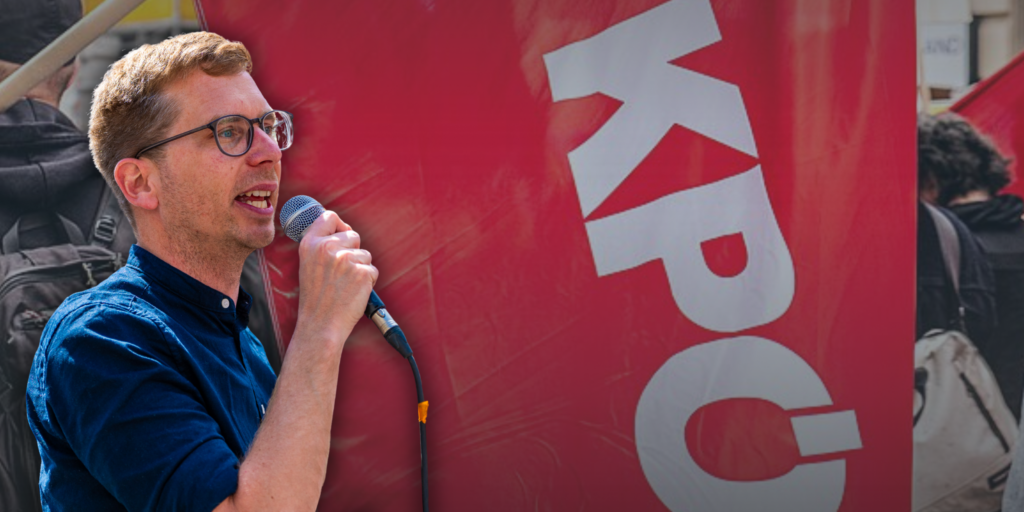
Below we publish the first part of the conversation with Robert Krotzer, who has been a city councilor for the KPÖ Graz since 2017 and is responsible for the areas of health, care, integration and employment.
Before joining the Graz city government, he taught as a teacher in a comprehensive school, was a local councilor of the KPÖ and federal chairman of the Communist Youth of Austria (KJÖ).
Interview Tim Krüger After the KPÖ unexpectedly emerged as the strongest force in the municipal council elections in Graz in 2021 and has since appointed Elke Kahr as the city's mayor, the party was able to win in the most recent election on March 28th.
June achieved an outstanding success with over 35% of the vote.
Did this victory surprise you or did you go into the election confident anyway?
Well, we live in times when it is more likely that communist parties can get 0.35 percent in elections rather than over 35 percent.
Therefore, it would of course have been presumptuous to go into the election contest with an exaggerated certainty of victory.
Our success in 2021 was already a sensation.
We were also a little speechless at first.
But fortunately this speechlessness didn't last long.
We said to ourselves: Why should bourgeois forces that govern a city in the interests of a few manage a city better than a communist party in the tradition and as part of the workers' movement?
We are trying to organize a city in the interests of the broad majority of the population and in this sense we have actually been able to implement a lot and achieve many social achievements in the last five years.
Of course, we have maintained a lot of contact with people, but you can still never be sure whether this work will actually be seen and whether you will receive the support of the broader population in the voting booth.
Therefore, the election evening with this enormous gain was of course a great success for us and we are pleased about the great support of so many people from Graz.
But even if we can look back on a period of government in which we achieved many things, we would not be the Communist Party if we were satisfied with everything we were able to achieve under these conditions.
At the same time, it must be said that this surprisingly strong popular vote was of course not achieved in a vacuum.
It wasn't as if Elke Kahr as mayor or the KPÖ had been courted in the media or as if there hadn't been massive political headwind.
The election victory was also the result of an election campaign that largely came from below and was supported by people who are convinced of our work and who sympathize with our ideas.
We also owe this electoral success to them.
You just mentioned it.
Of course, it is really a rarity that a party that has the ostracized attribute “communist” in its name can win over more than a third of the voters in the second largest city in a European country.
Mayor Elke Kahr had repeatedly said that it was “earned trust” that distinguished the KPÖ from the other parties.
But this had to be purchased first.
How did you manage that?
For us there are two central guidelines.
On the one hand, we assume that we have to earn the trust of the population and working people every day.
It's not like you have the support once and then you can just do whatever you want.
That means a lot of work, a lot of contact and also a lot of concrete support that we try to give people.
On the other hand, we have to take a brief historical turn to the beginning of the 1990s.
Based on the very deep and global crisis of the communist movement at that time, we as the KPÖ Graz and KPÖ in Styria developed the slogan that we want to be a 'useful party for everyday life and for the great goals of the workers' movement'.
We have thus begun to focus on the topic of housing and renting and, in particular, on municipal housing in Graz.
It was about being there specifically for the tenants, helping, finding solutions to problems together and asserting their interests.
This has since been incorporated into the way the KPÖ works in Graz and we are trying to expand this further and into other areas.
Elke Kahr expressed this in her declaration about the election as mayor.
She said we want to approach the tasks from below.
Because we are of course a party of working people and put their interests at the center of our politics.
That's why we have to maintain daily contact with the working population and with people who are in precarious life situations and have to struggle with many worries.
This is nothing strange to us, but something that we experience every day in our consultations and consultation hours.
We see our offices as open city council offices where everyone can come with their concerns and we take the time to address these issues and talk to people about their situation.
The concerns are of course very broad.
This starts with very classic issues such as rent arrears or high additional payments for operating costs and heating.
In the area in which I work, many questions revolve around health or care as well as working conditions.
We deal with people who suffer from addictions as well as people who are confronted with harassment at work and advise on employment law issues.
This is, so to speak, our daily bread in the work of the KPÖ and also shapes our view.
We are always a learning party in all of this.
Only through this work do we find out where people are really struggling and then try to translate that back into our politics.
The content of our newspapers, campaigns or social media posts is often based on people's concrete experiences and our exchanges with people.
We also have an upper salary limit.
This means that all of our officials only keep an average skilled worker income for themselves and pass on around two thirds of their income to people in need.
Of course, that also makes a difference when it comes to the question of trust, but also when you look at the traps that bourgeois parliamentarism lays out.
How many parties of the socialist and even communist left fell into this?
Suddenly they have high salaries, company cars and chauffeurs and are suddenly extremely far removed from the everyday lives of working people.
Our salary regulation naturally influences the public perception of the KPÖ, because in comparison people can see exactly how far removed all other political representatives of the established parties are from their everyday concerns and where the KPÖ stands.
And the salary cap ultimately ensures that no one joins the KPÖ for career reasons.
That means the salary restrictions or social advice were already part of your concept before 2021?
The consultation hours and direct contacts have been around for a long time.
Even when Ernest Kaltenegger was still a local councilor, he was out and about in the council apartments, spoke to the tenants and the party, which was still very small at the time, developed broad campaigns.
For example, to limit the rent in municipal housing to a third of the tenants' income.
When the KPÖ's application for this was rejected by all parties in the early 1990s, the party swarmed into the municipal apartments and then presented 20,000 signatures to the mayor at the time.
When the application was voted on again, there was suddenly a unanimous decision - and the additional rent payment that was fought for at the time still exists today!
The salary cap has also been in place for a very long time.
As the KPÖ, we have always spoken out against the high salaries of politicians and when Ernest Kaltenegger became a city councilor in 1998, he was suddenly in the situation of receiving a very high politician's income.
Remembering the tradition of the Paris Commune, it was clear that you only keep an average skilled worker's income and use the rest to specifically help people in need.
And how does the money get from you to the people?
For Elke Kahr or for me, for example, we discuss with people during our consultation hours where we can help.
For me it's about 4,500 euros a month that I can pass on.
Since 2017, that's over 560,000 euros with which I've been able to support people.
At first it seems like a lot of money, but of course there are also a lot of people who are dependent on support.
It is often a matter of organizing quick help if, for example, there is a rent arrears.
We will then transfer a partial amount to the rent account and contact the property management company.
We tell them: “Look, Ms. Müller is with us right now and a part of me is coming now and we will also go further,” for example with applications to the Volkshilfe or the city social welfare office.
In this way, we are sometimes able to prevent the involvement of a lawyer and the associated spiraling costs.
In other cases it involves medical aids, medication or additional payments for school trips.
Concrete help when needed is one thing, but ideally government responsibility can improve the general situation so that people no longer find themselves in this precarious situation.
What successes have you achieved in recent years and where have you encountered obstacles?
A very important point is the community housing.
The city of Graz has around 4,500 city-owned apartments.
In addition, there is a roughly equal proportion of transfer residential buildings from cooperatives, for which the city has the right to allocate.
The city has introduced a rent cap for city-owned municipal housing.
This means that rents have not increased by more than 4 percent in five years between 2021 and 2026.
For comparison: Rents on the private housing market have risen by over 4 percent twice a year.
At the same time, we were able to build 420 new community apartments during this period.
A total of almost 1,500 municipal apartments were built under the responsibility of the KPÖ.
When it comes to community housing, as an important form of public ownership, the municipality has important scope for design.
On the one hand, you can specifically provide people with affordable public housing and, on the other hand, you compete with the free housing market.
Ideally, you can ensure that people in precarious housing situations do not have to accept overpriced, poor-quality housing.
At the same time, we have set up the KPÖ tenant emergency hotline since the 1990s.
Of course, in the private housing market there are always disputes between people and their landlords or real estate companies and they usually have well-paid lawyers on their side.
We try to provide legal assistance, inform people and encourage them to enforce their rights.
I can say that about housing.
At the same time, we in Graz have the so-called social card, another achievement that was preceded by a long-term campaign by the KPÖ.
The social card is an offer for people with low incomes.
With it, for example, you are entitled to the social card mobility.
This is an annual public transport ticket for just 60 euros.
This is unprecedented in the whole of Austria.
There are also various other supports such as additional Christmas payments, heating cost support or, for example, a school start allowance for families.
During our first term in office, we were able to expand the circle of recipients to include people with low employment income.
Until then, working people were excluded and only people who had to live on low pensions or social support were entitled to the social card.
That was always a toxic line.
If people who work for low wages feel like they are being excluded from something while those who have even less feel entitled to it, then that can be hugely toxic to building class consciousness and class solidarity.
Now we were able to expand that.
From the very beginning, it was a strategic concern for us to transform the city so that it is a city that supports the population.
Of course, it is clear to us that we cannot build socialism at the local level, whether with 29 percent or 35 percent of the vote.
The great balance of power remains, but it still matters who is on whose side.
That's why we wanted to create facilities that people can turn to.
It doesn't matter whether it's the "health and care hubs" for care or health issues, the district work or the newly established initial consultation of the social welfare office, a housing advice center or a housing information center.
I think it is a very important building block of a city based on solidarity that, against the background of so many crises and their effects on life, people have places to go and are not alone with their problems.
If people can't find suitable medical care, if they have questions about care, if their spouse or parents are suffering from dementia, or if someone doesn't know what to do about housing, then these are very specific questions.
Of course, as a Marxist left, as a Communist Party, you can present explanations for many of the big questions of our time, explain the background and provide analyses.
This is of course also important.
But there are also real situations in which people say: I have this problem, I need help here.
It is very important that this help is effective and can be experienced in everyday life.
In these questions we are also fighting against neoliberal and right-wing thinking, against the loss of solidarity and against the feeling of powerlessness.
It is crucial that as far as possible no one has the feeling of being forgotten and left out in the cold.
As the Communist Party, this is a very important tool for us at the local level.
People's trust can be earned not only on an abstract level, but also through concrete help in everyday life.
One could now object that this is all just “career or caritas politics”.
But the question is whether people develop self-confidence from below and class consciousness.
So whether they can develop an understanding that a society can be different than the neoliberal and right-wing propaganda that hammers our heads every day.
Those in power say that in the end no one will help you anyway.
Through our work, many people were able to experience that we have built strong networks and a stable security system here.
Ultimately, this is always an ideological confrontation with the neoliberal and capitalist hegemony, which aims to destroy all social security systems and solidarity networks and hand them over to the free market.
The perception is created that public administration is inefficient, lazy and unfit.
If people then experience that public administration does not work well, then that is of course grist for the mill of these same forces.
Conversely, it is therefore a basic prerequisite for revolutionary realpolitik that you can offer solutions in people's everyday lives.
Only then can people's trust grow that things, both small and large, can be different and, above all, better.
That's why we say that one of our greatest political opponents is resignation and the perceived powerlessness.
In 2021 we accepted the great task of breaking through this and have now received this task again.
History will ultimately judge whether we succeeded or not.
You mentioned the private housing market.
When people fall into rent arrears, evictions quickly become the order of the day and are a major problem.
Others have their electricity or heating turned off if they can no longer pay.
Do you as a municipality have any opportunities to intervene?
Unfortunately, as a municipality we have no recourse against evictions in the private sector.
When faced with the threat of forced eviction, we naturally discuss with those affected whether such a situation can be averted, whether a new form of housing provision would be better and how this can be found.
We have also set up a new housing advisory service for the city's social welfare office.
This helps when looking for an apartment and at the same time is intended to prevent people from losing their apartment in the first place.
The municipal energy provider does not allow electricity or heating to be switched off in the winter months, because that is simply inhumane.
At the same time, we have support offers for electricity or heating costs.
We have a redistribution mechanism in which part of the municipal energy provider's revenue is used to help people in energy need.
Let's talk about the KPÖ's style of government.
How do you guarantee the highest possible level of transparency, proximity to citizens and participation of the population in city politics?
We have ensured that all political groups are represented in all committees appointed by the local council.
That wasn't always the case.
Until 2021, the KPÖ was excluded from all supervisory boards, despite the fact that we had long been the second strongest party.
They were obviously afraid of our control.
We have now changed this to allow for greater transparency and control because we have nothing to hide.
At the same time, we have also made the allocation of positions in the city of Graz objective and transparent.
Before, it was common practice to run party books and place one's own favorites in good positions.
We have abolished that and the population really appreciates it.
At the same time, as mayor or city council, we and our teams take care of answering all incoming emails.
When Graz residents write to us and raise concerns, questions or even criticism, they receive an answer.
Some people are very surprised when the mayor reports back at 11 p.m. on Sunday evening: “Thank you for your letter.”
Some people say they can't believe it.
But that also says more about the governing style of the bourgeois parties before.
We are also part of urban life ourselves.
You can speak to the mayor in person at street parties, on the bus or on the tram.
This also has the advantage for us that we notice more quickly what is on people's minds.
There are municipal formats for participation, such as the citizens' advisory board, but our experience is that you often only reach a small section through the municipal formats.
That's why what people tell us on the street or while shopping is so important.
In the Federal Republic of Germany, many municipalities are struggling with the fact that budgets are being continually squeezed while more and more burdens are being passed on to the municipalities.
What is it like in Austria?
It's similar in Austria.
The municipalities are always the last link in the chain, are given more and more tasks and are at the same time underfinanced.
On top of that, we have had to deal with two major burdens in the past period.
On the one hand, the tax reform of the black-green federal government, which was not counter-financed, and on the other hand, a care financing law at the Styrian level, both of which burden the Graz budget with many millions annually.
This has led to enormous challenges.
At the same time, Austria is continuing a neoliberal budget policy and even tightening it up.
Even an adjustment to the property tax, which would directly benefit the municipalities, is vehemently rejected and blocked by the ÖVP.
One has the feeling that the ÖVP would rather let its own mayors literally starve and close outdoor swimming pools, rather than allow a minimal reform of the property tax, which has remained unchanged since the 1970s.
This is class warfare from above that protects the wealthy and ensures empty public coffers.
Accordingly, we face major challenges.
We were able to invest a lot in the last period and had to do so because the need to catch up was huge.
This includes sewer renovations, the construction of a new sewage treatment plant and the purchase of new trams and buses.
In Graz, for example, there are still trams from the 1970s that have long since reached the end of their service life.
We have therefore spent a lot of money on expanding public transport, but also on greening streets and much more.
We are now in a phase of budgetary defense struggle.
Our main concern is securing the social infrastructure and public property of our city.
This was also a big question in the election debate.
Public property, especially municipal housing, is currently being sold in many Styrian cities.
We also see the strengthening of the KPÖ in the Graz elections as a clear mandate from the population that we do not discuss the privatization of municipal housing.
We made this clear in the election campaign and this was also where the greatest points of friction with the bourgeois and right-wing parties lay.
Overall, however, we know that we are now moving from an offensive course that we have been able to take in recent years to a different phase in which the main focus will be on securing the existing situation.
But we are not satisfied with that: as the Communist Party, we will continue to rely on extra-parliamentary protest and social movements, for example for a tax on the rich instead of burdensome packages or an end to the billion-dollar military build-up, which in Austria is also at the expense of affordable housing, health or education.
In the second part of the interview we talk to Robert Krotzer about the question of government participation, the realignment of socialist politics in the 21st century.
Century and cadre politics.
Photo: https://commons.wikimedia.org The article Building socialism at the local level? – In conversation with Robert Krotzer, KPÖ city councilor in Graz first appeared on Lower Class Magazine.
Read the full story at the source →
Source: Lower Class Magazine